
Inflationists Fail to Explain ‘How’

Yesterday’s challenge – explain how inflation will get off the launching pad in a deflating economy – went unanswered, although the topic itself provoked quite a response in the Rick’s Picks forum. The question was not rhetorical, since in order to produce inflation there has to be a mechanism for all of that printing press money inflationists keep blathering about to physically make its way into the consumer economy. Anyone who thinks massive fiscal spending alone can create inflation should read Hayek’s The Road to Serfdom, since the equally massive borrowing needed to finance a public works economy will place a severe drag on the productive, private half of the economy (and that’s assuming there will even be a private economy once President Obama completes his fascist project of merging The Government with America’s biggest corporations).
helicopter

One of the more interesting comments in the forum came from reader David White: “There will be no policy changes,” David writes, “only more of the same until the situation is so dire that handing out checks will be the only way to get money into consumer’s hands, thus depreciating the currency to save the economy. For a little while longer, at least. Rick obviously doesn’t believe that Bernanke won’t do what he said he would. But I assure you he will. For that matter, the government started handing checks out last you, setting the precedent for bigger and bigger checks.”

When Government Gives Up

 My response:   “Exactly:  “…until the situation is so dire that handing out checks will be the only way to get money into consumer’s hands.” This is what I meant when I wrote the following: ” Hyperinflation will arrive when The Government decides that fiscal stimulus alone cannot ever get us out of debt, given the vast sums of debt that need to be inflated away.

 But I am not talking about some piddling $1800 tax refund; rather, the checks that the government hands out will need to be as big as the “underwater” part of everyone’s mortgages – plus some substantial cushion of perhaps $50k to $100k- in order to “solve” debtors’ problems and keep consumption numbers up. The cushion would tide us over until good jobs return – hardly a given, since the U.S. without a banking industry has little left to sell the world.

 Bernanke Still Behind Curve

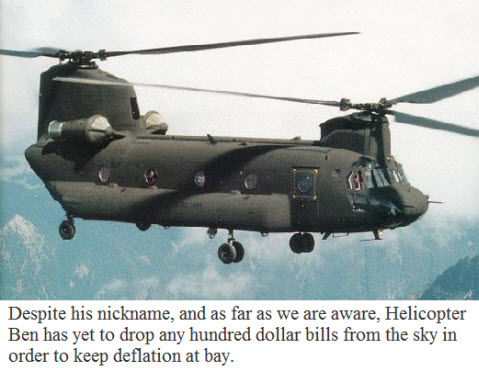
 Concerning Bernanke, a political stooge, he hasn’t come even remotely close to shoveling $100 bills out of helicopters. Whatever the guy said he would do, and regardless of what he allegedly learned studying the Great Depression, in practice he has been too chicken-hearted to do what it would take. That’s why the $11 trillion shot at the problem so far has done nothing to reverse the deflationary slide in real estate. Bernanke has been behind the curve since the beginning, and he still is – still hasn’t copped to the fact that the only solution to deflation, other than via deflationary liquidations, is to hyperinflate, literally distributing large bills to the populace.”

The comments, in the forum, of “Jack” also raise some provocative questions. He believes in deflation but cannot see why, if that’s what’s coming, an investor should stick with gold:

This is a great debate,” he writes, “and I appreciate everyone’s thoughtful opinions. Your opinion that deflation is a certainty and is underway is logical and I have no argument there. But you also say that inflation is not going to happen and that hyper inflation is only a possibility.

Sell Gold Now?

“Let’s assume that you are 100% correct and that deflation continues and that the possibility of hyperinflation does not occur. If that is true then wouldn’t I be better off to sell my gold and silver and stuff the cash back in my safe deposit box? With continuing deflation and no inflation then gold will soon be below $500 an ounce and my treasury bill hoard will double in value. Well, won’t it?

“The cash will buy twice as much gold and should also buy twice as much milk, eggs, gas…

“Or, am I missing something? If your deflation theory is dead on then how can U.S. treasury notes not be a better investment than gold or silver? I do believe you are right about the deflation but I just can’t force myself to make this trade.

Bogus Bills

“As an aside, did you know that the treasury says that 50% of all the U.S. paper money in circulation is outside of the United States? And they also admit that 50% of the money circulating outside of the U.S. is counterfeit. Not copy machine quality but bills printed on the same printing presses the Treasury uses and with equal quality printing plates, ink and paper. They are printed by sovereign governments and are pretty much indistinguishable from genuine currency.

“Just a thought. Rick, you may be right on but I’m going to hold back a little bit of that gold and silver.  Jack.”

The short answer, Jack, is that Gold is likely to do well regardless of whether we hyperinflate or deflate. If the latter, bullion will be one of the very few monetary assets on earth that is completely unencumbered by debt.

On these and other matters we welcome your further comments, dear readers, since we don’t claim to have all the answers.   Let the dialogue continue.

(If you’d like to have Rick’s Picks commentary delivered free each day to your e-mail box, click here.)  

  • Rob April 6, 2009, 11:25 pm

    Re-post:

    An earlier post (April2&3) that explains how money gets into the system.

    Rob writes:
    As far as this issue about money needing to be borrowed into existence in order to create inflation, that is largely an academic argument. Look at any of the inflationary scenarios of the past and you will see there is almost no “borrowing” going on, especially by “consumers”. Zimbabwe, Argentina, Russia, Weimar Germany, etc. In all cases the money was not ultimately borrowed, it was printed up to cover cash flow needs irrespective of debt. Once the money is created, by whatever means and paid out, it is forever in circulation, no matter what debts default. The total M3 (or equivalent) money supply amount only increases. So yes the current U.S. monetary policies will ultimately be inflationary, regardless of debt. All previous countries started their inflationary trends based on too much debt. Had the debt overwhelmed the inflation of the money supply, then you would have seen no price inflation and no problems. However this has never been the case. Ever. So this argument about deflation is totally wrong based on observable evidence and is little more than science fiction based on a “conceivable” idea of what could, maybe happen, yet never has. In all cases the debt went bad, yet the printed money, electronic or physical, was still floating around and ultimately caused price inflation. Just because a debt write off happens, that does not pull the credit out of circulation. Throw in FDIC insurance and such and it actually increases the inflation of the total money supply and the future associated price increases. So stop this stupid deflationary talk.

    Rick writes
    Stupid deflationary talk? That’s a pretty silly thing for you to say, Rob, considering that perhaps $100 trillion in asset values have already been deflated out of existence, and considering that the real burden of debt is close to crushing the last breath from the global economy. Anyway, you can join the crowd in having failed to explain how all that alleged money will get into the system. You stupidly mentioned the FDIC, but if the FDIC bailed out the entire system it wouldn’t add one dime to what depositors believe is in their accounts. Finally, in none of the countries you have mentioned did hyperinflation simply “happen.” Rather, in each instance, the government willfully and deliberately hyperinflated. So far, Obama and his brain trust have shown no desire whatsoever to go down that path. In the meantime, mere fiscal stimulus will achieve almost the opposite, since, no matter how much you pour down the toilet of public works projects, it will only consume capital and destroy the wage base. As Fekete has noted, debt service is now consuming productive capital so that more borrowing/stimulating in itself has become deflationary. RA

    Rob writes
    No, stupid deflationary talk is not a silly thing to say. I did explain exactly how the money gets into circulation: “In all cases the money was not ultimately borrowed, it was printed up to cover cash flow needs irrespective of debt.” It does not take borrowing by consumers. The Obama administration/government and Federal Reserve itself did go down the hyperinflationary path even more last week when they announced that it would monetize the treasury purchases and other asset purchases with money simply printed up. Inflation/deflation is defined as the relative expansion/contraction of the total money supply over GDP. So using your own logic, with 100T in asset values lost (translate shrinking GDP) and the monetization of the treasuries and such (i.e. printing up even more money into circulation), total money supply increased relative to GDP. Go look at the total M3 and it has never gone lower, it only moves higher. Even today it is expanding over 7% a year (Shadowstats.com). This is inflation defined and will result in general price rises sooner or later, especially in gold, oil and agricultural commodities. The money can get into the system merely by the government spending the money on public work, giving it away through welfare, bailouts, military spending, etc. That gets money that is simply printed up, into the system. It is that simple and exactly how all the inflationary scenarios of all the countries listed above happened. The U.S. treasury used to print the money up as dictated in the constitution, but now they pay the private banks (i.e. Federal Reserve) to print the money up using treasury bonds as the vehicle to achieve such. The FDIC bailing out everyone certainly would add money into depositors accounts as it would replace the money previously borrowed and spent that is still in the system and add an additional amount visa via the printing press, so total money in circulation goes even higher. Just because a bank goes broke because of falling asset values on their books, this does not mean the money is pulled out of the system. The money is on someone else’s books as a credit and is still in circulation. Hence, that is part of the reason for an ever expanding M3 and the accompanying general rise in prices.

  • David April 6, 2009, 5:08 am

    We have virtually no manufacturing capability left in this country for the everyday stuff found in Wal-Mart and other, similar, stores. Clothing, shoes, carpeting, steel, food, furniture, and most other industries have been closed down and shipped away, because the home-made goods were expensive and nobody wanted to pay the real prices, including the high wages and benefits of the local workers. Many of our web-based service jobs have also been shipped overseas, leaving us with a lot of people that shuffle paper, but who do not produce anything of real value. We import virtually everything we need to sustain our lifestyles, and we pay with depreciating paper. Unlike in the 1930’s, we have no mothballed industrial capability to speak of, and we have virtually no savings. There is no way to quickly get our industrial production up and running, as we did when World War 2 broke out. We are truly dependent upon the kindness of strangers.

    As long as the Chinese, Indians, and others continue to take our funny money for their very real goods and services, we will continue to have the deflation that we are experiencing now. The system goes on, as rickety as it is, but nothing seems wrong.

    The hyper-inflationary spark will come on the day that the rest of the world decides, covertly or overtly, that they no longer trust the “value” of the US dollar, and demand to be paid either in gold or in some IMF SDR currency. When that happens, we will need to pony up more and more paper dollars to pay for the same amount of goods, to reflect the distrust that is building. As that game continues, more and more dollars will have to be thrown at China/India/whereever to convince them to continue to ship their goods our way. The costs of the imported goods, oil, vegetables, plastic doo-dads, and other things will quickly ratchet up and, yes, the prices can get jacked up to the sky, at least for a while, because there are enough “haves” with stacks of dollar bills who will be able to afford those things. The rest of us will end up out in the cold with our noses pressed up against the windows, watching the swells sit in their warm dining rooms wolfing down their overpriced dinners. Once the elite draw down enough of their hoards, the prices will finally collapse; with no money chasing fewer and fewer goods. That’s when we get a final crushing depression like nobody has even dreamt about.

    In my opinion, gold and silver will be the currency of the black markets that will crop up everywhere, and will thrive in the hyperinflation and deflation periods alike. If you think of gold in terms of dollars, you are through. Gold has to be valued in terms of what it can be traded for. Can you buy a loaf of bread for a quarter-ounce of silver? Great. Who cares what the equivalent number of dollars will be at that point? Can you buy a used car for ten ounces of gold? Great. I don’t care what the dollar amounts will be.

    If the economy goes through the scenario that I have outlined, the dollar will be essentially worthless, first through hyperinflation, and then through absolute distrust, leaving it among the 2000 or so other paper currencies that were issued with the best of intentions throughout history. During that final depression, an ounce of gold may go for less dollars than you paid for it, but what would you want to offer if the only source of food was a black market: a handful of pretty paper, or a 10-gram gold bar in an assay card? What do you think will be a better store of value, when the dollar goes through that final valuation roller-coaster?

  • Rick Ackerman April 5, 2009, 3:04 am

    Posted by RA for David Perry:

    I think one of the things that makes this debate so ornery is that we are in uncharted territory in some ways. I think it possible that we could see a divergence with prices of different things going in opposite directions. The prices of things people most need, like food, may follow the base money supply, while non-essential manufactured goods and services my continue to collapse. Another example of divergence would be the dramatic supply destruction in silver at exactly the time we have increasing investor interest. About 60% of silver production has been by-product from base metal mining. Credit Suisse and others are publishing impressive numbers for base metal mine closures since December. Which also begs the question: where will demand destruction start to bump up against supply destruction, which commodities will hit the wall in what order, and how will this play out?

    Then there is this other question about the extent to which gold and silver will increasingly behave as money. Will gold respond more to massive monetary inflation or to massive asset (price) deflation? And, of course, how will perceptions influence the outcome?

    Interesting times.

  • Economic Philosopher April 3, 2009, 8:51 pm

    Apparently you don’t understand economics. The banks don’t need to lend you or any other consumer money for the money to get into the economy. All the banks need to do is buy government securities and then the government spends the money. And then it is in your pocket.

    ******

    The government can’t spend enough to make a meaningful difference, especially since the borrowing costs are already causing each additional dollar of “stimulus” to produce negative economic growth. Fekete has explained why, but the trend (marginal productivity of debt) has been headed in this direction since around 1946. Anyway, I know we don’t disagree about whether this stimulus will grow the economy out of its problems. Do you think it will grow underwater home “owners” out of theirs? RA

  • John April 3, 2009, 5:10 pm

    Great discussion.
    Here’s perhaps some economic heresy from an engineer (what do I know?)
    My take is that we are mostly looking at this the wrong way. I would even suggest that your question of how the money is going to get into my pocket, Rick, although a good one, is not something that is necessary to happen for price inflation to occur.

    OK, here’s my different spin: Most all of the arguments above seem to have assumptions based on the theories of quantity and velocity of ‘money’ ($US) causing deflation, inflation, or hyper inflation. What if the root issue is not quantity or velocity of $US, but CONFIDENCE in $US. The US federal reserve note, after all, is only an intangible, that has value only due to confidence, a very fleeting quality. Other real goods we trade and use (food, clothing, shelter, transportation, metals, etc.), have intrinsic value, but the US federal reserve note has none.
    In a well connected world economy, therefore, if CONFIDENCE in the $US wanes, prices for goods and services (in $US) can go up, regardless of the quantity of $US, or whether, Rick, you or any of us has any in our pockets. If confidence continues to wane, the $US rate of price inflation may be more directly related to rate of loss of confidence. Thus the question of inflation vs hyper inflation may be tied to the rate of loss of confidence, more than the quantity and velocity of money.
    How’s that for economic heresy from an engineer?
    BTW, the forces out there trying to create an Asian reserve currency (presumably for trading of Asian manufactured goods), a Persian Gulf regional reserve currency (presumably for purchase of oil), seem to heading the way of decreasing the US dollar’s purchasing power, due to this loss of confidence, and can you blame them? Thus even in a world of massive $US deflation (lower quantity and velocity of $US money), I can easily see the price of goods and services rising (in $US). We in the US are very myopic in thinking that the $US is ‘real money’ and the only significant medium of exchange out there, but that is a fleeting snapshot of history that appears to be fading rapidly.

  • Rick Ackerman April 3, 2009, 4:03 pm

    Posted by Rick in behalf of Rishab Singh Solanki:

    Hello Rick, I have been reading your free newsletters on goldseek.com for quite some time and have been very keenly observing your and others views regarding the inflation (hyper) and deflation scenario.

    I am from India and a commodities trader and also into stocks and real estate and felt that I should also put my views to the current discussion. I am not here to change the opinion of inflationists or deflationists, as I think it should be left to the market to prove whether a particular theory holds true or not. And believe me it never takes much time.

    1. First, I would like to quote the Indian Stock market. One of the foremost emerging markets and perhaps 2nd in EM scenario after China. When the Sensex (benchmark Indian index) was making new highs, while Dow was making new lows a Decoupling Theory was very much in news. Dow breaks below 12000 and Sensex toppled 18000. A perfect decoupling scenario. But, I was always skeptical, either the Dow was not acting right or Sensex was not acting right. The reason being, most or almost all the top buying was being done by Foreign Institutional Investors (FIIs), mostly from US and Europe, the developed world. So these people were betting for EM, while their own backyards were burning and I never believed that decoupling theory. Ultimately, Sensex came crashing down from 21k to 8k in a span of few months. All the FIIs were no longer buying but selling to cover for margins on losses made in US markets. If this decoupling theorists, had got their facts right, Chinese markets had started correcting much earlier.

    It shows that people in their greed or exuberance, forget the basic principles of economics and always come up with irrational or illogical terms to support their argument. And have to learn the hard way. The same is with Gold now. Either the whole global recession scenario is wrong or the price of Gold is not what it should be.

    2. Now, coming to Gold price and some basic fundamentals. Why Gold, as a commodity should move forward?

    The first driver is demand and supply, which would hold true for any commodity. Now, India is the biggest consumer of Gold and believe me we Indians, especially women here are crazy about Gold. India is not a big producer of Gold and mainly relies on imports for its gold needs. In a recent report by Bombay Bullion Association (It is not a cartel of any sorts, a consortium of traders of physical bullion); the overall import of Gold was reduced by 45% in 2008 due to high prices, volatility and recessionary fears. So we Indians are buying less physical Gold. The biggest market of Gold is not that having that much demand and Gold price is still trying to skyrocket?

    Second, Gold is priced in US dollars and is having an inverse relationship to it. US Fed has cut interest rates to almost Zero and the other countries are also following suit. If we see the current movement of Dollar Index (at present around 86, on 21st Jan 2009), still price of Gold is above 850$ per ounce. Again, either the US Dollar or Gold, one is going to change course.

    My personal view on US Dollar (even many guys may laugh at it) is that the bottom is in, at least for the time being, and that time could be even 4-5 yrs to a decade. Yeah, at zero interest rate, I am hoping for a currency to go forward, that’s a real crazy thinking. With Dollar, having that tag of world’s reserve currency and other central bankers following US Fed in rate cuts for easing lending (or supporting US Dollar) all other major currencies are also getting devalued along with USD. Well, call it Dollar manipulation or central bank manipulation, but it is a fact and markets (in fact real life too) have to factor in all the manipulations and move accordingly. It is just a part and parcel of the whole game.

    All the money US Fed has put into the market, well the money is used by Banks to correct their balance sheets, to fill their reserves. The money is still not in the markets. Lending has not picked up and perhaps would never pick up like before, at least not till the recent memory of this crisis is fresh in the minds of everyone involved.

    Now, if we see the price of Copper and Crude (commodities which points to Industrial activity) have crashed. Manufacturing is at an all time low, banks are not lending, many hedge funds have also winded up, leveraged money is not easy to get. I don’t understand how the price of Gold will move forward, in such a scenario, when institutions, individuals are not getting money as easily as they were earlier. Some funds are still rosy about Gold (like they were on Indian stock markets) and trying to hold up its price in exchanges. So it is paper gold which is being bought to support the prices, not physical gold. Any commodity trader, with some experience would agree to the basic premise, that in absence of physical demand, prices are not sustained for long.

    And where is the inflation or hyperinflation in this entire scenario. It is just like crude oil, it was moving on supply concerns, mind you supply concerns, not actual supply shortage. So it is also fear of inflation, which is being raked up to justify the upward trend in Gold prices.

    US Fed started reducing rates in Aug-Sep 2007 and Gold started it move upwards and break out its trading range of 540 to 680$. Now with rates near zero, there don’t seem to be any further scope for cuts. Fed will hold rates to low level till market conditions improve and will raise rates to a stable level, so where is Gold supposed to head. I don’t buy the argument that whole world will dump US dollars and it will crash creating hyperinflation. Who is the biggest consumer of Chinese goods? Well certainly not Chinese, but people in developed world. Either we have an alternative currency as Worlds reserve currency or stop making dollar doomsday theories. And as for Gold becoming the reserve currency, read the next para. People in EM have seen how this decoupling theory is very wrong and wiped out money from stock markets like it never existed.

    And for hyperinflation to really exist, would mean end to paper currency all over the globe. It would be like a science fiction movie, where a state of lawlessness exists everywhere and it’s like a jungle law, where might is right. So, in that scenario, it won’t be people having Gold, but I suppose people with fire power, muscle power would benefit. They can always rob you of all your gold, so with that argument, it would perhaps be better to buy some firearms, rather than gold.

  • Economics Philosopher April 3, 2009, 3:49 pm

    The banks don’t need to lend the money to consumers for the money to enter the economy. The banks could buy government securities and monetize the debt which would effectively put the money into the consumer economy and ultimately raise prices.

    ****

    Congratulations! You are the 1000th person to completely ignore my question; like all the others, you have failed to explain how this money will get into my pocket. FYI, I am not going to borrow money, no matter how aggressively the banks try to shovel it at me; I am not planning on buying any big-ticket items, even at 0% interest; nor are my wages likely to rise. RA

  • taras tsibulya April 3, 2009, 8:09 am

    ok i see that no one is really answering your question (funny how that happens), ie just how do you get all those dollars into pockets that dont want to borrow any more suicide money. this had me going for a couple of days, but the answer is simplicity itself. short of writing very large checks directly, which sounds completely goofy, the government becomes the largest ‘business’ in the country. undoubtedly a large unemployed mass of people bodes no good for things as they are. so the government becomes the employer of last resort, just as it becomes the lender of last resort. the country becomes a last resort for a last vacation.
    now for some numbers. at a population of 320 million with roughly 1 in 2 working, and the government employing 2 out of 3 people we get approx 100 million on the payroll at 25k/yr or 2.5 trillion per year pumped into the economy with very marginal utility (you can adjust these numbers as desired without harpooning the argument). not a bad start for check writing?! and at a new improved tax rate of 50% the government gets back half of that so the actual cost is a mere 1.25 trillion. and with the majority on the payroll any and all laws can be shoehorned in without much trouble, and you can kiss goodbye any reelection worries if you happen to be a public servant. if you say they’ve already shoved 7 trillion into a black hole another 2.5(1.25) doesn’t seem like much at all to keep the party going a little longer.
    i admit some details may have to be worked out such as writing a lot of job descriptions. heck we could put at least 10000 to work right there. as they say, government work is not rocket science … yes i know every great theory has a flaw somewhere, that is why i am still a grasshopper

  • tony bonn April 3, 2009, 7:49 am

    “But what about the 800-pound gorilla in this inflation/deflation tussle that you say we shouldn’t be having: Will homeowners be bailed out by hyperinflation? A deflationist would predict not — that lenders will prevail, converting mortgages into lease agreements. RA”

    i don’t claim to have an air tight answer – just a few more speculations 😀

    i don’t see banks getting into leasing because that is a totally different business than what they know – not that they know banking….maybe they will contract that solution to someone else and become a stock holder but it represents capital losses for them plus potential long term expense lossses….if they were smart they would avoid that solution altogether….but it is nonetheless interesting….however banks are going to be busy with the coming commercial real estate meltdown playing at a bankruptcy court near you starting this month….the banks don’t have the capital to support any creative solutions….the commercial market is just as bad as the personal but we haven’t heard a lot from it….yet.

    homeowners who are employed and work in jobs with sufficient pricing power will definitely be bailed out by monetary inflation….but they are precisely the ones who probably do not need it…..some homeowners in the middle zone will benefit but the problem is that there is a huge glut of housing and a shrinking supply of people who can buy which means many will simply be buried by hyperinflation…..and forget the folks being able to convert to leases – they can’t afford it in a price-hyperinflationary environment because wages will be needed to buy food, gas, etc – they will use traditional rentals or tents…

    price hyperinflation will exacerbate economic contraction because price signals will become increasingly difficult to respond and plan to. they have been corrupted for decades through federal reserve interventions in the bond and capital markets. but price hyperinflation will be lethal.

    the problem with our economic situation is that capital destruction necessarily means falling real wages…..combined with the deleterious effects of hyper price inflation wage destruction is compounded – another reason for being doubtful about lease conversions. income earners without pricing power will be pummeled.

    my argument is that there are no universals in this dire economic situation….assets and money flows will have their own dynamics based upon the characteristics of the class. the bottom line is that the bubble cannot be put back into the bubble any more than tooth paste back into the tube. (well technically you can do it but let’s not go there 🙂 )….

    one last thing i forgot to mention previously is that the debt monetization under way will be enormous – it will be a gale force wind – once it enters the economy – if the fractional reserve effect can be produced…..but, as noted, a contracting economy makes that problematic which is what some folks are probably alluding to when speaking of deflation – they really mean a contracting economy. regardless of where else the monetized debt goes it will go into gold….that asset will not suffer price loss although the treasury will try hard.

    i hope i am wrong about the doom and gloom…..but until the economy liquidates bad investment this sorry mess will drag on….i am completely unimpressed with the recent equities rally as a durable phenomenon….on p/e basis it has just made stocks ludicrously expensive….all of this liquidity is pushing on a string….

  • Gerald Clifton April 3, 2009, 5:02 am

    Actually, Rick, Blake (similarly to Yeats, a century or so later, who wrote a pioneering essay on Blake’s “The Mental Traveler”), was referring to the cycle of rebellion and suppression, politically and metaphysically. Money is simply the grease that speeds up the rounds. Yeats transferred the drama to “subjective” and “objective” epistemologies. Grounded, of course (as is the way of poets) in the concrete — after all, Yeats wrote of his supernatural “instructors,” “…they did not come to me to bring me the truth, but images for poetry.”

    This is an important point, it seems to me, and quite relevant to market behaviors. Just as the “ultimate” appears to be upon us, counter forces bring us back into the “same old dull round.” Of course, these counter forces become identifiable only in hindsight.

    There will be no hyperinflation. There will be no deflation. There will merely be more cycles, more of the “same dull round.” Many trading opportunities, though, for contrarians who are content to take the big middle out of each cycle, large or small.

    All the best to you and your subscribers.

  • tony bonn April 3, 2009, 5:01 am

    regarding the initial question of, where’s the inflation? and the follow on of how is money created i have a couple of modest answers. to the last question please see G. Edward Griffin. he even has several videos on youtube which explain in detail how money is created through the federal reserve. it is very straightforward. the federal reserve creates deposits in financial institutions which then lend them to customers. because of the fractional reserve system the initial deposit can be multiplied anywhere from 10-33 times. but in order for that to happen the money has to unfold to its maximum expansion. in today’s economy that is not happening because economic uncertainties and barriers prevent the multiplier effect from occurring…..before explaining that further a couple of definitions are in order.

    inflation is not a rise in prices – that is merely a possible effect. or to be more accurate inflation is a polymorphic term which needs a modifier to explain the kind we are talking about.

    monetary inflation is the creation of money. stop. say no more. that is the definition. discussions become so convoluted and confused when folks conflate the cause with the effect. don’t even say but….deflation is the destruction or removal of money from the economy….stop…. confusion arises when people confuse monetary deflation with economic contraction…..inflation and deflation are monetary phenomenon – no more and no less – which may or may not have an effect on the price level. and you can throw out that crap about velocity of money and all of the other claptrap from keynes\friedman….they were quacks and snake oil salesmen….

    when discussing inflation it is always helpful to say price inflation or monetary inflation. The debate over whether we have inflation or deflation is absurd.

    to talk about economic activity we use the terms expansion and contraction. thus we can talk about gdp growing or shrinking. but keep in mind that gdp is an economic construct – it is not directly measurable – it is merely an attempt to model the idea of an economy growing or shrinking. it is composed of a plethora of assumptions and proxies which may or may not be material to the real world. for a further explanation of this see government shadow statistics – one of the finest sites on the web.

    so how do you correlate money supply with economic activity and asset prices? before we can get to that we have to recognize the special place of the usd. it is the world’s reserve currency accounting for about 67% of all currency reserves held by central banks and governments. as such it does not always play by the rules or the rules play out somewhat differently than we would expect.

    the observation was made that 50% of all us money was held outside the usa. it will also be observed that we have a trade deficit anywhere from 700-900 billion usd annually. these factors tend to mitigate against price inflation even though monetary inflation may be zooming as it currently is.

    also keep in mind that studies show that 12-18 months transpire between fed actions and fed results. thus the massive inflation we have seen illustrated on the hockey stick graphs has yet to be played out in price inflation.

    before moving to conclusions, let’s understand that fed actions may be global but they act locally per time unit. also remember that there are different sectors in the economy which react differently to money. there are equities, liabilities, commodities, real estate, and the commercial assets (transactions of goods and services) which compose the economy but whose contours on the terrain differ. think of the economy as an atmospheric system wherein different pressure cells and sun and temperature cause wind. we know not wither the wind listeth…..so it is with these asset classes i mentioned. in the long run they will respond to global fed monetary inflation but in the short term the results are indeterminate.

    now getting back to the hockey stick. yes the fed has pursued massive monetary inflation but the money is going no where. banks are afraid to lend. they are insolvent and can’t lend even if they wanted to and even if they could lend no one could borrow because they up to their ears in debt – consumers and businesses….this is bernanke’s plan to recapitalize the banks…..the money goes from the fed to the banks who in turn deposit it back in the fed banks to earn a very small amount of interest….this will slowly pay money to help repair balance sheets while the fed figures out how to remove the bad assets….unfortunately bernanke is a quack and can in no way solve this problem with the bad asset bank which geithner and company are concocting….it is simply another con game to stick tax payers with bad assets while the banksters profit from the play…..

    the fed’s theory is that they will buy back all of the hockey stick money before it is loaned out to cause hyper (price) inflation….they will fail….once the stimulus spending goes into effect that money will come falling out of the closet in an avalanche and ruin the dollar…..but this takes time….

    going back to the economic contours – the massive increase in spending – and the deficit is meaningless in this analysis because it is ***ONLY*** a stupid number – will starve the productive sector of capital…..the federal reserve must perforce of its existence re-allocate money from equities into bonds – tbonds….this forces interest rates lower which in turn induces economic contraction by destroying capital….capital destruction eventually leads to price declines among certain asset classes….

    one final point about the fed and treasury….they have in the past admitted to manipulating asset markets – they are doing so now at a furious pace….its interventions into the gold markets is breathtaking as it is in the equities….this is why gold fails to respond the way everyone thinks it should….the fundamentals say up but the technicals say down…..thank the treasury….the reason why the treasury manipulates gold down is so that this alternative money does not siphon “investment” i.e. speculation in bonds which is necessary to maintain perpetually low interest rates to finance trillion dollar deficits as far as the eye can see……if gold were to operate freely interest rates would rise and make the deficit programs absolutely impossible….and remember that with the fed open market operations there is absolutely no reason to increase taxes….the congress taxes through fed ops…..

    there are innumerable currents in our economy now which seem contradictory and are difficult to predict where we are going in terms of asset prices all of which, like a mirv, may be independently targeted….we can make a few certain statements
    1. the fed has massively inflated (see definition above) but the effects are still sterile because the money has not been released into the economy
    2. the currency will be debased
    3. economic activity will continue to contract as capital destruction continues at a torrid pace
    4. we will eventually see massive price inflation but that is still 6-12 months away….keep an eye on gold and oil…..
    5. the federal reserve and banks are insolvent….the treasury and fed are frantically trying to reverese that…..
    6. the american economy is bloated with debt – creating more debt will not solve the debt problem…..
    7. the effect on asset prices will unfold according to when the fiat dollars hit the general economy….with massive gdp contraction since 2000 and tax payer dollars going to banksters it is hard to know how this works…..also the dollars going overseas will mitigate price pressures until the dollars are recycled back into treasuries…..those dollars have no place to go…..however they do not get reinvested in the productive sector further contributing to capital destruction….
    there is much more to be said but this is a start.

    &&&&&&&

    Great stuff, Tony, and thanks. But what about the 800-pound gorilla in this inflation/deflation tussle that you say we shouldn’t be having: Will homeowners be bailed out by hyperinflation? A deflationist would predict not — that lenders will prevail, converting mortgages into lease agreements. RA

  • Jim Quam April 3, 2009, 12:38 am

    Rick I agree the prospects for inflation are dismal right now. However there is one other Fed option-Devalue the dollar. It’s is quick (no need to print) and the pain is over unlike the Japanese who have tried since the 90’s.
    Of course like FDRs cabinet , Obama insiders could transfer their funds overseas right before it happens.
    This would be monetary shock and awe, like a whack from a defib machine to the chest of the American econ.

  • peaknik April 2, 2009, 11:32 pm

    In a fiat world inflation is a matter of choice.
    You therefore need to differentiation what you think is an outcome from what is possible outcome.
    If TPTB are keen enough they can easily get the money into the real economy by buying more goverment bonds. This money can then go into all sorts of crazy projects that benefit suppliers and wage earners.
    The fed can create $300B through quatitive easiing but with one extra key stroke that could be $300T.
    It all comes down to how keen they are.

    The alternative is this.
    Treasury sells unlimited amounts of bonds and prices don’t react and USD doesn’t drop. As a result US treasury can purchase everything in the world that is for sale.

  • Gerald Clifton April 2, 2009, 9:09 pm

    Rick, don’t see ON BALANCE inflation or deflation. In other words, the prices of some foods will rise with the cost of raw materials, while other desired (but not necessary for living) items that are technology-driven will fall in price (television sets, cheap music playback equipment, computers, and the like). I cook for myself, buying the best grocery items available (still cheaper than eating out), and these prices are still steadily on the rise. Residential rents will probably continue to rise, even if overall real estate prices remain weak. I think that we will live in the sloppy middle for decades to come. Unreal extremes like “hyperinflation” and “deflation” will, in reality, measure as “disinflation.”

    Gold tracks debt as well as the amount of cash in the world financial system(s), and will remain strong as long as we keep borrowing into the future. As long as monetary and political authorities try to encourage a consume-not-produce society, and as long as they remain deluded about U.S. world dominance as some kind of eternal norm, they will have to artificially prop things up. Currency debasement will continue world-wide, as different G-7 countries keep sponsoring inverted beauty contests (that is, the ugliest pig wins) with all the major currency crosses — or until one national currency emerges as the most desirable store of value.

    As the great mad poet, William Blake, said, it will all be “… the same dull round.”

    &&&&&&

    Blake was referring to the ideological character of his era, the time of Napoleon, but in most other ways those times were surely not dull. Your “disinflationary” future is about the most wildly optimistic scenario I could hope for as my children enter adulthood. RA

  • Citizen AllenM April 2, 2009, 7:46 pm

    Rick,
    Pay no mind to the man behind the curtain.
    Inflation is coming, without a doubt, driven by the *basket* of international goods that a dollar will buy.

    When that total drops, you have inflation that hits everyman in the pocket directly.

    Right now you have money being pumped into the banks- which everyone is screaming about without fail.

    What most fail to mention is that money is now being pumped from Washington straight into local and state governments to keep them afloat too- money that is essentially being printed, as taxes are no longer covering most of the federal expenditures. Money that will also be printed to support some failing businesses (right now banks and autos) that is direct injection into the economy.

    That direct stimulus from unsupported fiscal spending is *directly* inflationary. No doubt, without question, inflationary. Counteracting that you have the consumer (finally) beginning the arduous process of delevering in the face of declining income (unless they are broke in which case it is instant;-).

    The current question is quite simple, and drives everyone nuts because there is no simple answer- is the stimulus enough to keep the economy in motion?
    If so, then worry about inflation later. Call this State 1.

    Is it not enough? Then the folks in Washington will *provide* even more to keep the system from locking up- not gonna bail everyone out, just enough to keep the *system* intact until it can adjust to the new realities. Call this State 2.

    Is it too much? No way- in spite of the Chinese worries about the value of their precious bonds- at this point the stimulus appears to be insufficient to spark *much* inflation. If it was too much, the value of the dollar would be dropping and folks would be in a bit of a panic to find gold and silver, gasoline, food, etc.- Call this State 3.

    The caveat is to watch the other players in the system- as long as they continue to take dollars and park them in Tbonds- we will be wavering between State 1 and State 2.

    Now, should China, Russia, and the rest of the second and third world resource produces decide to tie to a basket of commodities through a transparent exchange method, well, welcome very quickly to State 3.

    That, in a nutshell, is where we stand. To pick one state and put all your marbles into it is a quite reckless action. ALL three are possible, and combinations are too.

    How’s that for a bit of analysis!

    Someday this war’s gonna end…

  • Rick Ackerman April 2, 2009, 6:15 pm

    Posted by Rick for Jose Podero:

    Rick,

    I am an ardent reader of your commentaries and it looks like we hold a common view.

    This note is in response to your most recent commentary on the G20 bullshit meeting where you ponder Where do we go from here?…

    That is a mighty important question, and one that seems never to have been addressed, or at least the repeat of political miseries seems to suggest that even great thinkers and the colonial planners of our once promising country failed to give adequate thought.

    I offer to you that moral philosophy is the foundation of any nation, or call it country if you will. Even now that implicit philosophy is centered on some brand of mysticism. It is time to throw all that ridiculous crap out the window. It is time to be completely objective.

    I owe an immense debt to Ayn Rand who shed light on the road to objectivity for me. I read her philosophical works enthusiastically.
    Indeed, I was a vanguard member of the effort in 1968-1969 to set up a colony by her principles in the Turks and Caicos Islands.

    Along the way I discovered that she made a grave error in suggesting that e could right all political wrongs by embracing some curious form which she called “limited government.” That’s like wanting to be just a little bit pregnant to see what that’s like.

    In the course of time I discovered other authors and thinkers who had pondered the question of “government” and tossed that also out the window. Principal among them were Albert J. Nock with “Our Enemy, The State” and “The Market for Liberty” by Morris and Linda Tannehill.

    Here’s the bottom line: We absolutely need to jettison this evil critter called “The State.” They’re a bunch of gangsters that turn the power given them to their own benefit and screw the rest of us.
    Any supposed “service” the State was supposedly providing can just as well –and let me say BETTER– can be purchased from a free-market company. No more Supreme State to lead us into wars around the globe.

    The attached articles and the books mentioned above light the path we would wisely follow, else we repeat the damned fool errors of the past.

    Sincerely yours,

    Jose L. Podero
    Panama City, Panama

  • Alex April 2, 2009, 6:00 pm

    People don’t need the luxury items like swiss watches, european cars and boats, but they will still need to eat and if they are lucky to have a job more than likely drive to work. Eventually when the decreasing demand for oil and other commodities finds a bottom, as it surely must, the owners of these commodities will simply raise the prices to meet the loss of purchasing power of the inflated currencies. People will not stop driving or eating because the price has risen just as they didn’t when oil hit $145 + a barrel. Some very good posts. I think
    Brian Ciarallo and Clark summed it up best! The Banksters are in control and robbing the taxpayers (debt slaves blind) and this time will not be different no matter what these crooks’ puppets sing about on TV. History repeats because people do not learn from the past.

    Alex

  • GlennK April 2, 2009, 5:50 pm

    Hey, Rick I have my wheel barrow all oiled up and ready for the hyper-inflation. If the super Deflation happens instead , I’ll just use it to haul around what’s left of my belongings.

  • Chris April 2, 2009, 5:40 pm

    Good take Clark,
    I couldn’t agree more. I might add that the most profitable way to get from this currency to the next is indirect. Via gold and silver. The Gov’t sets the terms in a currency to currency exchange ( ask any European how they liked it) The provate market sets the terms in PMs to currency.
    To prevent structuring, there is usually a time limit placed on exchanging old currency.
    Also I imagine the IRS might be interested in who is exchanging how much currency.

  • DOM April 2, 2009, 4:45 pm

    I have been debating inflation/deflation in my head for a while here. I agree with the point that until banks lend and consumers and businesses borrow or are even able to borrow, the great inflation in the monetary base will just “sit there”, harmless.

    The part that worries me is the huge deficit this year and into the future. If this continues and of course it will, we will get to the point that the treasury auctions will begin to fail and the confidence will be lost in the dollar. When this happens, inflation could be triggered due to the rapid devaluation of the dollar. So for example, if oil is currently at $50/barrel and the dollar devalues by 50%, would oil not rise in terms of the dollar? Wouldn’t all imported products rise in terms of the dollar? I guess it depends on what happens to other currencies as well, but my guess is the dollar will devalue soon and when that happens, that will trigger price increase for imported items which will filter into the general economy.

    Also, it is possible for the above situation to play out while many asset prices fall. This will not leave us in a good position.

    Until the politicians and bankers are able to fix the money system, the politicians will continue to buy votes with printed money.

    DOM

  • C.C. April 2, 2009, 3:57 pm

    Greetings gentlemen –

    I shop at Trader Joe’s. I purchase in or about the same items every week. Within the past 12 months, I have observed roughly a 5 – 7% rise in those exact same items I purchase – i.e., eggs, dairy, frozen foods, non-perishables, fresh food – all the usual stuff. Have you seen any price Declines for the items you _need_ at your local market? How can this be? Aren’t we in deflation?

    How about apparel (aside from liquidation/GOB sales?)

    There are things I (we) need. Namely, commodities that go in the north end to sustain life, commodities that maintain life (toothpaste, aspirin) and commodities that help to keep life clean and sanitary at the south end.
    Have you seen prices for any of the aforementioned commodities trend down during the past year?

    Why are corn farmers cutting back acreage this year? Costs. How can this be? Aren’t we in deflation? Isn’t everything getting ‘cheaper’?

    Do I _need_ the ‘asset’ with a tile roof on it that is currently ‘deflating’ in value to sustain my existence?

    Do I _need_ the ‘asset’ with a zinc-primered roof and 4 rubber tires to sustain my existence?

    We can absolutely have serious inflation in the products we need to sustain, while at the same time, have big-ticket asset deflation in the non-necessary items we don’t – like, 2500 sq.ft. houses and $30k cars.

    In the end, it matters little to the average man, the phony wealth evaporating from his dwelling and the car lots, into the ether. What matters are the prices for real goods & services he needs to sustain life for himself and his family.

    Concern arises from the standpoint of whether or not I will be able to afford items to sustain life, while my country’s currency value evaporates into the ether, much the same way as the phony $Trillions evaporated from overpriced housing.

    -C.C.

    &&&&&

    Sorry, C.C., but like every other post so far, this one fails to address the nettlesome problem of collapsing purchasing power. Even your rubber tires and zinc roofing material cannot get marked up to-the-sky if consumers are flat-on-their-ass broke –which they will be without recourse to the credit money that formerly bridged the gap between household incomes and expenditures. RA

  • Brian Ciarallo April 2, 2009, 1:51 pm

    As of yesterday the amount the Government has printed and pumped into the “BANKSTERS” coffers is 12,800 Billion or 12.8 Trillion. All these Trillions, and yes this is not over yet, to save these insolvent banks, which will not lend and have no intentions to lend.

    Once they “the globalists, elitists or precisely known as the ILLUMINATI” continue with their plan and agenda to steal everyone’s 401k’s, pension funds, and stocks, once they succeed in completely collapsing the system…well they will come in and buy all the desirable assets for pennies on the dollar.

    These BANKSTERS are criminals pure and simple and have no desire to fix any of the problems facing the country. Their concern is of the nature of more power and more control.
    And they “The Puppet Masters” have the perfect puppet in place to completely fool the masses.

    Listen to “The Obama Deception”, just out on video describing in detail who he really works for and what the agenda really is. All your questions and doubts will be fully addressed.
    (youtube.com or infowars.com – the Alex Jones show)

    The central bank or federal reserve is the root cause of what we are witnessing today. This
    was totally engineered by them and these control psychopaths answer to know one, they are above the law as they can not be audited. We will never know precisely which Banksters got what amount and how much bonuses they all received, which are in the billions…AIG is a drop in the bucket and just a smoke screen simply to distract the masses.

    Inflation will be a concern for the near future but for now deflation is in the cards…

    Have an open mind and do yourself a favor. What Rick often says will be confirmed.
    Listen to the video…

    Peace and Gratitude,

    Brian

  • David April 2, 2009, 1:13 pm

    Rick, you write: “But I am not talking about some piddling $1800 tax refund.” Well, neither am I. As I wrote yesterdayL\: “Simply put, if it takes writing $10.000 or $100,000 checks to every man, woman, and child in America, that’s what the Fed will do. Everything so far (nearly $13 trillion worth) is just a warm-up.”

    Yes, Bernanke (and everyone else in Washington with the exception of Ron Paul) is clueless about what to do, for the simple reason that they don’t know what the problem is and who really caused it: namely, the monetary fascism that is centralized, fractional-reserve banking. So let’s be clear. The Keynesianism that has been running rampant in Washington at least since Richard “We are all Keynesians now” Nixon put the last dagger in the heart of the gold standard comes down to one simple fact: that the bulk of the so-called economics profession is to true economics what astrology is to astronomy.

    And the practice of their pseudo-science will soon have us awash in a rising sea of worthless paper.

  • corey April 2, 2009, 12:46 pm

    Maybe someone can help this debate out. I think I remember listening or reading a researcher that gold (over the long-haul) actually does BETTER during deflation. I could be remembering wrong.

  • Clark April 2, 2009, 12:43 pm

    May I make a comment on this deflation/inflation topic:

    IMHO; Its seems there may be a simple answer. One need to only look at history to see how this was handled by other countries. The one comparison I like best at the moment is France when John Law, an englishmen, ran the treasury for Napolean. By printing to much money to finance the wars and telling the people it was backed by gold, which in the end they didn’t have enough gold to back all the paper they had printed, they first had inflation then deflation and then hyperinflation or stagflation, I think stagflation is a better term than hperinflation. Either way the net result is that things you don’t need will go down in price and the things that you msut have will go up in price. The gray area in pricing comes with things you think you should have but don’t really need. So as the US prints more paper- bonds, the USA’s dollar becomes worth less, (our golden name), the dollar will be trashed, things we have to have and things of preceived value will go up. When our currency loses most of its value, gold will go way up in value just as it did in France after they cut off John Law’s head. Got to put your money somewhere, and everyone then knows paper isn’t worth much.
    Then at some point, in the end, as history tells us how it has happened with almost all other countries in the past. The US Banks will have a bank holiday mandated by the FED and the US will issue NEW money. You will have to trade in your old green backs for new looking money at an exchange rate of what ever the Fed picks, say 3 to 1 or 10 to 1. This is “Hyperinflation” mask by this currency repricing. I believe we have new money already printed just for this. Based on history, it is just a matter of when? This is when things of value will soar even more than the exchange rate as prices swing to readjusted. Thank you, CM

  • Carol April 2, 2009, 12:38 pm

    Judging by the current situation in Zimbabwe, it would appear to me that they keep the Zimbabwean currency for the people not favored by the corrupt government. They play games with their “official” worthless currency by adding zeros, then “taking away” the zeros. I do not claim to be completely versed in the situation there but I’ve heard BBC analysts say that Zimbabwe’s troubles really took off when Mugabe gave away formerly highly productive farm land to his henchmen who, in turn, ran it into the ground or otherwise, through sheer incompetence, made the land wildly unproductive. Meanwhile, the printing presses kept grinding out the ever growing worthless Zimbabwean currency. My bet is that Mugabe and his henchmen, who only appear to fear the capture and assassination of Mugabe et. al., deal only in gold and silver and foreign currency themselves, thus sparing themselves the sharing of the burden of personal involvement with their own worthless national currency. Just an uninformed guess. But 3 years ago their inflation rate was at 2000%. It is now in the billions of %.

  • Andy April 2, 2009, 11:03 am

    Courtesy of Harry S. Dent: http://www.hsdent.com/inflation_indicator/

  • HARRY April 2, 2009, 7:10 am

    Whatever country you take as an example the process is the same
    – ordinary folk are poor, without influence on prices or wages
    – the guy in charge prints loads of money and gives it to his cronies
    – the moneychangers get a whiff of this and mark down the exchange rate
    – commodity prices rise, and thus the price of staples: rice/tortillas/bread

    And when the guy in charge decrees an unrealistic exchange rate to hard-currencies or gold, shortages and black-market rates emerge. Sounds familiar?

  • cameroni April 2, 2009, 6:41 am

    OK Rick,

    I am no professor but I will throw in my two bits.
    We have two choices given our current and growing debt levels.

    We can bankrupt or we can inflate our way out of this disaster. What will it be? Shall we renege on our obligations, suffer through several decades of deflation leading to all round impoverishment of the population or will we devalue the currency and pay our bills? Can you imagine that the government will seriously reduce most services, eliminate pensions, cut medical benefits, reduce military spending and stop servicing infrastructure etc as we repay our debts overseas? Do you really believe that is in our future?

    While I understand your belief that we will simply be all deflationary in the near future I think we all know intuitively that the final outcome will not allow the pain that a true deflation entails. It just won’t happen. We will inflate because we must inflate. There is no other choice. How it happens, the mechanics of it all are hardly relevant. It will happen because it must happen and no other scenario is possible.

    Can you tell me Rick, how we might escape the escalating debt noose with the least pain? Then ask yourself, what will be most politically expedient course of action? You know it’s hyperinflation. This whole debt monetization exercise is just a prelude to what is really to come. You must know. You have alluded to it several times in recent articles including yesterdays.

    Now all we need is a crisis to set it all off. A war maybe or some serious event that brings on the required supply constriction to light a fire under the brush pile. We will hyper-inflate despite our current deflationary trend. There is no other option.

    Cam

    &&&&

    Yes, I do agree with you, Cam. But we should not get too comfortable with the idea that hyperinflation will be the “easy” way out, since, what will come in its wake is the complete wreckage of the financial system — not for just a year or two, either, but for at least a generation. Credit-lessness (among a multitude of problems) implies a condition of near-universal poverty from which few Americans will escape. RA

  • Psycho April 2, 2009, 6:00 am

    I’d say the easiest way to create that hyper inflation is much simplier than you think. It’s a comical way of looking at it, but if you are the government, and you throw all caution away, and no task is more important than to inflate, then you do the following:

    Fed orders all banking institutions in the US to add a zero to ALL their customers deposit balances. No change to cutomers liabilities. FED creates an equal amount of electonic funds and gives it to the BANKS’S ASSET side(which are your debt), essentially paying 9/10 of all customers debts. All the extra cash in banks hands will immediatelly flow into new loans and the confidence in the currency will be destroyed immediatelly. The mad hunt for buying everything tangible in sight begins.

    Very simplistic idea of course, unfair to some who had miniscule deposits and large debts, and has several flaws, such as people with cash or no deposits and many other flaws. Can be implemented overnight with proper warning to the banks.

    But if its hyperinflation you want and you need it now, chaos or no, there you go.
    Feel free to correct errors in my thought process.

  • Jack April 2, 2009, 5:17 am

    Jim Sinclair
    Every hyper-inflation that has ever occurred has happened when Velocity of Money was stimulated by a loss of confidence in the currency unit in the midst of a period of horrid business activity.

    This is what will bring hyperinflation to the US dollar and price inflation in the midst of a deflationary depression. There is no means to drain this liquidity regardless of what the Fed would have you believe. There is no exit on this Highway to Hell as the president of the EU labelled it.

  • Lennon Zamora April 2, 2009, 2:23 am

    Interesting (non-rhetorical) question.

    The facts so far is that the government *is* “printing” (inflating) money. Exhibits A & B:
    http://www.shadowstats.com/charts_republish#m3
    http://www.federalreserve.gov/releases/h3/Current/h3.htm

    However…

    Is all that money going to find its way into the consumer market thus creating true inflation or even hyperinflation? Well, as the question is non-rhetorical I assume it will take someone smarter than both of us to answer because I don’t exactly know either.

    A place to start though might be to ask “how does/has every day inflationary money made its way into the consumer market?” Another question to ask is how has hyperinflationary money (ala Zimbabwe, Germany etc.) in the past made its way into the consumer market? The answers to both questions will likely lead how it will happen here in the United States. Let history teach us.

    What I find most disturbing though is the rise in the base money supply or M0 which is the actual coins and paper dollars for the most part. The spike in December of 08 has to go somewhere…vaults of the fed? Just sitting there? How do they *usually* get it out into circulation? We already have inflation, just not hyper-inflation. If we can get the answer to how everyday inflation occurs all we have to do is add the zeros, no?

    While I am just as curious to know the answer, I cannot so easily dismiss the possibility that we will have hyperinflation as history clearly shows that it CAN happen and that we are at least in part (and perhaps in whole) committing the same mistakes that countries who destroyed their currency have in the past.

    Any former fed bankers in the house want to tell us how the hard currency gets into the consumer market?

    &&&&&&

    Having searched a billion web pages, I was astounded to find that not one of them describes how German printing press money found its way into the economy during the 1920s hyperinflation. They all say pretty much the same thing — that Germany revved up the printing presses, and that there was hyperinflation — but without describing how the continually modified currencies came to circulate. I can only surmise that huge quantities of paper money were physically shipped out each day, or perhaps several times each day, to Germany’s major employers. (What drove Germany to hyperinflate was not so much the onerous burden of war reparations, as is widely believed, but the government’s fear that high unemployment would bring civil unrest.)

    In my web search, I may have overlooked a key piece of information, since there were tens of millions of words and many accounts to sift through. I would be most grateful if someone — a professor who knows the topic well, perhaps — can tell me how hyperinflated paper money was circulated to workers, since the precedent may have implications for U.S. policy down the road. RA