
Stimulus at Its Most Frightening

If you thought Geithner, Bernanke & Friends were out of touch with the basic principles of Econ 101 — i.e., Savings=Investment — you should listen to what some private economists are saying. Richard Koo, for instance.  He is Nomura’s chief economist and therefore about as mainstream as they come. But to hear him speak his mind ofrankenkeynes-smalln how to end the recession is to despair of the possibility that private capital will have a significant role to play in whatever economy emerges from the ruins of the one now dying.   
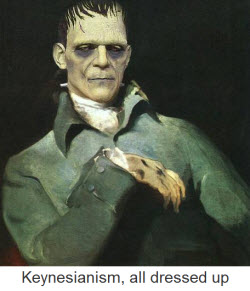
Koo evidently thinks the U.S. has something to learn from Japan’s death-like experience with deflation and prolonged recession. However, his advice to U.S. policymakers overlooks the fact that Japan itself has yet to escape the deflationary drag that has constrained the island nation’s economy for the last 20 years.  Ignoring this depressing fact, Koo emphasizes instead that Japan managed via heroic fiscal stimulus to keep the country’s GDP from falling even as deflation destroyed wealth equivalent to three years’ GDP.  Is it possible the economy did not flatline simply because insatiable U.S. consumers kept its export business humming?  If so, it is an explanation that Koo chose not to explore.

 Spend It Now!

 Here’s a link to his speech, which runs about an hour.  The topic, “America’s Balance Sheet Recession,” is supposed to conjure up something far worse than the usual inventory recession.  It surely is; but we part company with Koo on how to resolve it. He says policymakers have not acted aggressively enough to overcome the lack of private borrowing.  The solution? Get the government spending huge sums right away, says Koo.  The idea is troubling enough, since Government is not likely to put a dime of that money into the kind of cutting edge companies and technologies that in fact hold the key to America’s economic future. But Koo boldly asserts that this hardly matters – that it is not what the government spends the money on, but how quickly and how much of it gets spent.

To believe that wasting money in this way, and the more promiscuously the better, will somehow put us on the right track beggars logic.  Koo’s prescriptions are Keynesianism on steroids, but perhaps it would ultimately be beneficial to give them a try, since the epic failure likely to result would put Keynesian quackery to rest once and for all.

(If you’d like to have Rick’s Picks commentary delivered free each day to your e-mail box, click here.)  

  • evanism April 14, 2009, 12:26 am

    Mo, we speak of Keynesianism and flawed monetary policy and you sprout on about 2000 year-old-dogma. Dude, your thinking is Stone Age. What we are speaking of may ultimately take us to a more primitive time, but I can assure you that your thinking will NEVER gain traction – for that is a true definition of insanity…. go buy some government bonds, and remember to vote GOP.

  • BRIAN April 13, 2009, 10:03 pm

    IMHO there is more to Keynes circa 1936 than in all the the nonsense others purport to claim Keynes said, thought and wrote.

    &&&&

    Keynes in his own words can sound impressive, for sure, but if he was a genius, then what was Rothbard? RA

    ps: Here’s an interesting note on Keynes from Doug Casey:

    “The longer the Great Depression continued, the more economists suspected that something was wrong with the neoclassical model. By 1935, John Keynes thought he had figured it out, and the following year he published his General Theory. The heart of his explanation – here’s Keynes in 28 words – is that when most people want to save but most businesses are afraid to borrow those savings and invest them in real things, the economy’s path to recovery is blocked. The public’s attempt to save pushes the economy down to a level where incomes are so low that saving becomes impossible. The cure recommended by Keynes was for the government to borrow what the public wanted to save and spend it for them.

    “The Keynesian model quickly replaced the neoclassical model in the thinking of most economists. They liked it so much that they kept liking it even when the government ran huge deficits through the later 1930s and the economy failed to recover. Cynics say economists liked it despite the evidence, because understanding the implausible idea that thrift hurts must be the mark of a really high-powered intellectual wizard and because the subtext of Keynes’ message is that the world would be a far better place if economists were in charge. Politicians, of course, liked the theory for the license it gave them to spend and spend without taxing.

    “Roughly a decade later, an astounding fact emerged, astounding in itself and astounding that it had gone unnoticed for so long. Keynes’ intellectual enterprise took for granted what most observers, noticing near-zero rates in the money markets, took for granted about the collapse from 1929 to 1933 – that it happened even though cash was plentiful. But in fact cash had not been plentiful. The money supply had shriveled by a catastrophic one-third.

    “Why hadn’t anyone noticed? Easy. No one noticed because the Federal Reserve is the branch of the DMV with jobs for economists. Although the information was close at hand, no one at the Federal Reserve or anywhere else was compiling the money supply data routinely provided by commercial banks and the U.S. Treasury. Ultra-low money market interest rates seemed to be saying “Looks plentiful.” But the simple adding machine no one thought to use would have revealed “Shrinking fast.”

    “Summary statistics tracking the shrinkage of the money supply that started in 1929 weren’t available at the time. They weren’t compiled until the 1940s. I haven’t been able to find the source for this, but I’m told that before Keynes died in 1947, he said that if he had known of the one-third contraction in the money supply at the start of the Great Depression, he would never have written the ‘General Theory’ .”

  • JGU April 13, 2009, 1:50 pm

    Government spending is equivalent to wealth re-distribution, it is the only way to solve the “too few people controlling too much wealth” problem worldwide. Without a solid middle class, there will not be a wealthy nation.
    Your thinking is flawed.

  • Edwardo April 13, 2009, 1:07 pm

    Yes, Mr. Koo sounds like a right Frankensteinian, er Keynesian, economist. That is to say he is one who either doesn’t know, or misunderstands the nature of debt as it relates to GDP. Well, here it is, Mr. Koo, an essential truth that should inform the nostrums of any self respecting practitioner of the dismal science. The marginal productivity of debt is always and everywhere a vastly more important measure of debt as it relates to GDP than any other.

    With that in mind, Mr. Koo, did you know that In 2006, the U.S. marginal productivity of debt dropped below zero for the first time ever? I suspect you know what that means. It means that adding more debt produces nothing but a burden on the future since there is no economic productivity to be had through the addition of debt. Put more starkly, imagine a man thoroughly plastered on martinis given a bottle of vodka as a remedy for his inebriation, and you will have an idea of the rank stupidity in recommending that government continue to borrow and spend as a means to arrest our present economic calamity.

  • Mo April 13, 2009, 11:33 am

    In my opinion; it does not ready matter what we Americans do to jump start our nation. Once this nation started to withdraw from God our Father, taking prayers to Him out of our schools, rejecting Him Commandments and tearing our own familes apart due to personal selfishness….than we bring all this destruction upon ourselves and our nation, including our economy system….so says our Lord.

  • Gerald Clifton April 13, 2009, 6:09 am

    The problem, it seems to me, is that nobody in the mainstream (read, “authoritative” political and monetary policy makers) is questioning the definition of “money.” Okay. After that last comment, my pants are down. I am of the Austrian bent. But, at least I’ll admit it, and publicly.

    The monetarists and Keynesians (could it be that they are, at LAST, beginning to merge into one noxious blob?) are assuming that illusions can be perpetrated forever, if only the “markets” (snort! that’s a good one…) will give them a few more decades time (hence, the sobbing over “mark-to-market” necessities and anti-short-selling riggings), then all debts will mature without strife. Just die in debt, and leave it to the living to postpone all reckonings infinitely.

    However. If you assume that “money” is finite and lives and dies over cycles of time, then you come up with different conclusions than the “infinity-ists” (sorry, I am merely a poor dullard who has to balance his checkbook each month, and I felt a sudden creative urge to coin a collective term that covers today’s delusionary government and monetary authorities’ policies…) are currently trying to foist on our poor, miserable human race. If money is truly finite, it comes and goes. Hence the cycles. Easy come, damned difficult go. Or was it the other way around? It depends on how you define “money.”

    I haven’t read everything on the internet. Who could? Still, comparisons between the current times and the 2 decades that bracketed the so-called “Great Depression,” all seem to ignore definitions of money. They seem, on the contrary, to focus on how much more we know today about the “Great Depression’s” causes, and, thus, on how much better we are equipped, today, to defeat this evil monster’s second avatar. In short, nobody nowadays seems to want to engage the problems, when drawing parallels, centering obviously on the fact that, today, money supply is endless, and, during those dreary times, money was gold, which is not endless.

    Question. I can tell you with some authority that, right now, the quest for a good New York Strip Steak at the local supermarket (after many miles driven and more than a few traffic jams) will reveal that good New York Strip Steaks are NOT in unlimited supply. Go through your own shopping list. Bread? Kumquats? A nice Pomerol for under 40 bucks? Okay. NONE of these desirables is in unlimited supply. NONE.

    Second question. Why should “money” (whatever it is) be in unlimited supply?

    Just a thought.

    Apparently, now, definitions are up for grabs. So, great leaders, just what IS this “money” you are talking about, this grand abstraction that is in unlimited supply???

    I am truly sorry about the prolixity of my post. Too much money, too much booze. Still, since this is supposedly a Democracy, couldn’t we just press these bastards a WEEEEE little bit as to what they are talking about when they say “dollars”??

    Oops. I forgot. Ron Paul already did that. Obviously, a crackpot. In the words of Roseanna Roseanna Dana, “never mind.”