
Will homes maintain their value best in expensive neighborhoods, where homeowners presumably are not under the gun to sell or even to make mortgage payments? I’ve argued the opposite – that in percentage terms, high-end homes are likely to fall the hardest as the nation’s real estate crash runs its course over the next 4-5 years. While it is true that the wealthy, most of whom own their homes outright, do not face jeopardy from mortgage lenders, they could find themselves on the ropes for other reasons, including the failure of a business or devastating investment losses. That could easily force the sale — for starters — of a vacation home, which would put price pressure on all of the other homes in the neighborhood. Keep in mind that prices are set at the margin and that $2 million homes in a high-end development all become $1.4 million homes overnight if just one of the homeowners is forced to sell in a hurry.
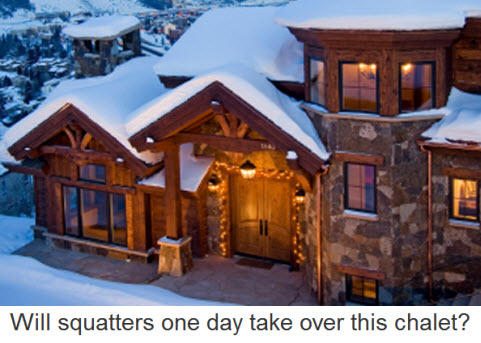
There is an additional factor working against valuations of high-end residential properties, namely the relative lack of demand, especially in hard times, for custom homes priced above $1 million. Such properties are not in nearly the same demand as 2- and 3-bedroom bungalows, nor do they attract anywhere near the number of bargain hunters. In fact, the market for custom homes with $250,000 kitchens is far more limited than the market for basic homes geared to the broad middle class.
‘Bargains’ in New Mexico
The following note from a subscriber reveals how badly the high end has been hit in, for one, New Mexico: “My wife and I have been contemplating moving to Placitas, an upscale area between Albuquerque and Santa Fe. A Realtor I have been working with called me with two smoking deals: 1) A new, never-lived-in house appraised at $1.2 million in 2007, now foreclosure-listed at $749,000. He says I can probably buy for $500,000; and, 2) a house that my wife and looked at during spring break for $650,000, now listed for $599,000, can be bought for $425,000 before it goes into foreclosure. Tempting.”
Tempting indeed. But we still believe that home prices will go a lot lower as deflation runs its course over the next several years. Long-Wave (i.e., Kondratiev) cyclists see the trend continuing until around 2015. By then it’s possible that a prediction we billboarded here a while ago will have come true: a Central Park West co-op that has changed hands for as much as $12 million eventually will sell for $250,000. It could be even worse in ski country, where, we’ve predicted, $10 million chalets will change hands for back taxes, and squatters burning furniture to keep warm will have to be evicted.
(If you’d like to have Rick’s Picks commentary delivered free each day to your e-mail box, click here.)
to zippythepinhead:
Sounds good, but if we believe the that dollar will decline rel. more than other currencies (I do too), then I would feel at least as comfortable in buyin some real estate in good ole Europe. Despite all, that is certainly a more stable place than most of Latin America, with an infrastructure much more like the US.
Caracas has beautiful parts, yet I would much rather live a secondary European city if need be.
Real estate in many European countries avoided the bubble mania. That does not include the UK, Spain, and Ireland. Those countries were more bubbly than the US, and the fall is yet to come.
But France, Germany, Austria, to name some, didn’t froth that way. Outside of Paris, Munich, Vienna you can get 6 bdr, 2500+sqf apartments for a song compared to major American cities (in places such as Lyon, Nancy, Leipzig, Berlin, Graz, etc) with a much smaller likelyhood of decline, because it didn’t rise meteoric in the first place. Especially in East Germany, much of this is brand new, renovated prewar upscale stuff (thanks to still generous tax writeoffs).
And, no worry about insurgent bombings, Morales/Chavez style confiscation, and much lower crime than Latin America’s (just look at Sao Paulo for that).