
With Goldman shares mired in a cyclical dither, we expected Google to lead the market higher yesterday. And so it did, although the net effect was a merely weakly buoyant Dow Average that crashed in the final hour. With hubris alone driving stocks higher, it would seem there’s no substitute for the un-real thing. Which is to say, Goldman’s flashy, smoke-and-mirrors modus operandi will always look more impressive to traders than Google’s old-fashioned focus on advertising revenues. Google was up nearly $8 at one point, and nearly $32 since Friday, on perceptions that it is among the few companies in America with a hot enough earnings story to persist even if the U.S. economy slip into Depression. That’s great for Google, but is it enough to drag the shares of Wal-Mart and McDonald’s higher? Apparently not.
We already know how the Goldman story will turn out, since it is at the leading edge of a financial sector in its death rattle. What will a share in Goldman Sachs be worth after the term “financial product” has been banned from the English language a few years hence? By then I will have danced the hula in Times Square, but my detractors shouldn’t kid themselves about whether my $29 forecast for the stock is still viable.
Caterpillar Uptick
Speaking of what’s viable, more green shoots sprouted to the top of the Wall Street Journal’s front page yesterday: “Business Spending Looks Up”. What a crock! Caterpillar and Parker Hannifin, two heavy-duty manufacturers, evidently think the worst of the recession is past. Now let’s see how eager they are to expand. The payoff for America, if they’re serious, would come in the form of higher capital spending. But how much of an offset would that be when measured against asset shrinkage in the financial sector amounting to tens of trillions of dollars?
The headline beneath the Journal’s louche main headline was more cautious in sizing up the nation’s capital spending prospects: “Investment Uptick Seen”. And the story itself broached this “disclaimer” as its fourth paragraph: “Any spending improvement remains tentative and will be coming off depressed levels. Both Caterpillar and Parker, even as they forecast brighter times, reported sharp year-over-year drops in revenue Tuesday. Some companies that foresee higher sales don’t expect to boost capital investment significantly because they can just bring back idled production.” Some recovery!
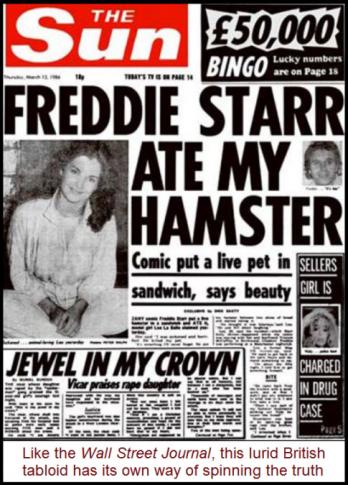
As you can see, there’s quite a disconnect between headline and story. Is the bullish slant of the headline a staid newspaper’s version of lurid sensationalism? Rupert Murdoch clearly knows who butters his bread – and it’s not readers.
(If you’d like to have Rick’s Picks commentary delivered free each day to your e-mail box, click here.)
The market looks like it’s had enough of the green shoots, and maybe it’s even viewing them now as a reason for the Fed to tighten monetary policy, which would be negative for the economy. And I feel that until the govt addresses the basic structural problems in our financial system of too much debt, we will not have a sustainable recovery. So while the stock market can stay irrational in the shorter term, in the long run I believe it will go back to reflecting the fundamentals of our boom and bust economy. And I therefore still feel that for long term investors a better portfolio allocation is in cash and gold. I think the gold price will continue to rise due to a lack of faith in central banks’ policies and in fiat currencies. I recently read some very interesting articles on these topics at http://www.goldalert.com/gold_news.php, which discuss the relationship between the dollar, the gold price, and gold mining companies given the Federal Reserve’s monetary policies. I thought the article titled “Gold Price Up, Dollar Down – Does it Really Matter?” was particularly useful for investors to read to get a better sense of the relationship between these asset classes given the volatility and uncertainty in our entire global financial system.