
Even TV Anchors Are Growing Skeptical

Now that’s more like it. After a night’s sleep, Wall Street traders and speculators evidently decided the 3.5 percent GDP growth figure released by The Guvvamint on Thursday wasn’t such great news after all. On Friday the Dow gave back all 200 points of the previous day’s gains, plus 50 more. We’d have to concede that the news media played a positive role in making this a “teaching moment” for the poor saps who actually believe the economy is recovering. Instead of the usual cheerleading, network news anchors emphasized that virtually all of the dubious growth had come from Cash for Clunkers and a massive infusion of fiscal spending. This most surely played a role in Friday’s selloff.   

Actually, the networks have been doing a better job lately at describing economic reality than the Wall Street Journal, whose coverage has grown increasingly schizophrenic. While generally downplaying negative news, the Journal has headlined any ostensibly upbeat story that contained even the faintest glimmer of light at the end of the tunnel. Thus, when Caterpillar reported a 53% fall in profits for the third quarter, the prominently displayed story emphasized not only that that number beat estimates, which obviously had been low-balled, but that the company “believes” sales have bottomed.  
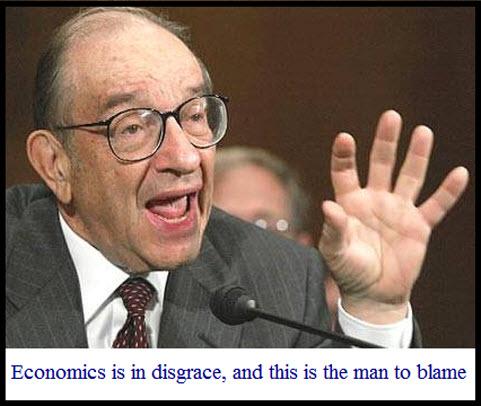
Greenspan 


Such stories have received undue emphasis in the Journal, especially on the front page, even as far more important economic news has gotten tucked away on inside pages. You’d have to get your information from the newsletter world, from blogs, and from local newspapers, to understand, for one, how dire the situation is for state and local governments. Their budgets are imploding, creating a severe drag on the economy that will be felt for years. Is consumer spending supposed to overcome this?  

Consumption Above All 

The very question raises another issue about mainstream coverage of the recession-cum-Depression: How can a revival of consumer spending be the key to any recovery?  The  very word “consume” – as opposed to “invest” – should raise a yellow flag. The belief that consumption is the key to a strong economy is so deeply ingrained that few Americans even question that it has become the basis for all economic decisions made by the federal government.  But popular delusion is at a tidal crest when it views pumping up home prices and retail sales as government’s most important domestic role.  We might have expected economists to know better, and to help lead us out of the woods, but for the fact that credit-based consumption has become their credo as well. This belief was handed down from on high by Alan Greenspan, the man who single-handedly brought the dismal science to the point of utter disgrace.        

(If you’d like to have Rick’s Picks commentary delivered free each day to your e-mail box, click here.)

  • RichI November 2, 2009, 8:35 pm

    Goldman appears to be going down from 247.38 and taking homeowners and the market with it. McClatchy doing an expose series that may lead to calls for GS heads:

    http://www.mcclatchydc.com/227/v-print/story/77791.html

    http://www.mcclatchydc.com/227/v-print/story/77841.html

    Tomorrow: Secret GS Grand Cayman deals.

    How the mighty have fallen…

  • Chris T. November 2, 2009, 6:10 pm

    to Jake:

    Having just finished Ron Paul’s “End the Fed”, wherein he nicely traces Greenspan’s 60s position on sound money (which is presumably the time that his views were Randian), to his 70-80s view on gold, to his 90s/2000s hubris, one can’t be sure how much of Rand’s philosophy was left in him, when he changed his other positions so much.

    More important though is, what would that philosophy really be, which would have influenced him? That which one can (perhaps) glean from “Fountainhead” or “Atlas”, or that which one of the inner circle, such as Greenspan, may have picked up from her in person?
    If the latter, there really is no philosophy after all. To see that, take a look at this: perceptive take by Murray Rothbard on Randianism:
    http://www.lewrockwell.com/rothbard/rothbard23.html
    sounds like nothing more than spur of the moment charlatanerie to me.

    When it comes to Greenspan, the adage that people get wiser with age definitely does not hold looking at how Ron Paul traces that.
    It would be nice if the final disavowal of this huckster would come in time for him to still be able to see the ruins of his posterity.

    Some “committee to save the world” these dudes turned out to be.

  • Carol November 2, 2009, 6:00 pm

    Rupert puts his fine touch on the WSJ. It was only a matter of time.

  • Peter Montgomery November 2, 2009, 1:25 pm

    Good to see that Peggy has put down the KoolAid after being in the tank for Obamessiah for quite some time.

    For awhile, I couldn’t read her articles without wanting to spew and wondered if her and Chris “tingle up my leg” Mathews were going to do a ObamaWow show with all their sycophantic gushing.

    Here’s to many other Obots seeing this narcissistic and evil little man for what he is.

  • Jake November 2, 2009, 5:29 am

    Isn’t it strange how one man’s dogmatic belief in Ayn Rand’s philosophy – regardless of a Fed “Board of Governors” who provided other opinions – could inflict so much damage. Too much power concentrated in one place maybe?

    I’m still waiting for the media to call “Toxic Assets” what they really are – “Toxic Liabilities”.

  • Rich November 2, 2009, 3:33 am

    Rick,
    We are governed by sociopaths (Goldman, Morgan, Wall St and their link with the White House/Congress.). Callous children would be an upgrade for these criminals.

    Nice shot at Alan “Bubbles” Greenspan. The world wide housing market has collapsed in large part because of this puppet and his superiors.

  • bill November 2, 2009, 12:05 am

    “We’re Governed by Callous Children”.

    Well… that’s a load off my mind. For many years now I’ve labored under the false notion The U.S. was under the spell of a lunatic fringe group of psychopath, satanic, criminals, hell bent on our destruction. It’s good to know our problems lie within a relatively benign group of callous children which by definition can be dealt with and will soon pass away.
    Maybe next week Mrs. Noonan will enlighten us on our “Consumption conundrum” which has a much longer time frame. Starting in 1913 we have witnessed a progressive,systematic, expansion of taxes on PRODUCTION in almost all its forms; with barely a glance at taxing consumption. Let’s see…. that is 48 consecutive congresses and 24 administrations in which NO ONE seriously challenged the basic economic principals of taxing production vs consumption. Any 12 year old (if we can find one unaddled with fluoride,vaccinations,Ritalin or Prozac) could figure it out given proper information.
    Mrs. Noonan inquiring minds want to know.

  • gary leibowitz November 1, 2009, 11:26 pm

    I am one to ignore the news, both good or bad, since they are usually followers not leaders in the market trends. The problem with emotional expectations is that they are almost always invariably wrong. That hold true for the printed news also. The strange part about the market is that they usually do not get caught up in emotional expectations. In almost every case the major moves down or up came when the economic news had no coorelation.

    On a technical standpoint you could argue that we are due for a major drop since we rose so fast in a short time period. There are problems however with making this assumption a sure thing. First off the fibonacci camp will argue that we haven’t hit the 50 percent retracement yet. Seasonality we have just fininshed the low point and should be soon on an uptrend. Finally those that try to match the 1930’s move in exact step will usually find themselves wrong.

    Finally I would add that news commentaries have a way of becoming skewed towards the viewers own point of view. In other words we hear what we want to and disregard the rest. I have seen of late a very mixed bag of news reporting indicating there is a healthy skepticism still out there.

    Back to the fibonacci camp, there is a major turn date set for Nov. 9th. If this method holds true then we can expect a rather sharp reversal after then. If you are a die-hard bear that might suggest a very nasty drop next week. Me, being a very long term bear I do not see this occuring just yet. In almost all instances a rebound from such dramatic crash levels usually faulter when everyone is on board indicating there are clear skies ahead. The economic news usually doesn’t play much of a part during such strong emotional times as these.

    Jobs, consumer spending, consumer sentiment have been laggers in market trends. I suspect this is still true today. Markets just look for opportunities to make money. Cutting work force and driving down raises is always a winner for the market. Its the expectations after that that usually go astray.

    Sorry if I strayed on my comments since I realize they are tangential to the current article.

  • Bam_Man November 1, 2009, 10:09 pm

    Rick, please tell us how you REALLY feel about Mr. Greenspan.
    LOL.

  • Paul November 1, 2009, 6:31 am

    Rick,
    Thanks for picking up Peggy Noonan’s article. I almost wrenched my neck from all my Yes-head-noddings.

    I can understand why both the WSJ and the CNBC are trying to cheerlead the market higher–they are owned by listed corporations whose leadership gains through a strong market, and, most importantly, whose advertisers want the public to be confident and spend, spend, spend.

    “The biggest long-term threat is that people are becoming and have become disheartened, that this condition is reaching critical mass, and that it afflicts most broadly and deeply those members of the American leadership class who are not in Washington, most especially those in business.”–Ms. Noonan

    In the 1970s I had confidence that “the grown ups” would eventually pull us through that decade’s destructive effects. Paul Volcher was one of those filling the parent role. Now, late in this decade, I have zero confidence. Heard much from Volcher after he was paraded around by Mr. Obama late last year? Feel confident about the early re-appointment of Helicopter Ben?

    India, China, Brazil and other developing countries are able to comfortably out-compete US laborers and professionals in almost all fields. Even industries where the US has had great success, such as pharmaceuticals, are now being attacked (re: Ms Noonan’s reference to “Big Pharma”) as too profitable by politicians.

    There is little doubt that the USGov’t is willing to sacrifice the US$ in a futile effort to “get us over the hump” until the US economy magically “gets better.” There is no [industrial] basis for it to get better. And when the Gov’t realizes that “hump day” is not arriving, they will deliberately put the QE pedal much closer to the metal. How close does the pedal have to get to “floored” before US Treasury holders bail?

    Best of luck to all.

  • Don November 1, 2009, 3:40 am

    There are others in addition to Mr. Greenspan ie. NAR, lobbyist, politicians from top to bottom. The list is long and convoluted.
    My saving grace is having taken Rick’s trading seminar in December 2008 and thus far net assets after living expenses etc. up double digits for the year.