
Bears Should Fear Gold Above $1170

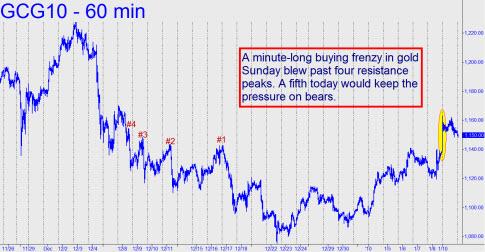
Early Monday evening, Gold was holding onto most of the impressive gains it scored a day earlier. You needn’t be a technician to see unfinished buying in the chart below. It shows Sunday’s explosive, $25 rally in the Comex February futures contract, followed by a tedious consolidation that was still in progress 24 hours later. Shorts have good reason to be nervous when gold shows such reluctance to give up ground. As recently as Christmas they were salivating over the prospect of a major selloff. Gold had come down hard from an all-time high of $1227 recorded earlier in the month.  When quotes dipped beneath $1100 just before the holidays, some were predicting the bull market had breathed its last. In retrospect, it appears they were wrong. Assuming the $1075 retracement low holds, the correction will have amounted to about 12% — mild and healthy, as far as bull-market consolidations go. 
Pressure-on-bears

 Notice how Sunday’s buying frenzy drove gold’s price past four resistance peaks.  Using Hidden Pivot analysis, we require only that two such peaks be surpassed to create a bullish “impulse leg.” This leg obviously has power to spare.  Above peak #4 is another peak at 1170.20 that is unlabeled. If the February contract were to get past it by Wednesdays’ close, that would refresh the bullish impulse, putting even more pressure on shorts. It would also practically guarantee a test of the $1227 high. Bears can see this as well as we can, implying that the $57 rally it would take to put the futures at the threshold of new record highs is likely to occur very quickly. Traders should therefore be ready to seize the breakout opportunity if 1170.20 is breached within the allotted two days.  

(If you’d like to have Rick’s Picks commentary delivered free each day to your e-mail box, click here.)

  • FranSix January 13, 2010, 2:19 am

    If all of the smart money available is sitting on the short side and nobody on the long side, except for a small group playing the futures, then the vast majority of players can actually be burnt right out of their positions. The longer it goes on, then the bear market players will literally be left without a single red cent to gamble against a market decline.

    So the obvious here is to burn out the shorts. As opposed to gold markets, where the action is to burn out the longs. An interesting market dynamic is occurring to say the least.

    If we are at a top, then it will be a long rollover, or we can look forward to another three months of rally.

  • Doug January 13, 2010, 2:04 am

    Mario: Looked to me like Daboyz called an “audible” across the pond to have the UK chaps finish their tea and start selling.

    Who knows?

    Rich: that fed piece is amazing. Lose hundreds of billions, if not trillions, and claim a gain (we own the bad mortgages). Like Rubin and Summers are responsible for success. Rubin made $125 million while at Citibank. Citibank lost $60 billion in value. Success for Rubin. SS Summers’ wake just keeps moving like a tsunami.

  • Chris T. January 13, 2010, 12:35 am

    Having just has a good laugh at the intraday charts for Ag and Au (use Kitco for the three-daz overlay) with the purely coincidental drop in the last minutes of NY trading, this comment about mario cavolo”s comment.

    Mario writes:
    “than 20,000 middle class Americans who were making $50,000/year”

    Your comment is surely correct on its point, but alas, $50.000 p.a. salary is NOT middle class anymore, and has not been for a while.
    Middle class means (or better meant) that you could afford certain things, such as ensuring the betterment of your kids by funding their education and also your own future, along with some perks.

    Back about 20-30 years ago, a middle class family, whether one earner or more could:
    a) afford a home and expect it to be debt-free at some point, with an increase in value keeping up with inflation
    b) send the kids to those colleges they qualify for on ones own income
    c) save for retirement
    d) have a 1-2 week vacation once or twice per year for skiing or the or the ocean.
    e) pay a property tax burden without fretting over it being a substantial part of ones income.

    There are some others I left out.
    But on 50k these dayz? No way, that is tough even if one does not live in the North East or CA.

    Fact is, our conceptions of what is middle class have not kept up with reality. Pols like Obama can talk about socking it to the rich with extra taxes, and when they then define what the rich are, they bandy about amounts like 150,000-250,000, with no one objecting that that is not rich or wealthy.

    Per the Minnesota Feds inflation calculator:
    50k in 1980 equates to 130k today.
    19.5K in 1980 equates to 50k today.

    This is without going to John William’s website, and rather using the B(L)S or other official data. Using the real number at shadowstats only makes the point much more stark.

    Back in the early 80s 50k would have been considered middle class and done what I point out above, and also perhaps the next couple of years.
    I don’t remember people back then calling <20k p.a. as middle class.
    TV helps: While the Cosby lifestyle was at the upper- middle class level (a lawyer and a doctor with house-personnel and an NYC townhouse), it was presented as part of the middle-class, not of the wealthy elite.

    We need to disabuse ourselves of these long-held markers which have disappeard long ago on real reflection.
    Today one needs a substantial six-figure income to be middle class in the way that that was used in the past.

  • JJR January 12, 2010, 7:05 pm

    http://watch.bnn.ca/trading-day/january-2010/trading-day-january-8-2010/#clip253604

    Not related to this post I just thought it was an interesting theory about the Feb pumping up the market.

  • Rich January 12, 2010, 4:33 pm

    Let the games begin. Remindful of Hollywood accounting, after paying for the artwork, dining clubs, private jets and 1000 economists who did not predict sunrise they have $45 B left over for the Treasury? Profligate usury cannot be good for the USA Economy…

    Federal Reserve Made Record Profit in 2009: Report
    FEDERAL RESERVE, FED, PROFIT, BANK, BANKING, QUANTITATIVE EASING, PRINTING MONEY, BERNANKE, ECONOMY, INTEREST RATE
    Reuters
    | 12 Jan 2010 | 04:05 AM ET

    The U.S. Federal Reserve made record profits in 2009 and will return $45 billion to the U.S. Treasury, after its efforts to prop up the economy created a windfall for the government, the Washington Post reported.

    The $45 billion reflects the highest earnings in the 96-year history of the U.S. central bank, the newspaper reported on its website late on Monday. The figure was obtained by calculations based on public documents, the Post said.

    The Fed funds itself from its own operations and returns its profits to the Treasury. The largest previous refund to the Treasury was $34.6 billion in 2007, the Post said.

    The report said much of the Fed’s higher earnings were sparked by the central bank’s aggressive program of buying bonds to push interest rates down and stimulate growth.

    “By the end of 2009, the Fed owned $1.8 trillion in U.S. government debt and mortgage-related securities, up from $497 billion a year earlier,” the newspaper reported. It said interest income on the investments was a major source of Fed profits.

    The central bank also made money on its emergency loans and on special programs to prop up lending.

    Even though it had reported billions of dollars of decline in the value of loans made to bail out investment bank Bear Stearns and insurer American International Group, the Fed received $4.7 billion in interest payments from those loans in 2009, the Post said.

    The report said the Fed was due to release its estimate of 2009 earnings on Tuesday.
    # Slideshow: Central Banker Report Cards
    Copyright 2010 Reuters. Click for restrictions.

    URL: http://www.cnbc.com/id/34818508/

  • mario cavolo January 12, 2010, 4:32 pm

    Rick and friends, news below indicates quite clearly what I have been trying to say about the new reality of American society: that the U.S. will “overall” be ok, because while there is a group of 40 million whose lives have been raped, pillaged and sentenced to a lifestyle of European socialism, the rich are doing just fine and will continue to support the country. There is less and less need for the American “middle class” to be considered the “foundation” of the country. That model, that paradigm, is truly gone. 100 rich people worth $1 million USD in assets has far more spending power than 20,000 middle class Americans who were making $50,000/year with debt up the wazoo…see?

    Meanwhile, PLEASE tell me what the HECK happened at around 10:30 GMT that caused the U.S. stock indexes, gold, silver, and oil to suddenly all nose dive together? ….I couldn’t find anything on the newswires or announcements…..

    Cheers, Mario

    Tiffany’s fellow high-end retailers Saks Inc. (SKS 6.85, -0.27, -3.79%) and Nordstrom Inc. (JWN 38.50, +0.15, +0.39%) last week also reported better-than-expected sales and were among the outperformers in the industry in December, signaling that consumer spending is gradually recovering and shoppers feel more comfortable about buying things they don’t need, analysts said.

  • FranSix January 12, 2010, 5:37 am

    IF the previous two years’ analogous price moves are any indication of how the gold price should progress going forward, then we have approximately a three month’s rally in front of us, out until April. But that may also imply that much in the way of the markets will continue in the same vein for about the same time period.

    Weekly Analogous Gold Chart

    http://tinyurl.com/yhc34r6