
Yesterday we aired a bearish prospectus for Canada written by “Cameroni,” a regular contributor to the Rick’s Picks forum. He expects a real estate bust and sees the Canadian economy ultimately getting dragged into the same deep bog that has trapped the U.S., on whom the nation’s export economy depends heavily. Below is a response from “Bobtor” arguing that Canada is in far better shape than the U.S. to weather hard times, for a number of reasons. For one, the retail climate remains much healthier, with few signs of the blight that has shuttered tens of thousands stores, restaurants, malls and prime commercial properties across America. Bobtor also thinks Canada’s political and business sectors are unpolluted by the kind of lies and corruption that have become endemic in the U.S. Here’s Bobtor’s post to the forum which can be accessed by clicking here:
Thank you, Martin, for reinforcing some of the key points of my comments that seem to be lost on Cameroni. I too was not saying that Canada is in great economic shape, but that by comparison we are doing much better than the US, for the reasons you have mentioned and for many other. And Cameroni, I am not a real estate professional any more than I am a stock professional; I merely invest in both real estate and in stocks. I just like to know the rules of the games I play, hence my knowledge of real estate financing.
Real estate prices will not crash in Canada in the manner or to the extent they have in the U.S. We do not have rental stock in our cities to accommodate the people coming in. The economics of cost, and rents, and rent controls in many Canadian cities have precluded the recent building of new rental stock. By recent, I mean the past 15-20 years! Most of what young people are buying today in Toronto are tiny shoe-boxes by the standards of their parents: two bedrooms and a den in 800 square feet or less. More like the European version of a “home” than the American-based suburban dream.
Real estate prices will go down, and real estate prices will go up. They always have and always will. Like the stock market, if you can come close to identifying a trough, buy and have the staying power and capital to ride out the bad times, you will do spectacularly well, much the same as if you bought stocks at last year’s March crash [lows].
Beat the Sale Tax
The real estate markets in British Columbia and Ontario are also being driven currently by the Harmonized Sales Tax which comes into effect July 1. This will add (in the case of Ontario) 8% tax to the price of a new home (as well as similar-percentage tax on legal and real estate fees). This is driving the market for closings before June 30. Put down your newspaper and walk into the sales offices of the various condos for sale in Toronto (not the suburbs, but the city). You will be amazed to find lots of “middle aged” buyers, empty nesters, single women of all ages, some seniors, and, yes, lots of young people too, buying units.
The point I was trying to make, which you turned into a tirade against the Canadian economy and its dependence on its largest trade partner, the US, is that, quite simply, the conditions that were the root causes of the U.S. real estate crash do not and cannot exist in Canada. Of course it was designed to protect the banks — it’s the banks’ money that is put up! But it also protects the consumers against their own greed and foolishness, unlike the U.S., where those traits were encouraged. You cannot buy a house up here that you cannot currently afford. That is not to say you will be able to afford it a couple of years from now if you lose your job. In the U.S., people were being given loans that they could not service on the ruse that the price of their house would only go up, they could refinance and pay down the loan.
‘Shocking’ NYC Vacancies
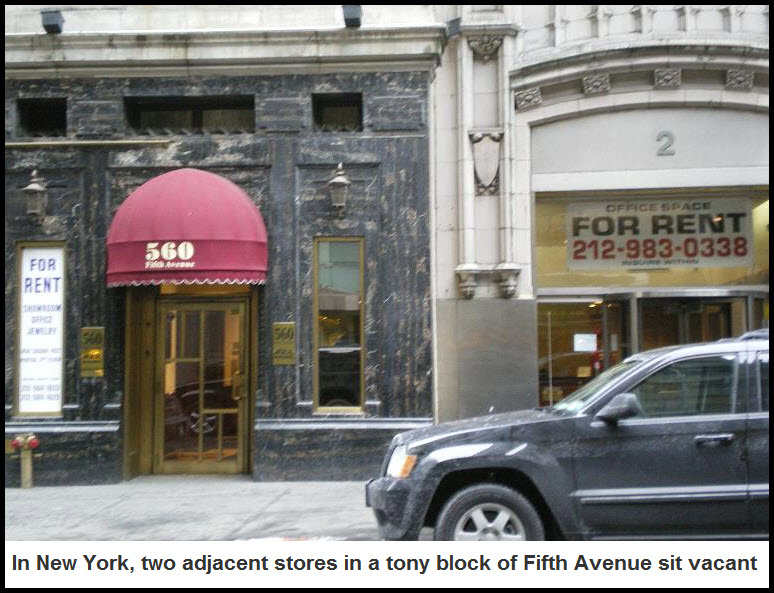
I walked from Madison and 25th to Broadway and 78th in New York a short while back. That long walk takes in some of the most prestigious and expensive commercial real estate in the world. I was shocked. Huge corner-commercial spaces that commanded seven-figure rents were vacant — and tons of them. Go to the suburbs and there are malls and strip plazas that are literally vacant. Get off the oceanfront strips in Florida and such and there are almost whole blocks of homes up for sale or repossessed or foreclosed. That is not happening up here. There is in fact too little supply on the resale housing market in cities like Toronto right now, driving up prices.
Separate and distinct from residential real estate issues, there is a commercial real estate crisis brewing in the U.S. in the billions of dollars. All of those vacant properties I mentioned have mortgages but no income. Apart from the lack of capital available to finance them, the owners no longer have tenants and the required income to pay the monthly costs, so further, severe losses are imminent. Clever and well funded “bottom fishers” are salivating and digging into their war chests for long-term holds. The Reichmann’s with Olympia York did it in NYC in the 70’s and ended up collecting more in annual rents a few years later than they paid for the properties. Sure, they subsequently blew most of it in the U.K., but that’s a different story. Brookfield is making the same move today in cities like Washington. One of Boston’s commercial skyscrapers sold for a small percentage of its construction cost. We seem to be coming back to a situation where money talks…and b.s. walks.
A Land of Plenty
So do not misunderstand, Cameroni. I do not think in any way that the tail wags the dog and that Canada’s economy has become autonomous of that of the U.S. But we do have the good fortune of having lots of petroleum, which the world continues to want; as well as gold and silver and uranium and diamonds and many other commodities that remain required, regardless of the ebb and flow of quantities. Full employment in this country is deemed to be somewhere in the 5% to 6 % range in large part (in my view) due to our overly generous welfare state. The parking lots of our malls are full and it is nowhere near Christmas. Lineups at the border are hours long again for cross-border shopping participants going and coming. We went from losing 20 members at our yacht club by the 2008-2009 season to gaining the same number for the 2010-2011 season. And their boats are a lot bigger than the older folks who were compelled to give it up and sell.
Of course, trade matters, Cameroni. And of course, the universal facets of economic function apply to Canada. I consulted for a company for over 30 years that moved to the U.S. last year and took 120 jobs with it. I consulted for another multinational for 16 years that closed its Toronto manufacturing plant three years ago and moved it to Singapore, even though the cost of shipping the goods back to North America is greater than the labor savings. That put another 300 out of work. We are not immune to economic downswings. But please understand that in Canada we simply do not have the fundamental systemic banking corruption, ranging from absurdly “liberal” (i.e., irresponsible) government-sanctioned bank-reserve ratios, to outright systemically fraudulent (by Canadian standards) lending practices that were endemic in the U.S. Sure, people here may end up at times, and always at the wrong time, having a home worth less than their mortgage. But a fundamental difference is that that cannot be the case from the very date of acquisition, as routinely occurred in the U.S.
I am glad my comments have been able to stir up such spirited discussion!
And so are we, Bobtor. Thank you for weighing in with some very interesting observations and counter-arguments.
(If you’d like to have Rick’s Picks commentary delivered free each day to your e-mail box, click here.)
Max Power,
When I say Bond Prices are irrelevant, I am not belittling their importance. I am saying that the price is manipulated, and therefore has no relevance. Against other currencies on the dollar index the American Dollar is trading fairly high. However, aginst gold it has lost value. I believe this is what I said. At the same time Gold is undervalued. They are doing the same thing governments have always done in recessions,—printing money. The difference is that all Western Countries are doing it simultaneously. This allows them to kick the can down the road for a considerable length of time. It might have worked if there was another bubble they could inflate like housing, but there isn’t one. All of this money is going into the stock market and that neither creates jobs or increases the tax base. In other words, the end is near!