
Friday’s commentary, “How Home Prices Will Find a Bottom,” elicited responses over the weekend that were both provocative and insightful. For one, there was this common-sense suggestion for investing during the very challenging times that lie ahead: “Buy real estate to rent out to people making their money in crisis-resistant jobs.” We agree with this approach, as well as with the author’s conclusion that better opportunities may be difficult to find if, as seems possible, the economic environment combines the worst features of deflation and inflation.
For the most part, inflationists took the hind quarter in this discussion, although we would caution that it was not altogether favorably disposed toward gold as a long-term play. To access the forum, click here. We have culled one post in particular because it brings considerable evidence to bear against a sunny view of Canada’s economic prospects espoused by one “Bobtor.” The gist of it is that Canada is so dependent on trade with the U.S. that it will not be able to avoid getting dragged into the morass that has all but asphyxiated America’s economy. Here is the post, from a forum regular who goes by the handle “Cameroni”:
Well Bobtor, my fellow Canuck, we are indeed reading different newspapers. Or perhaps we just interpret the data differently. Last time I checked, Canada’s (official) unemployment rate was still above 8%, and although there was the appearance of strong jobs gains in January and February, it is clear that many, many thousands of those jobs were generated by the Winter Olympics. How many? Well, enough to thoroughly skew the statistics, that is certain.
Government stimulus measures (i.e., taxpayer-created jobs) still comprise a large portion of new hires, and that program is slated to end. What do you think will happen to those positions when our stimulus money runs out? I will add that a large proportion of new jobs are temporary and part-time as well, so let’s not get too excited just yet. Thousands of high-paying positions in the auto sector, for example, are now gone for good. They will not be returning any time soon with the dollar rising so sharply against the Greenback. I submit that they are gone for good.
5% Downpayments ‘No Help’
I am guessing you are a Realtor, judging from your detailed knowledge of Canadian real estate minutiae. That means you have a vested interest and cannot be impartial when it comes to your calling. You reel off regulation like it is scripture while forgetting it was primarily created to protect the banking sector, not home owners or buyers. Five percent down payments certainly will not help many if prices decline by 10 percent, now, will they? Underwater is still underwater, and it just means we lost real wealth — real money that we worked for and saved. We could only envy that Americans could buy into homes with nothing down at one point and get out with no personal savings lost or profit in earlier times by selling zero-down homes that miraculously generated equity almost overnight.
To see where we are headed, you need to look at some fundamentals of our economy. Can you ignore the fact, for one, that roughly 85% of all Canadian trade is with the U.S.? Or that Ontario, which accounts for a significant portion of our manufacturing trade, is in recession while the province posts deficits? I ask you to check for yourself the Conference Board of Canada’s estimates for the value of trade lost for each single cent our currency rises. We know this. Our currency is near parity for the first time in almost 30 years. We know our exporters have lost 10 percent on signed contracts in six months alone! That is mostly trade with our neighbors south of the border. If you have been watching the course of the recession down there and the mounting job losses and plant closures, you would be irresponsible to suggest that is good news for Canada. Forget the daily drivel you are being spoon-fed by the media, and think for yourself. Start looking at the real consequences we face with the U.S. mired in a difficult, ongoing recession.
Rising TSX a Distraction
And please don’t imagine that a rising Toronto Stock Exchange is a sign of real recovery. That exchange is heavily weighted with gold shares and other resource plays. It may remain a little more buoyant than other exchanges on the strength of Gold and Silver for now, but don’t get too smug yet, because it is looking more likely that a rocky ride lies ahead rather than a moon shot.
So, are we an island up here, where the normal rules of trade and finance don’t apply? I don’t think so.
Quite the contrary actually. There is no other country in the world with more at stake and more dependent on a positive outcome for the U.S. economy than Canada. No country’s economy is more exposed to the U.S. We are their largest trading partner and they are ours. Combined, the value of all our trade makes us the largest trading bloc on the planet. So take a careful look at the facts down there and ask yourself about how strong our markets really are. The U.S. is in fact experiencing a prolonged downtrend in real estate values, consumption in the dumps, retailers shuttering their stores across the nation, a real unemployment rate that is closer to 20% than 10%, record bankruptcies, commercial real estate in crisis and an extremely dismal long-term outlook for the greenback. Nothing could be worse for our economy.
What Good News?
I am not sure what good news you are referring to. In British Columbia the forestry industry is at a near standstill due to lack of new home construction in the States. In Alberta literally dozens of oil and tar sands projects representing billions in investment remain stalled or mothballed while the unemployment benefits of thousands of workers are running out. In my own backyard of Saskatchewan, the provincial government recently miscalculated potash revenues by two billion dollars — a stunning amount for the size of this province that amounted to a 100% error when no potash was sold and the Chinese backed off on signing new contracts. Nobody saw that coming, that is for sure.
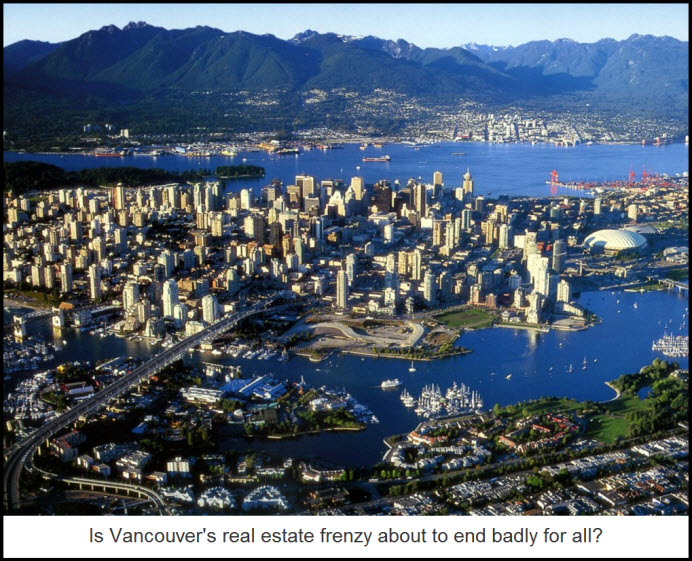
And with Toronto homes selling for a factor greater than seven times annual income, and Vancouver’s at ten times income, you cannot possibly believe that is not bubble territory. Take a close look at who is buying and you will see it is mainly young people — young professionals who have been duped into believing that this is their last chance to get into the market before interest rates rise. It is a panic, and that is a sure sign things will unwind. Look at who is selling too. It’s retirees who have seen it all before and who want to get the hell out before it’s too late. It is already too late, though.
Toronto Bubble Biggest
As far as Vancouver goes, you can find data yourself that clearly show listings rising over the last few months while the ratio to sales is in decline. It is worth noting that one of the other big factors prompting Canadians to keep buying in this environment is that the GST (Goods and Services Tax) on new homes will soon rise by a percentage, and the rules governing the amount of down payment and maximum length of amortization are changing. All of this has driven frenzied buying, and no one in his or her right mind could doubt that when Toronto homes jump 10 percent in value in a single year, that they are in one of the biggest bubbles of all. You might call that a “hot” market, but I see all the hallmarks of a disaster in the making. The writing is on the wall, and we are about to hit that wall head-on.
But our biggest concern by far should be the health of the U.S. economy. With nagging doubts about the future strength of the greenback, it is certain we will suffer economically here as our dollar rises above parity. Where will it end? A Canadian dollar at 2.00 perhaps…or three. You can call that crazy, but we are pegged to the greenback, and our currency in particular does appear to strengthen whenever the U.S. dollar weakens. The prognosis for the U.S. dollar is not good when measured against current, monolithic debt levels. So where is the good news? It’s terrific for tourists heading South to shop and visit, I suppose, but it spells disaster for our struggling manufacturing sector and resources such as lumber. Ontario’s current plight will lead to a very nasty reckoning for this great country. We are no longer posting fat national surpluses, my friend, and the cash cows are thinning out as casualties to a faltering American economy.
Crash Unavoidable
So, yes, I stand by my comments. Real estate will crash here. Big time. I hear the gnashing of teeth and wringing of hands already as the typical Canadian, a single paycheck away from a home foreclosure, blindly saving a meager one percent of income for old age and depending on the value of their homes to support them in old age, finally wakes up and realizes that he could not read the signs of what is coming – that he blindly followed the same path of consumption hell, borrowing, and credit-card debt that is currently plaguing the US economy; and that our fate really does rest on the actions taken or not taken that could lead to an eventual U.S. recovery.
So we are not special. We are not different in Canada. The same rules of economics function here as they do South of our borders. Trade matters. Our housing crisis is coming, and we are merely a little behind schedule, so pay attention or you will lose your shirt.
(If you’d like to have Rick’s Picks commentary delivered free each day to your e-mail box, click here.)
I agree with Rick Ackerman. Then why canadian economy is not crashing?
I think the main point you all guys are missing is…
Canadian borders are open to the whole world bringing 300,000 (1%) people every year in such a small canadian population 30 Million people.. Adding 1% population everywhere creating huge demand for housing.
By the way 80% populatiuon goes to Toronto or vancouver or montreal.
Up to now most of the new immigrants know ..there is nothing for them in canada unless and until they bring huge cash in their pockets, canadian govt. has no restrictions on cash.
All the money is flowing from middle east /china /hongkong….
Do you realize who is opening new businesses in canada or buying homes…. It’s all immigrants who is adding up the demand.
Simple fact …. On such a huge unemployment in Canada….I do not believe what canadian govt says in terms of unemployment %…..If no inflow of people, then whether rental places should be cheaper or homes should be cheaper…But both are expensive.. where the demands is coming from???????
Do you realize for 1 labor position is Home depot in Toronto.. there are 200 applicants applies who are also highly over qualified.
Guys … what is happening to your Math?
Canadian like to dream and they will continue dreaming as soon as immigration doors are open.