
We exited a bullish position in the E-Mini S&P yesterday on a trailing stop, expecting to reverse our strategy and get short at a slightly higher price. The futures need only have tacked five points onto Tuesday’s highs to trigger the new trade; alas they spent all of Wednesday going nowhere as we sat on our thumbs, bored half to death. The charts suggest the market is tied up in knots — and what’s a trader to do? We are given to infer once again that there is virtually no buying interest right now other than from bears covering shorts; moreover, when demand from that source is absent, stocks cannot make even an inch of headway to the upside. Just as obviously, there is no selling power whatsoever, and any market that has declined even moderately for a few hours is ripe for bottom-fishing.
Under the circumstances, our most successful trades have involved buying or shorting futures contracts at, respectively, swing lows or highs. It is in fact possible to short repeatedly into a strong rally and make money consistently, provided your timing is right and you are quick to take relatively small partial profits on pullbacks. We have done this over and over – not so much because we expected to catch the Mother of All Tops, but because we might have; because it’s easy to do; and because we risked little or nothing in trying.
Time Decay
But attempting the same trick with put and call options is another matter, since time is always working against the retail customer, who is more or less forced by margin rules to be on the long-premium side of option trades. While there is no way for option buyers to eliminate the problem of time decay, we can try to mitigate its pernicious effects in a few ways. For one, we should try to buy puts at swing highs and calls at swing lows. If we get this part of the trade right, the position should become profitable within minutes of our entry. Under the circumstances, there is no reason to go out several months to give a directional bias more time to come around. Time would only work against us, and that is why we always advise buying the near-term strike — preferably at- or slightly-out-of-the-money. But even more important is taking that partial profit early in a trade. This effectively reduces the cost basis of the options we still hold, offsetting the ravages of time decay for perhaps a week.
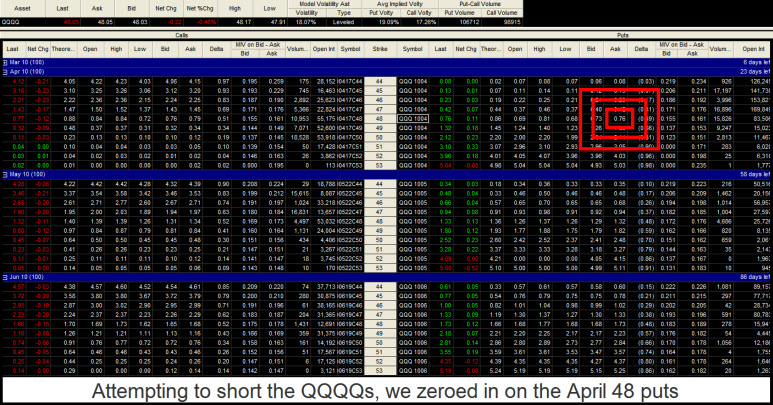
We did all of these things in buying April 48 put options on the QQQQs at a recent swing high. Our entry price was at 0.86, the low of the day, and by the time the closing bell rang, the options had traded as high as 1.22. That represents a theoretical gain in a single day of 46 percent. We can’t lose, right? To fatten our odds even more, we sold half of the position the next day for a gain that reduced the cost basis of the other half to 0.56 per option. Then, we made our first error – a small one, to be sure, but in this game you cannot afford to make even small errors if you want to come out ahead. Our advice to subscribers was to exit another 25% of the position at 1.32, based on a prospective decline in the underlying QQQQs to a 47.09 target. Unfortunately, the QQQQs went no lower than 47.25, and the puts rose no higher than 1.26. So we still hold half the position rather than 25 percent of it, and although it is theoretically profitable based on yesterday’s closing price of 0.76, we find ourselves hoping the QQQQs continue to recede, driving the price of our puts higher. However, we have learned over time that, in the trading business, whenever “hope” comes into play, hopelessness cannot be far behind. A corollary for option traders is that any execution that falls shy of perfection will leave the trader in the same position as a hitter facing a 95 mph fastball when he is behind 0-2 on the count.
(If you’d like to have Rick’s Picks commentary delivered free each day to your e-mail box, click here.)
Rick,
Another Perfect call on ES. Great D target played out just like you called it. I am still lurking in the background here and truly enjoy reading your articles everyday.
Thanks again for all you have done for me, I just love using your hidden pivots.
Mark
&&&&&
Thanks, Mark. Heard on the grapevine that you’ve added some nifty tricks of your own to the technical brew. RA