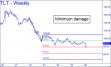
Although T-Bond prices have been skittering sideways for more than three years, a further fall in this U.S. Bond proxy to at least 78.43 seems unavoidable. (Note: The numbers have been adjusted somewhat to reflect the more precise picture afforded by the weekly chart.) This implies that rates are headed higher, since they correlate inversely with T-bond prices. Yields on the 30-Year were at 4.82% when last week ended, but we might expect them to rise to around 5.5% if TLT falls to 78.43, a midpoint Hidden Pivot support. That would seem to be enough to pop the financial bubble, although we shouldn't underestimate Trump's ability to keep it intact for yet more months. _______ UPDATE (Jan 16): A sharp rally toward the end of the week created a minor impulse leg on the daily chart before a relapse on Friday wiped out the gains and then some. Let's see whether bulls can follow up with a C-D leg that surpasses the 88.83 high recorded on December 11. If they succeed, it could turn the short-term picture less-than-dismal.
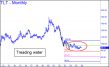
T-Bonds have been treading water since Trump took office. His eagerness to stimulate growth with a gusher of fiscal spending and consumer credit has increasingly weighed on fixed-income markets. However, this has been more or less offset by the President's ability to attract buyers of Treasury debt from outside the U.S. The chart says this precarious balance is about to end with a fall in bond prices and a corresponding rise in long-term yields. At a minimum, TLT is headed down to the red line, a midpoint Hidden Pivot support at 78.05. If yields on the long bond were to rise commensurately, they would hit 5.33%, up from a current 4.79%. That might not seem like much, but it would squeeze the last breath from a consumer economy already suffocating from debt fatigue and persistent inflation. The already shaky housing and auto sectors would collapse, presumably led by a stock market that is filled mostly with hot air. Nor are there any guarantees that the red line on the chart will hold. If it doesn't, and TLT falls to the next logical plateau at 62.23, the damage this would do to the U.S. economy and to our way of life is distressing to imagine. Any spike in rates would be short-lived, since it would quickly deflate the economy into deep recession. Since this would be fundamentally a deleveraging event, investors should not be looking for opportunities at this moment; rather, they should secure their capital in safe-haven assets such as Treasury paper, bullion and utility companies with strong dividend histories. The burgeoning healthcare sector's ability to withstand hard times is not a given, since it thrives now only on the illusion of prosperity. _______ UPDATE (Dec 14): Friday's vicious reversal, which featured the gap-down penetration of a 'hidden' midpoint support,
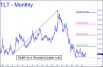
My hardcore deflationist point of view has saddled me with a bullish bias whenever I ponder a T-bond chart. Although this allowed me to catch the October 2023 bottom just off the low, it also caused me to see the nearly two-year dirge that has occurred since as base-building for a long bull market that has yet to materialize. I don't doubt that it's coming, presumably in conjunction with the next recession. But TLT's chart suggests it could take many months before it rises and, inversely, yields begin to fall. In the meantime, look for it to scuddle sideways, with a moderate bias to the downside that would correspond to merely somewhat higher long-term rates. Altering our expectations in this way can help diminish the distraction of believing Trump can do something about it -- i.e., about rates determined by markets, and about high levels of debt that are crushing America's middle class. He can't, and his expansionist, credit-driven economic policies will only exacerbate the bearish trend in bonds. Suppose the small rise in their price over the last two years has completely discounted the global appeal of Trump's bold leadership and the additional demand this has created for U.S. Treasury paper. In that case, it's hard to imagine a bullish surge in T-bonds when the President's inflationary policies produce the opposite of instant economic miracles: stagflation. ______ UPDATE (Dec 3): TLT is breaking down in the context of a bearish head-and-shoulders pattern begun three months ago. This is within the scope of my original tout (see above), which was intended to provide a much more accurate picture for long-term rates than the guys and gals with degrees in economics who toss darts to predict such things. Rising rates and inflation are going to increasingly hurt Trump's credibility and popularity

TLT continues to grind higher, perhaps to deny skeptics the inspiration they need to climb aboard early in this bull market. It is still in its adolescence, too early to predict which tectonic financial event(s) it is signaling. The trend flouts Trump's persistent efforts to cheapen the dollar, if not to say trash it. This is a paradox that I've explained here before, to wit: the president's bold leadership has been attracting hordes of T-Bond buyers from around the world, providing an offset to the fiscal and credit excesses Trump believes will lift the U.S. economy. Grotesquely inflated asset prices belie the fact that, for most Americans, the economy has slipped into a deep, intractable recession. For the lucky winners, a debt deflation and bear market in stocks awaits those whose net worth has soared mainly due to Fed easing. Regarding TLT, don't pass up an opportunity to buy it 'mechanically' on a pullback to the green line (x=89.85), stop 88.45. ______ UPDATE (Nov 7): A nasty, six-day selloff triggered the 'mechanical' buy I'd suggested at 89.85. The futures continued to fall but didn't stop out the position, since the downtrend went no further than 88.88. Maintain the 88.45 stop-loss for now and hope for a push above 90.66, since that's what it would take to put bulls back in charge. A decline that touches the stop would be the most bearish event we've seen in this vehicle since last April.

The bull market begun in May continues to make slow progress as it head-butts resistance at the 91.24 midpoint Hidden Pivot shown. Because bulls have pushed past it slightly, any swoon to the green line would be a 'mechanical' buy. Such weakness would equate to a perhaps fleeting spike in long-term interest rates, which, although unlikely, is not inconceivable. The rally in Treasurys is ironic because Trump's obsession with stimulus has put a great deal of pressure on U.S. debt. However, it is the President's bold leadership that has attracted bond buyers from around the world, reducing pressure on the Fed to mop up paper for which there might otherwise be weak demand. It is a big change from Biden, a walking corpse whose style of governing was enough to give investors in the U.S. and abroad the dry heaves. For your information, a rally to the 94.02 target would equate to a fall in long-term rates from a current 4.60 % to 4.39%. Although that's not enough to shift re-fis into second gear, it certainly would be a positive for the U.S. economy.

T-Bonds got a strong lift from Friday's panicky sell-off on Wall Street. TLT became a good bet to reach p=91.24, at least, but a decisive move through this Hidden Pivot, especially on first contact, would imply more upside to p2=92.63, and thence to as high as D=94.02 over the near term. Although the pattern is a conventional one with a 'C' low above 'A', it is sufficiently compelling to lend authority to the bullish case. Assuming D is achieved, look for stocks to continue lower, with hard selling in the institutionally driven lunatic sector (a.k.a. the 'Magnificent Seven') and in Bitcoin.

This ETF proxy for the Long Bond has generated its first impulse leg since August with a pop above two prior peaks on the weekly chart. The move is not nearly as strong, and it is no reason to break out the bubbly, but it implies the rally cycle begun from 83.30 in May will achieve a minimum 92.91. That is an important midpoint Hidden Pivot resistance associated with a big-picture rally target at 102.52. The target comes from a pattern on the weekly chart begun from 82.42 in October 2023. As always, a decisive penetration of 'p' on first contact would shorten the odds of a continuation to as high as 'D' , but to least p2 (97.82 in this case). ________ UPDATE (Sep 25): The correction should come down to at least 88.08 before TLT turns around, but if it doesn't, I'll need to ratchet down my mild bullishness a smidgen.

Bloomberg and other news sources that despise Trump and wish him ill have been asking with increasing fervor whether a recession is taking hold in the U.S. Of course it is, as any middle-class American could have told you. But in this chart, we have a corroborating detail: long-term rates are headed lower, presumably because of a weakening economy. The two stalls since early July at the red line had seemed to imply that T-Bond futures were trapped in a bearish pattern that might at best produce sideways movement for the foreseeable future. However, this week's powerful blast through the red line, a midpoint Hidden Pivot resistance at 87.88 suggests that T-bond prices will continue to rise at least until D=92.45 is reached. A corresponding drop in long-term rates would yield 4.49%, down significantly from the current 4.68%. This is a high-confidence call, although there is a possibility the decline in rates will stall or reverse at 4.66%, just a hair below.
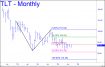
It was nearly three years ago that TLT tripped a sell signal tied to a Hidden Pivot target at 80.84. This ETF proxy for T-Bonds was trading just above 102 at the time, and few could have imagined then that such a grim outlook was justified. The thumbnail chart shows an even darker possibility based on a long-term bottom at 74.38. But the graph also allows for a possible turn from p2=81.20, somewhat above our longstanding target at 80.84. This is what I believe will occur, since a further fall to 74.38, implying correspondingly higher long-term rates, would choke off expansionary pressures long before TLT could plunge to such depths. For now, though, you can use 81.20 as a minimum downside objective.
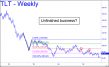
TLT's performance over the last four years has grown increasingly painful to watch, and there are no clear signs this is about to end. In fact, a little more downside remains to complete the pattern shown to D=80.84. Alternatively, I'd need to see an uncorrected thrust above both of the circled peaks to infer that an important reversal is under way. Barring that, we should assume that more downside to at least 80.84 awaits; or if any lower, to 74.79 (! ) (Weekly chart, A= 108.87 on 4/7/23). _______ UPDATE (Aug 22): You can chase boredom by monitoring TLT's passage along the route of the reverse pattern shown. p=86.91 is a good place to bottom-fish by scalping options or the underlying, but we'll also be able to use the pattern to gauge trend strength, such as it is. ________ UPDATE (Aug 31): Zzzzzzzzzzzzzz.


