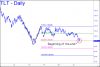
I've featured a scary forecast for this vehicle in the latest Morning Line commentary, but the requisite plunge is not yet a done deal. That's because sellers have hesitated to crush the midpoint support of the pattern shown. It was touched for the first time twice in the last week or so and has begun to creak under the weight of selling, but we shouldn't dismiss the possibility of a rally-out-of-nowhere, since it is always darkest before the dawn. However, the bounce would have to exceed July 31's 'external' peak at 103.33 to generate a promising impulse leg. _______ UPDATE (Aug 13, 11:20 p.m.): Check out my post just now in the chat room. It contains potentially actionable advice using call options. ______ UPDATE (Aug 16, 7:44 p.m.): Stay close to the chat room if you care about this symbol, since that's where the buzz is. It looks like it's about to fall to at least 88.05, the secondary Hidden Pivot shown in the latest tout.
Is Mr. Market about to deliver the coup de grace to bond bulls? It certainly appears that way. They've been getting schmeissed regularly since a frightening few days back in March 2020. At the time, investors were struggling to decide how covid would affect their financial lives. The wild gyrations near the top, followed by the subsequent collapse of Treasurys as yield soared, attests to the fact that they all got it wrong -- and so did everyone else who subsequently jumped in. In technical terms, TLT, an ETF proxy for T-Bonds maturing in 20+ years, is on thin ice. It tested a key support two weeks ago when it came down to the red line, a 'midpoint Hidden Pivot support' that must hold if TLT is to avoid a further fall to the 80.84 target. Although the line has yet to be penetrated decisively, it looks to be giving way. A two-day close beneath it would likely send TLT down to at least 88.05, a last-ditch support. Beneath it lies an abyss that portends a rise in long-term rates to at least 5.5% (as noted here earlier) from a current 4.27%. If there is a bright side to this scenario, it lies in the implication that an all-but-certain debt deflation much more destructive than any consumer inflation we are likely to experience is going to be yet a while longer in coming.
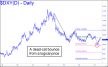
Although we were using a somewhat higher target at 103.50 for this dead-cat bounce, the fact that it reached the green line at 102.80, triggering a 'mechanical' short, warrants shifting our focus once again to the downside D Hidden Pivot at 93.55. That would amount to a 21% correction off the 114.78 summit recorded in September 2022. Keep in mind that although the decline has already taken a brutal toll on the biggest, deepest, most important 'commodity' in the world, it is still merely corrective of the long-term bull market begun in March 2008 from 70.70, and of a shorter cycle begun from a 89.21 high in January 2021 that projects to 119.37. Here's a chart stretching back to 2004 that shows this. Pivoteers will notice that DXY would trigger a 'mechanical' buy that could not miss if and when it comes down to the green line at 96.03. The next big rally cycle would be congruent with the debt deflation that I have long predicted. It will surprise everyone because it is so counterintuitive when seen in relationship to the unprecedented fiscal and monetary blowout of the last five years. However, it will nonetheless wring the life from all who owe, creating a wave of private, public and corporate bankruptcies worse than the cascade of bank failures during the Great Depression.
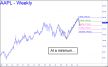
It's refreshing to see AAPL get the crap kicked out of it for a rare change. And there's more to come! But don't think that the chimps that this buy-and-hold no-brainer has made look like geniuses are not salivating over the prospect of accumulating more shares at 'bargain' prices, and of running the stock back up again without expending much effort or capital. Gap openings induced by short-covering will make that possible, just as they have since early in 2020. We can attempt to bottom-fish, but not before the correction comes down to at least p=172.24, the Hidden Pivot midpoint support of the reverse pattern shown in the chart. This implies the broad averages have further to fall as well. If the stock ultimately plummet to d=146.25, that would represent a 26% correction off the all-time high -- a mini-bear market within a longer-term bull that projects as high as 253.96. _______ UPDATE (Aug 7, 9:54 p.m.): Are DaBoyz awesome, or what?? They don't call them the Masters of the Universe for nothing. It seems They have finally figured out how to harness AAPL's lunatic energy on the way up while cutting it loose when it falls. If you'd told me that a $3 trillion stock was about to plummet by 10% in just a few days as the broad averages sad idly by, twiddling their so-to-speak thumbs, I'd have said "No way!" And yet...
Last week's steady, moderate decline tripped a theoretical sell signal at the green line (4535). It also brought into useful focus a corrective reverse pattern that promises to give us a solid handle on any trading opportunities that develop on the way down. This would be for trades both bullish or bearish, and we could confidently expect to make money, as we often do, even when we are wrong. The first and most obvious opportunity would entail bottom-fishing at the pattern's 4436.00 midpoint support, since a tradeable bounce from there appears all but certain. If the implied rally doesn't get very far and the futures relapse below p=4436, that would be warning of a further drop to as low as 4237.75. That is what I expect, but we'll position ourselves to profit regardless, and no matter how devious and evasive this correction becomes.
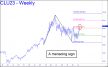
Last week's thrust above an important midpoint Hidden Pivot resistance at 80.61 was a menacing sign, since prices at the pump were already in a steep climb since dipping very briefly below $3 a gallon in some states just weeks ago. I bought 93 octane as cheap as $2.89 within the last two weeks in North Carolina but was surprised to pay $3.99 in a South Florida Costco this morning. If Friday's close for September crude above 80.61 portends more upside to D=98.82, we will likely see $5 gas. Taxifornia has already experienced much higher prices than that, but it would be unfamiliar to motorists in the East outside of New York and some other blue states that have increasingly been penalizing gas-fueled vehicles.
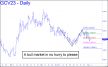
We need to keep reminding ourselves that even during those frustrating cycles when gold is being treated like garbage by investors, it is still in a long-term bull market. However, it has been so slow in developing that even hard-core bulls will find their patience tested to the limit. Accumulation is the strategy of choice, coupled with perseverance and discipline to make the ordeal seem worth the wait. To that end, we should be prepared for the correction begun from May's all-time high at 2112 to come down t0 at least 1908 before bulls are sufficiently rested to mount another charge (of the Light Brigade?). The corrective segment shown in the chart has yet to trip a 'mechanical' short, but it would on a rally to 1983.40. Check for details in the chat room if the set-up should ripen, since the $10,000 theoretical entry risk on four contracts can be cut by 95% if we do it right.
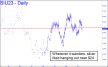
Although silver has grazed over a nearly $12 range for the last two years, it prefers to hang out near the $24 midpoint. To be sure, it is in a bull market with the potential to reach $36 or higher. But it seems in no hurry to get there, and it will likely remain an accumulation opportunity between 17 and 23 for the foreseeable future. A breakout would be signaled at 27.36, a tick above an important 'external' peak recorded by the September contract in March 2022. More immediately, a reverse pattern promises good odds for bottom-fishing at 22.98. That is the 'd' target of a= 24.83 on June 9. _______ UPDATE (Aug 8, 9:49 p.m.): Sellers bombed the 22.98 Hidden Pivot support, implying Sep Silver is likely to grope its way down to June's 22.34 low in search of support.
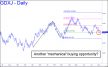
Will GDXJ's dip last week beneath the green line (x=35.58) generate another profitable 'mechanical' trade? This has already happened twice if you count the May 25 low at 38.79 that missed touching the green line by a relative smidgen. For purposes of bottom-fishing, however, we needn't risk much, even if this vehicle is destined to fall beneath C=32.25 of the big, bullish pattern that promised to deliver 45.56 since March. It is a promise that we should no longer take too seriously, given this symbol's punk performance since early April.
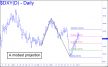
I'm not a big believer in this rally, so I've used a modest pattern to project a potentially important top in the uptrend, now three weeks old. It is slightly lower than a 103.50 projection given here earlier that was related to some previous highs. I'd suggest shorting at D=103.24, but there may be a 'mechanical' buying opportunity first at x=100.50. If it sets up correctly with a low-risk, reverse-pattern trigger, plan on a one-level ride but no more.


