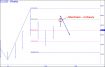
Trump has made a deranged mess of crude's chart, although I have displayed only a small, simple piece of it to illustrate this week's tout. It implies that Sep Crude should be shorted if it hits the green line (x=87.81), and that a 93.51 stop-loss just above the pattern's 'c' high be used to manage entry risk. (I have obscured the pattern's origins for proprietary reasons.) I am recommending the trade only to subscribers who know how to craft a 'camo' trigger to enter. It is predicated on a fall to 70.72, the 'd' target. 'Camouflage' entries are discussed in the Hidden Pivot Course I've made available free to all legacy subscribers and new ones who sign up for a full year. The course once sold for as much as $2500 and was conducted "live" around the world.
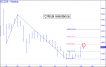
We may soon know whether gold is back on the recovery path or even the warpath. It all depends on how bulls handle the 4530.10 midpoint resistance shown. Last week's timid rally was a step in the right direction. Now, if they impale the Hidden Pivot, and especially if they close this erstwhile brick above it for two consecutive bars, that would be strong evidence of a resurgence capable of powering the futures not only to 5000 but also to a test of January's record 5781.
Although we used to feature edgy market commentaries in this space, the time and effort spent crafting them is now devoted to making the Rick's Picks Trading Room an absolutely unbeatable source of timely, profitable ideas for novices and professionals. I must also confess that your editor was deeply tired of having to write regularly about a stock market energized by clueless money managers whose only trick is recklessly throwing Other People's Money at some moronic investment-theme-of-the-week. Truth to tell, having to take the stock market seriously every week wore me down. You know it and I know it: It's just a giant con-job, created to enable certain people to make untold sums of money without having to lift a finger or get their hands dirty. You should still check here weekly, though, since I will continue to post links to my latest interviews and to offer visual enticements designed to entertain, enlighten and even warn you. Much of it will come from YouTube, since their video catalog is endlessly fascinating and vast. Submissions, including home videos, are welcome and should be sent to this address. To view this week's just-for-the-fun-of-it offering, click here and watch Australian dancer PeachyFeverr (pictured above) do her wonderful thing. Unlike last week's fake diver, she is the real deal. Subscribe Free! The analytical 'touts' below, overhauled each Sunday and updated 24/7, will continue as always, as will their barbed emphasis on the similarities between Wall Street and sleazy carnival midways. The unsettling accuracy of our trend calls and price targets is well known and a matter of daily record; it must be observed up-close to be believed. Sign up for a free trial with access to all site amenities by clicking here (no credit card needed). Then click here for my most recent interview
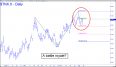
One might think manipulating yields on the Ten-Year Note would be beyond the reach, even, of Donald Trump and those who serve him in the shadowy corridors of financial power. And yet, each time the interest rate moves in earnest toward the psychologically hazardous 5% level, it swiftly retreats as though blocked by some unseen force. With the national debt creeping up on $40 trillion and the financialized, high-leverage economy going gangbusters, there is no logical reason why long-term rates should not continue to waft higher instead of stumbling and tumbling as they continue to do. A crucial test is not far off in any case, since a breach of the 4.58% 'p' support shown in the chart that was narrowly avoided last week is still an imminent possibility. If it happens, that would signal downforce capable of pushing rates to the 4.42% target shown. It would provide a breather for a badly overheated economy in which borrowers are in desperate need of respite. _______ UPDATE (Aug 15): Rates on the Ten Year Note ended the week marginally higher after aborting a downtrend that might have offered borrowers, including the U.S. Government, a hint of relief. They were ascending toward the 47.13 Hidden Pivot resistance shown here, but it will take an energetic push past it to suggest there's power enough to get to 5%.
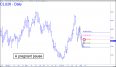
Friday's muted rally stalled just a penny from the 78.78 midpoint Hidden Pivot resistance shown in the chart. This could hardly have surprised, since none of the wack-os who trade crude could conceivably know what kind of fake rabbit Trump will pull out of his hat over the weekend. By saying the ink was nearly dry on a supposed deal with Iran to open Hormuz shipping lanes, Trump has further eroded his credibility in matters of international diplomacy almost to the vanishing point. Saturday's headlines note an Iranian missile attack on a U.A.E. tanker, news that hardly squares with Trump's bullshit and blather last week about an imminent cease-fire. For my part, I will not even hazard a guess as to whether crude oil traders will greet the new week with a push past 78.78. If they do, it will clear the way to at least 83.33, with a corresponding, economically destructive upsurge in prices at the pump, and, eventually, in the price of virtually everything.
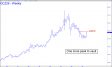
Did gold's bear market end with the 4016 low recorded a month ago? We'll likely have a definitive answer next week if the powerful upthrust of the last two days continues, exceeding the 4465.90 peak shown. That would mean the futures had exceeded two 'external' peaks on the weekly chart without a pullback, indicating that an exceptionally powerful impulse leg is in progress. It would presumably be strong enough to break the back of a bear market begun from a record 5782 last January. The minimum upside target thereupon would be 4819.30, still well shy of the old peak but a good start on it. Check the chat room for precise guidance if the futures should swoon, since that could set up an excellent buying opportunity down near 4200.
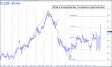
Trading in NYMEX Crude won't start for another hour, so I've had to imagine a pattern to predict how things might turn out. It is a foregone conclusion that quotes will open significantly lower, since Trump, as fully expected, has announced on a Sunday yet another ceasefire. This dog-and-pony show continues to impress because of what I call the "next idiot" theory (which I've explained many times in the chat room). It holds that if there is breaking news which a trader working at 305 Wacker Drive believes will cause his colleagues at 307 Wacker Drive to sell crude contracts, then he, too, is obliged to sell or face an avalanche. This is irrespective of whether anyone actually believes that Trump's weekly, ginned-up announcement about "talks" will cause peace to break out in the region or even ease the tense situation in the Strait of Hormuz. Allowing for the 'next-idiot' effect to determine this afternoon's opening price, I've imagined an initial bar that has Sep Crude trading down to around $81, about $5 or $6 lower than Friday's settlement price. I doubt the selling will be much worse than that, implying the bullish pattern projecting to as high as 91.70 still holds. That is what I expect to happen once it becomes clear by mid-week or so that Trump's cessation of air strikes against Iran has, as we might have expected, achieved nothing. _______ UPDATE (Aug 3, 9:50 p.m.): The futures have come to life in after-hours trading, thrusting to within 12 cents of the 81.34 profit target of an explicitly detailed trade I posted in the chat room early Monday morning. If you held a position after the regular session ended this afternoon, you should be out of at least half of it. The 84.24 'd' target remains viable
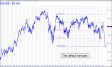
Although DaBoyz could easily short-squeeze this gas-bag to new record highs with just a dollop of fake good news, I've presented a chart that is somewhat bearish. The 7266.00 target lies just 3.5% below, and even though the tedious struggle between bulls and bears has yet to achieve it after six weeks, there is no reason to presume it will not be reached eventually. Bottom-fish when the futures get there, but be sure to use a 'camo' trigger, since my merely mentioning the target in print is likely to queer its magic and attract some clowns and Goldman algos. For the record, I have been won over by a strategy used successfully by chat-roomer 'Nick the Greek' that's pretty simple: short this hoax every time it pokes its greasy little snout above the waterline. Nick's stops are wider than I would recommend, but his tactics seem to be working. I have yet to adjust to the shift to a bear market myself and am still bottom-fishing stocks like TSLA out of habit when they are falling like cinder blocks. On Nick's inspiration, though, I hope to come around, and soon. _______ UPDATE (Aug 3, 12:02 p.m.): ES has easily exceeded a minor 'd' resistance at 7598.75, implying it will take shorts to the wire with an assault on June 15's 7648.75 peak. That is also the 'C' high of the bearish pattern projecting down to D=7266 (see above). If the vicious little sonofabitch head-fakes above June 2's record 7693.75, I will do my utmost to nail a shortable top for you. This should be relatively easy, since the clowns, droolers and algos will all be pretty freaked out at those unaccustomed heights
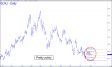
I gave GDXJ the benefit of the doubt when last week ended, but all it did was add to the disappointment we've felt waiting and waiting...and waiting for gold to show a pulse. I set a low bar, and GDXJ didn't have to do much to turn the intraday charts short-term bullish. Alas, two falsely-signaled rallies sevened out, and so I've switched to a bearish pattern that projects more downside to 86.60. I've aired another that implies even lower depths will be plumbed, down to 82.46 over the next 6-8 days. For now, though, let's take the bad news one target at a time. A 105.95 print would bull things up a bit, but let's not get excited until it happens. ______ UPDATE (Aug 8): Last week's effortless stab through adamantine resistance at 106.67 all but guarantees the 123.50 target will be reached. My hunch is that there is enough power in this move to push GDXJ easily past that target. However, buyers would still need to exceed the circled 'external' peak at 136.55 to reactivate the larger bullish pattern (A= 87.35 on 11-7-25) and its 159.97 'D' target.
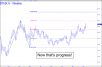
We've been using 4.82% as a minimum upside projection, but it's time to shift the target to the 5.09% Hidden Pivot shown in the chart (see inset). The erratic ascent of long-term rates has been making headlines lately, but Rick's Picks subscribers have been expecting them to hit 5% for nearly a year. The crazed bull market has acted as though it doesn't care, but it soon will—or rather, must—demonstrating its concern with a stunning decline. Nothing spells big trouble for the U.S. economy like 7% mortgage rates that coincide with the highest home prices in history. The Ten-Year Note hasn't been at 5% since the Great Financial Crash of 2008-09. Although the crash itself caused rates to recede quickly to 4%, we may not be so "lucky" this time. If you haven't done so already, time is growing short to secure your assets—and your household—against a catastrophic event that will rebuke financial excesses that have been piling up over decades.


