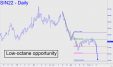
July Silver tripped a promising short at the green line on May 27 that is showing s small profit. Friday's swoon did not quite reach the red line (p=21.12) where half the position might have been covered 'by-the-book', but the trade still looks likely to work. We'll be better able to judge how likely a further fall to D=18.90 is over the next few weeks, but the A-B impulse leg is steep enough to imply the target will be achieved. _____ UPDATE (Jun 16, 10:36): The short could have been covered for a $6600 profit at p=21.37, but if you still hold a partial position, exit now.
As if the thimble-riggers at the Fed didn't have enough to worry about, the dollar turned rabid last week, threatening to transform America's still-undeclared recession into a downturn for the history books. The greenback's rally pushed the price of U.S. goods even higher for foreigners while increasing the cost of fuel that they pay for mostly in dollars. In theory the dollar's strength should have alleviated pain at the pump for U.S. consumers. Unfortunately, however, with the cost of gas and diesel fuel thrusting to mind-numbing new highs each week, the effect has been so muted as to be barely noticeable. Wall Street has noticed the gathering storm, however, and is doing everything possible to distribute stock to the rubes before pulling the plug. Last week, for instance, Amazon was trading down around $110 a share following a 20-for-one stock split. The idea that stock splits are bullish is a pernicious lie that has gained currency because most investors tend to think that more of anything is better. Now widows and pensioners who owned just a few shares of AMZN at $2000-plus per now have twenty times as many shares. How fabulous is that? They naturally expect those shares to rise eventually to their pre-split price, which would not be unusual in a prolonged bull market. But we are quite possibly in a bear market now, and the outcome may not be so felicitous as AMZN's peanut gallery might imagine. Whatever the case, you can count on insiders to unload as much of the stock as they can now that shares have become affordable for the masses.
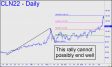
There's no relief in sight for gas prices that seem headed to at least $10 gallon. The chart above suggests July crude will likely hit $128 this week or early next, a whopping 7.5% gain over last week's high. But watch out if the futures shred their way past this Hidden Pivot resistance, since that would portend a continuation of the trend to $140, a target first drum-rolled here several weeks ago. It's a safe bet that Californians will be paying $10 or more for gasoline by then, even if far fewer of them are driving. Realize that it is not consumer demand that has been pushing up prices, or even conspiratorial constraints on supply, but rather a flood of speculative money into energy resources as a hedge against inflation. The irony is that the coming price collapse in crude will be part of a deflationary tsunami that wrecks the banksters' moronic shell game. It will occur simultaneously with a real estate collapse that has already begun. Indeed, bidding wars for homes appear to have ceased due to the steep rise in mortgage rates, record-high prices for homes, a dearth of inventory and a scarcity of qualified buyers. These factors have created perfect conditions for a real estate collapse. No Escape Inflation in energy and real estate are similar in that neither contains an escape hatch for investors. Because energy prices cannot continue to rise without eventually throttling the economy, the rally is doomed. But when prices finally plunge, as they must, that will suck the air from a $2 quadrillion derivatives market that was largely built using energy resources as collateral. The collapse in mortgage-backed securities did the same thing to the banking system in 2007-08. This time, although tens of millions of homeowners are sitting on huge paper
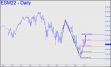
The futures wasted a week of our trading lives screwing the pooch, failing even to trip a 'mechanical' buy at the red line, let alone at the green as we prefer. This implies that Friday's weakness was just noise and that ES remains bound for the 'D' target. I've raised it a tad, to 4309.00, to correct an inscrutable error that I blame, as I am wont to do, on quirks in the Tradestation platform. You can use 4309 as a lodestar for bull trades, since the implied 200 points of upside leaves plenty of room for profit. The pattern looks too obvious, even though it's a reverse ABC, to allow a precise and painless short when D is reached. However, I still like it as a place to attempt shorting, and I would therefore suggest using a 'camo' trigger on the very lesser charts when the time comes. Stay tuned to the chat room and your email 'Notifications' if you would like further guidance on this. Please note that the unexpected swoon to x=3932.88 would trigger an enticing 'mechanical' buy, stop 3807.00. ______ UPDATE (June 6, 5:21 p.m.): Cancel the trade, since there's not much swooning going on. It could be distribution, actually, and there's no point in exposing ourselves to it. _______ UPDATE (Jun 10, 12:13 a.m.): A drop to the green line (x=3932.88) would trigger a 'mechanical' buy, stop 3807.00. I am not recommending the trade, however, even executed with 'camouflage', because of how sickly the futures looked all week. Ahead of the weekend we should be doubly cautious.
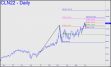
We've been using 140.12 as a big-picture target, but let's focus on a lesser one at 127.94 for now. Friday's tentative stab through the 119.57 midpoint resistance associated with the latter number, a Hidden Pivot resistance, was not sufficient for us to infer that a continuation of the rally to at least 127.94 is a done deal. However, a pullback to the small pattern's green line would trip an enticing 'mechanical' buy. Since entry risk would exceed $4k per contract, the trade is suggested only for those who know how to cut the risk down to size with a camouflage set-up. _______ UPDATE (Jun 16, 10:40 p.m.): During today's 'requests' session, I raised the possibility that crude had made an important top earlier this week at 123.68. If so, it will likely be found to have been attributable to the collapse of China's manufacturing sector and the prospect of global recession. Let's move to the sidelines for now.
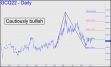
The chart implies that I am cautiously bullish, but that's a small exaggeration. The recent dip below 1800 seems to have exhausted sellers for the time being. However, bulls, such as they are, appear to lack the energy or enthusiasm for turning things around. For starters, they would need to surpass early May's 1917.60 peak to generate a bullish impulse leg on the daily chart. In the meantime, there's no point getting excited about gold's prospects until this happens. A relapse that breaches the 1792.00 low would have very bearish implications. Alternatively, if gold shocks with a powerful rally that blows up p=1937.20, we could justifiably take an earnest interest in the 2082.30 target, which is theoretically in play because the green line has been touched.
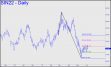
I'm using a more conservative pattern than in gold to project higher prices, since the May bottom at 20.42 was even more dispiriting than the corresponding one in AU. So far, the most bullish thing you could say about the rally is that it did not give us an opportunity last week to bottom-fish 'mechanically' at the green line. On the other hand, penetration of p=22.17 to the upside has been tentative and labored so far, implying that even the relatively modest 'D' target at 29.93 is not a done deal. I will provide trading suggestions if there appears to be interest in bullion in the chat room, but I am available to vet your ideas in any case.
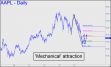
AAPL got pounded Friday, but it would take another drubbing to bring it down to the green line at 139.99, where the stock would become an enticing 'mechanical' buy, stop 132.60. There would be no guarantee of a rebound to D=162.12, since the uptrend begun two weeks ago has struggled to get clear of the midpoint Hidden Pivot resistance, 147.37. I suggest watching from the sidelines for a couple of days, since getting aboard in a place other than the green line would be labor intensive.
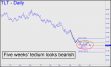
Five weeks of tedium have etched a picture of distribution on the daily chart (inset), presumably culminating with a dive at any time to the 108.74 target of the pattern shown. This suggests that my forecast for a major top in Ten Year rates at 3.24% may eventually be borne out. The so-far high at 3.17 reached on May 9 was close enough for us to have considered the target fulfilled. However, we should keep an open mind toward the possibility of a head fake corresponding to an important peak in rates. If so, it would portend deepening recession for the U.S. and the world. ______ UPDATE (Jun 13, 10:53 a.m.): I've adjusted the target upward to 3.56 using a less gnarly pattern in $TNX.X, a vehicle that tracks interest rates tied to the Ten-Year Note.
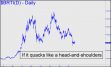
I have little to say about Bertie, other than that it continues to be as interesting as a bowl of grits. Bitcoin's deep-pocketed sponsors seem capable of maintaining a cruising altitude just below $30k indefinitely, and of popping it a few thou whenever conditions are right and they feel like mau-mauing skeptics. Although the May 12 spike down to $25k generated a quite powerful impulse leg, bears have been unable to do anything with it. For that reason, I am taking the obvious head-and-shoulders pattern as evidence that bitcoin is consolidating for a leap in a month or two to $65k or so, although not to new all-time highs. ______ UPDATE (June 11): Zzzzzzzzz. Head-and-shoulders pattern aside, I am unable to imagine a reason for such speculative fervor as that target would imply. It would reflective crazy-bullish sentiment that seems unlikely to return to securities markets for a long, long time. ______ UPDATE (June 12, 11:43 p.m.): I'd hate to be mistaken for a bitcoin bull just because I was fleetingly intrigued by an incipient head-and-shoulders formation that has turned to ca-ca with tonight's so-far $4,000 dive. I'd put out a 14,751 target in May which remains valid. To restore my bear bonafides, here's a pattern with a 9507 target I'll start liking if sellers shred the midpoint Hidden Pivot support at 20,930. For now, that can serve as our minimum downside objective.


