
The May contract got a strong push last week to the 'secondary' Hidden Pivot (p2) of a pattern with the potential to deliver more upside over the near term to d=33.635. The initial penetration of p=30.590 was hesitant, but once the futures got past the resistance they never looked back. Assuming silver plays hard-to-get, be ready to buy a pullback to p=30.590 'mechanically'. Your bid at that price would take a stop-loss at 29.575, so a 'camouflage' trigger of lesser degree is suggested. An easy and decisive move through d would portend more upside to 36,769, or even 39.844.

GDXJ struggled for eight months to push decisively past midpoint resistance at 49.02, so there are no guarantees that it will easily reach the 72.23 target, especially straightaway. More likely is a ratcheting move to the target that requires 6-8 weeks to complete. Gains from one peak to the next will likely be smaller than theoretical losses incurred from holding shares from trough to trough, but that also means positions can be 'worked' with covered writes on the way up to squeeze additional yield from your position.

The failure of sellers to push this air ball down to the 70,417 target is mildly bullish, but it will take an upthrust exceeding the two 'external' peaks recorded on March 24 and April 2 to put bulls back in charge. The peaks lie, respectively, at 88,530 and 88,805, close enough to form a double resistance that will require short-covering to penetrate. Once that happens, the 94,850 point 'C' will magnetically draw this vehicle higher. There is a theoretical path to as high as 133,759 (weekly chart, A=49,050 on 8/10/24), but we'll put that out of mind until such time as p=104,090, just beneath the record 108,388, is achieved.

Quotes for crude have turned up from an odd place, well shy of a 'secondary' Hidden Pivot support at 49.25. Odds of a relapse will depend on how bulls fare pushing past a minor Hidden Pivot resistance at 62.22, and another at 65.68 (60-min, A=56.42 on 4/9). If both of these numbers are exceeded, especially decisively, then last week's low at 55.12 may prove to have been an important one. For now, set screen alerts at 62.22 and 65.68 to determine whether the bounce is likely to get legs.
[Just ahead of last Monday’s steep plunge, I predicted here that an S&P reversal from 4820 would mark the end of the bear market. So far, SPX has rallied 646 points off an actual low at 4835. Bulls are not yet out of the woods, however, since a relapse could occur at any time. The stock market remains spooked by Europe’s dumping of Treasury paper in a deliberate attempt to destabilize the U.S. financial system. With the EU economy swirling down the crapper, the globalists are desperate to force Powell to ease in order to rescue big hedge funds that were leveraged up to their eyeballs with Treasury paper. So far, the Fed chairman has stood his ground, and it appears the EU attempt to sabotage the U.S. bond market will fail. In any event, the commentary below will continue to run until such time as the S&Ps crash the 4820 Hidden Pivot and prove me wrong. If you keep my thesis in mind — that as long as 4820 holds, there will be no recession, nor any harmful effects from tariffs — you will be better able to judge the jaw-dropping stupidity of the mainstream media’s coverage of Trump 2.0. Because of their blind hatred of the president, the eggheads, reporters, pundits and benighted editorialists will continue to get everything wrong until stocks are once again soaring to new all-time highs. RA] *** A word of advice if you’re looking for bankable information on the direction of the economy: tune out the mainstream media’s cavalcade of Trump-deranged bozos and focus on the 4820 target in the SPX chart above. Think of it as Trump’s lucky number, but also a very good place for these all-too-interesting times to find temporary equilibrium. That is my worst-case target for a bear market that many believe is
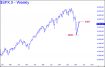
[Just ahead of last Monday's steep plunge, I predicted here that an S&P reversal from 4820 would mark the end of the bear market. So far, SPX has rallied 646 points off an actual low at 4835. Bulls are not yet out of the woods, however, since a relapse could occur at any time. The stock market remains spooked by Europe's dumping of Treasury paper in a deliberate attempt to destabilize the U.S. financial system. With the EU economy swirling down the crapper, the globalists are desperate to force Powell to ease in order to rescue big hedge funds that were leveraged up to their eyeballs with Treasury paper. So far, the Fed chairman has stood his ground, and it appears the EU attempt to sabotage the U.S. bond market will fail. In any event, the commentary below will continue to run until the S&Ps crash the 4820 Hidden Pivot and prove me wrong. If you keep my thesis in mind -- that as long as 4820 holds, there will be no recession, nor any harmful effects from Trump's tariffs -- you will be better able to judge the jaw-dropping stupidity of the mainstream media's coverage of Trump 2.0. Because of their blind hatred of the president, the eggheads and benighted editorialists will continue to get everything wrong until stocks are once again soaring to new all-time highs. RA] *** A word of advice if you’re looking for bankable information on the direction of the economy: tune out the mainstream media’s cavalcade of Trump-deranged bozos and focus on the 4820 target in the SPX chart above. Think of it as Trump’s lucky number, but also a very good place for these all-too-interesting times to find temporary equilibrium. That is my worst-case target for a bear market that many believe is
[Just ahead of last Monday’s plunge, Rick’s Picks predicted that an S&P reversal at 4820 would mark the end of the bear market. Here’s a chart that shows the 661-point rally that occurred off an actual low at 4835. Bulls are not yet out of the woods, however, since a relapse could occur at any time. The stock market remains spooked by Europe’s dumping of Treasury paper in a deliberate attempt to destabilize the U.S. financial system. With the EU economy swirling down the crapper, the globalists are desperate to force Powell to ease, ostensibly to rescue big hedge funds that were leveraged up to their eyeballs with Treasury paper. So far, the Fed chairman has stood his ground, and it appears the EU attempt to sabotage the U.S. bond market will fail. In any event, the commentary below will continue to run until the S&Ps crash the 4820 Hidden Pivot and prove me wrong. If you keep my thesis in mind — that as long as 4820 holds, there will be no recession, nor any harmful effects from Trump’s tariffs — you will be better able to judge the head-slapping ignorance of the mainstream media’s coverage of Trump 2.0. Because of their blind hatred of the president, these clowns will continue to get everything wrong until stocks are once again soaring to new all-time highs. RA] *** A word of advice if you’re looking for bankable information on the direction of the economy: tune out the mainstream media’s cavalcade of Trump-deranged bozos and focus on the 4820 target in the SPX chart above. Think of it as Trump’s lucky number, but also a very good place for these all-too-interesting times to find temporary equilibrium. That is my worst-case target for a bear market that many believe is only just getting started. As a die-hard permabear

It has always amused me that the business shows feed viewers a steady stream of heavyweights from the Federal Reserve and the biggest banks in the world to provide interest-rate forecasts that generally have proven no better than dartboard guesses. Rick's Picks, on the other hand, has not only gotten the trends and turning points precisely right, but with forecasts that went sharply against the consensus. And so we were hardly surprised when steeply falling rates last week ticked off yet another downside target at 3.96% that has been featured here since early in 2025. If you know a benighted producer at Bloomberg, please give her a nudge to let her know that rates on the Ten-Year will keep falling, at least until they reach the 3.674% target that has been featured here since way back when.

A 4820 target I've billboarded in SPX says lower prices are coming, but that shouldn't discourage us from identifying countertrend opportunities as this vehicle works its way lower. The pattern shown is theoretically suited to that task, but it keeps signaling money-losing 'buys' at the green line. Let's use it instead to tell us when a meaningful bounce might be under way. It will do so by popping above p decisively, but you'll need to adjust p with each new 'c' low to use the pattern effectively. It will be worth the work because any textbook 'mechanical' buy signaled thereafter is very likely to make you money.

This pattern, with a 353.96 bear-market target, is such a gem that I hate to publish it, since putting it on the home page, even visible only to paying subscribers, could queer its gnarly perfection. It has signaled winners at every turn: shorting at the green line conventionally; shorting there 'mechanically' a week later; and now, betting all your marbles on a tradable turned from D=353.96 -- a conventional target, no less! Trade this however you please, since it cannot miss. I'll be looking to naked-short puts myself, but also calls until the target is reached. It is guaranteed. _______ UPDATE (Apr 8, 1:18 p.m.): MSFT gapped below the target before launching into a nearly $30 rally. The island reversal this left on the intraday charts is bullish, but it looks like the stock will need to correct down to 352.65 to find good traction. It is currently trading for around 361 and falling. _______ UPDATE (Apr 9, 9:57 a.m. EDT): The stock needs one more relapse to fulfill the 332.11 target shown. My strong gut feeling is that it will get there.


