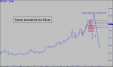
The chart summarizes various scenarios for Silver that can be inferred from the Hidden Pivot Method. I've previously identified the 103.215 target, a major 'hidden' resistance that could conceivably cap the steep bull cycle begun from around $50 in late November. But first, the current correction is likely to come down to at least 84.645, the 'd' target of the rABC pattern shown. If the slide continues, prepare for a further retracement to as low as 80.285, the 'd' target of a larger rABC pattern that goes back to the minor peak recorded at 82.76o on December 29. A renewed upthrust could ensue from either number, and its strength presumably would be easy to gauge based on price action at midpoint Hidden Pivots of varying degree. Two further possibilities are suggested: a runaway bull market, which is what the trend would become above 103.215; or a possible nascent bear market after a breakdown beneath d=80.285. The targets mentioned above should be considered as pre-empting any identified earlier. _______ UPDATE (Jan 19, 1:07 a.m.): Silver did its rude thing again Sunday night, blasting off to new highs while bulls and short-covering bears waited in vain for a smash to produce some bargains. Now it's on its way to at least 96.470, another downpayment on our ripening target at 103.215.

There is nothing to suggest this vehicle will not reach the target at 135.90, a once-unimaginable milestone that was first signaled in mid-November when GDXJ crossed up through the green line. The subsequent, confident move through the red line, a midpoint Hidden Pivot resistance at 111.63, significantly shortened the odds the target would be realized. This now appears all but certain, and although it would be implicitly bullish for gold, we shouldn't be too concerned if the respective moves appear to be somewhat out of synch. The ABCD pattern is sufficiently clear to imply that the correction following the final run-up to the target could be long and painful. _______ UPDATE (Jan 20, 11:10 a.m.): It is headed to 139,55 at least, or to 144.86 if any higher. Currently 134.68, just off the high.

The chart is featured in the current commentary, but let me add a cautionary note for subscribers only. The 50K milestone that lies just a hair above Friday's record settlement closely coincides with the 49,355 'D' target of the pattern shown in the inset. My gut feeling is that the so-far slight overshoot of the target happened because traders were intent on hitting 50K regardless of any Hidden Pivots that may have stood in the way. We should infer in any case that there is double stopping power here, and that a significant pullback is distinctly possible, even if it turns out not to have been the start of a bear market. Since we should always have a higher target ready just in case, the 53,022 Hidden Pivot noted in the upper-right corner of the chart can serve that purpose. Assume it will be achieved if the Indoos close for two consecutive weekly bars above 50,600. _______ UPDATE (Jan 30): The Dow has been jerking bears' chains with a Wile E. Coyote dance inches from the potential top I'd warned about at 50,000. Sellers will need to penetrate the red line (p=48,270), however, before I can diss this gas-bag with enthusiasm and still sound credible. Even then, it would be a good bet to fall no further than D=46,918, hinting that the broad averages, unlike bullion, are in shallow correction that will cause little pain or even anxiety. _______ UPDATE (Feb 8): The Dow broke out last week, but the follow-through could be less than spectacular. This chart shows a compelling Hidden Pivot resistance at 50,819, just 704 points, or 1.4%, above Friday's closing price. _______ UPDATE (Feb 20): No change: 50,819 still looms as a potentially important number.

Since nothing seems to slow this beast down, I've used the 'D' target of a pattern stretching back to mid-November to project minimum upside to 7163.25 over the near term. Although bulls did not penetrate its p midpoint decisively in their first two attempts, they've shown irresistible power for so long that we have to assume that any rally target will be achieved. Even so, this one is sufficiently compelling that there is likely to be tradeable resistance there. Short it with a small-interval (i.e., 'camo') trigger, but be prepared to cover at least a portion for a small profit.
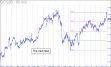
Bulls should enjoy smooth sailing up to the 4567.20 target shown. Allow for an alternative target four points higher, since I've used an irregular point 'A' low to construct a slightly reversed pattern. There should be little resistance at either Hidden Pivot, since the old high at 4584.00 beckons a test. The first obstacle above the peak is 4607.00, a 'D' Hidden Pivot derived from A=4319.70 (January 2) on the same chart. Since that number is unknown to other traders, it should provide an accurate 'read' on trend strength. You can short it with a 'camo' trigger if you are familiar with the tactic. ______ UPDATE (Sunday, 8:52 p.m.): Gold has opened more than $100 higher this evening, exceeding my 4607.00 target (see above), but not decisively. An update is warranted, however. Here's a link to a chart that should be able to confirm or refute Avi Gilburt's dramatic prediction of an imminent, major top in bullion. (See last night's chat room post from 1:59 a.m.) The new chart shows two bullish patterns in play. The 4538 midpoint Hidden Pivot of the larger one has already been exceeded, but not with enough force to 'guarantee' that D=5176.00 will be reached. The smaller pattern has a midpoint resistance at 4625.75 that is about to be touched. If the futures blow past it, that would greatly shorten the odds of a further push to D=4967.00. In any event, p=4625.75 is where our focus should be right now.

The futures punched through the 79.38 midpoint Hidden Pivot shown on Friday, but when they settled above it, that all but guaranteed the uptrend will continue to at least 85.235, the 'D' target of the pattern. Because the point 'B' high is pure 'sausage', I've made certain to start the pattern with a distinctive one-off 'A' low. For that reason, D=85.235 should show precise stopping power that can be shorted with a 'camo' trigger. Any further progress to the upside would likely encounter new resistance at 86.860, the target derived from sliding 'A' down to December 31's 69.575 low. It would be shortable as well. _______ UPDATE (9;38 a.m.): The 85.235 target has stopped the rally, but not precisely and probably not for long. _______ UPDATE (Jan 13, 9:17 a.m. EST): March Silver's decisive push through p=86.235 this morning has put D=103.215 solidly in play: https://bit.ly/3NHjcnz
GDXJ's ascent over the last month left quite a mess on the hourly chart, but it all fits so nicely within the 13-point channel shown that we can probably rely on it for predicting important turns both above and below. An ambitious target at 135.90 has served as a bullish lodestone for quite a while, and even though I am growing increasingly skeptical that it will be reached any time soon, meaning with the sensationally steep slope of the last six months, I'm ready to set my skepticism aside if this vehicle vaults the trendline and holds above it for at least two days.

Bitcoin tallied enough votes to remain on the list, but that doesn't mean it will get any respect just for being here. This week's chart avoids visualizing an ABCD pattern that would probably prove too conventional for a rabid badger like this one. Instead, I have extrapolated an imagined head-and-shoulders that follows from the suggestive homunculus traced out so far. If it materializes as imagined, we should see a potentially important top near 113,000 in April. And what a tedious slog that would be --unsatisfying for bulls and bears alike, since the former have long expected Bitcoin to use $100,000 as a launching pad for a moon shot to $200k or higher, while the latter, regardless of how high the king of cryptos goes, will never be convinced it is good money.
The Dow is poised to hit 50,000 this week, a milestone that would have seemed surreal when the blue chip average, plagued by covid, was bottoming near 18,000 six years ago. Although there can be little doubt that Trump helped kick stocks into high gear, one could argue that a powerfully bullish economic cycle made the man rather than the other way around. Stated another way, the stock market's spectacular rally reflects a cyclical mood-change across America that made Trump's election not merely possible, but inevitable. Would shares be at these heights with Kamala Harris in the White House? It seems implausible, since she could never have matched Trump's ambitious agenda. This is not to suggest that all or even most of his initiatives will succeed. In fact, some of the most important ones could lay an egg. Tariffs, for instance. They amount to little more than a new tax on global trade, with consequences that have yet to produce a clear result, let alone a positive one. His promise to make life more affordable for most Americans could also be a non-starter for reasons explained here a couple of weeks ago. And his plan to revitalize Venezuela's oil production has already been labeled 'uninvestible' by the CEO of ExxonMobil. As for the reshoring of manufacturing. no one is talking about how revived and new factories would have to be practically worker-less to compete with heavily robotized plants in South Korea, China, Japan and elsewhere. What Jobs? And what about Trump's plan to radically reorganize the mortgage market so that young people can buy houses? Although this sounds appealing, what will be the source of their income? The job market is changing so rapidly, especially with AI increasingly replacing more white-collar workers, that even seasoned recruiters can no longer predict

The futures were on a tortuous path down to the 6833.25 target shown, a Hidden Pivot 'D' target where you can try bottom-fishing with a 'camo' (i.e., short- interval) trigger using a reverse pattern (rABC). The bounces along the way grew increasingly gratuitous and violent as the week drew to a close, but none went quite high enough to trigger a mechanical short. (The only trade indicated so far was a 'conventional' short at the green line.) That's why if the trade fills, you should take profits on at least half of your position on a one-level gain to p2 (6873.44).


