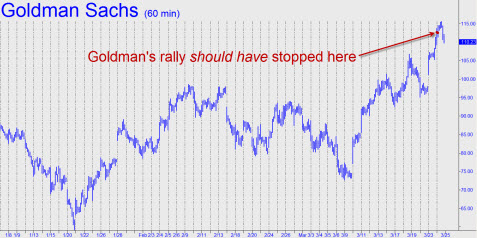
We hold a tiny position in Goldman Sachs (GS) right now that’s doing fine despite the stock’s exceptionally violent swings. In fact, if the underlying shares are trading at or near $115 when the April options expire in 23 days, our paper gain from two measly calendar spreads and a naked-short “kicker” could approach $1900. Nor can we get dinged for more than pocket change as long as the stock, which settled yesterday at 110.23, is trading anywhere between zero and $130 when the April options die. The even greater value of this trade, however, is that it has caused us to focus relentlessly on a stock that can tell us precisely what’s on Wall Street’s mind. To judge from yesterday’s action, we must warn bears: The rampage isn’t over.
A Wicked Little Monster
How do we “know” this? Simply because the spectacular short-squeeze of the last two days exceeded our rally target by a relative mile. While we’d been looking a run-up to exactly 112.31, Goldman demolished it yesterday and kept going to 115.65 before receding with the tide. Shorts may have breathed a sigh of relief on the $5 pullback that followed, but they had better not take their eye off this wicked little monster, because it’s bound to come after them again. It would be a rarity indeed if Goldman shares were to die in the stretch after having run the fastest seven furlongs since Secretariat in the ’73 Derby. We can’t predict exactly when GS will get second wind, but it’s not necessary to possess a crystal ball, since we need only look for impulsive rallies on the three-minute chart to tell us when and how to react. Most immediately, based on yesterday’s close, a thrust touching 112.49 would do the trick, and shorts had better scramble if it happens.
We view Goldman as the stockmarket bellwether right now, since it has been responding to mildly upbeat economic news as though it fervently believes every last word of it. We don’t begrudge Mr. Obama his optimism, nor do we blame him for spinning the news in any way he evidently believes is constructive. But we doubt that gaseous, feel-good news alone can continue to power the stock-market higher, especially when it is weighed each day against the mundane reality of underwater home values, steeply rising joblessness, waves of bankruptcies, and the bleak prospect of a U.S. economy trying to recover without a go-go banking sector to foster the perhaps crucial illusion of recovery itself. (If you’d like to have Rick’s Picks commentary delivered free each day to your e-mail box, click here.)
On March 20, in response to your article about “Citigroup’s Rally Just Hubris?”, Jay quoted a report about the Creature from Jekyll Island (The Fed), being privately owned by the likes of Goldman and Morgan. These are therefore the “Insider’s Insiders”, who are getting rich on this crisis (which their boys Barney Fank and Alan Greenspan helped engineer), while their competitors have become a shadow of their former selves. It helped to have their CEO, the former secretary of the treasury Paulson, do their bidding at the taxpayers’ treasury department. In this context, isn’t it interesting that Goldman was the biggest recipient of AIG payouts, as reported by AP/Yahoo? Here is an excerpt of today’s report:
QUOTE
Some of the biggest recipients of the AIG money were Goldman Sachs at $12.9 billion, and three European banks — France’s Societe Generale at $11.9 billion, Germany’s Deutsche Bank at $11.8 billion, and Britain’s Barclays PLC at $8.5 billion. Merrill Lynch, which also is undergoing federal scrutiny of its bonus plans, received $6.8 billion as of Dec. 31.
UNQUOTE
All these profiteering names are majority owned/controlled by the great puppetmasters in London, who also have a worldwide license to print money out of thin air at their own central banks, the Bank of England included. Your latest investment pick GS cannot fail with this kind of overwhelming power behind it.
******
There is no equity ownership of the Fed, only conspiratorial ownership. On this topic, besides the books mentioned, I’d recommended C.V. Myers’ The Coming Deflation (1978). RA