
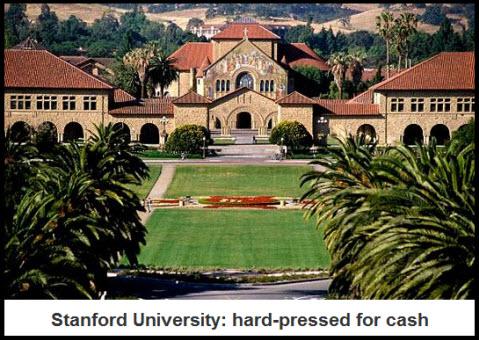
Stanford University is attempting to unload $1 billion worth of hard-to-sell assets — a treacherous undertaking that the Wall Street Journal said was being closely watched by private equity. That’s an understatement, since hundreds of the world’s biggest institutional and sovereign investors have portfolios very similar to Stanford’s, and many of them will be equally desperate to raise cash in these straitened times. The portfolio model they have embraced, perhaps all too eagerly, in recent years was pioneered by Harvard University, whose endowment fund is by far the biggest in the collegiate world. It was worth close to $40 billion several years ago — almost twice as much as number two, Yale University — but lost perhaps a third of its value since then due to the global collapse in asset values.
Before Harvard made a dubiously fine science of aggressive portfolio management, some of the biggest sovereign funds, including those of Saudi Arabia and Kuwait, maintained a simple allocation scheme favoring stocks and Treasury paper, with a conservative skew toward the latter. But Harvard was the first giant fund to diversify into a wide spectrum of assets that included such exotica as timberland, REITs, Norwegian fishing fleets, and mortgage derivatives. As a result, Harvard’s endowment fund was one of the most spectacularly successful among the majors just a few short years ago, and it was emulated and sometimes closely replicated by many of the biggest players in the investment world. But around 2007, when portfolio assets began to plummet across-the-board, Harvard and all of its copycats got caught in the downdraft.
A Novel Approach
Now Stanford has ventured forward to see what some of these illiquid assets will fetch. The school is taking a novel approach by selling only partial interests in the dubious partnerships it still holds. The sums involved total about $5 billion, or somewhat more than third of the funds overseen by Stanford Management Co. If the sale goes poorly, it will be a grim setback for the aspirations of other big-time funds. But even if things go relatively well it might be premature to break out the bubbly, since the market could get crushed if too many other big sellers take encouragement.
(If you’d like to have Rick’s Picks commentary delivered free each day to your e-mail box, click here.)
Rick, I have to laugh a bit when I see people shouting deflation using a sub 40 dollar oil or the the S/P under 600 as a “deflation” target. For most of my career as a petroleum engineer we used to dream of 40 $ oil and 4 $/mcf gas,during most of the 1980 and 90’s and as recently as 2002/03, (the same time you could stil get sub 400$ gold) Huge inflation has already happened! Big time. The dollar ain’t worth anything. Can’t anyone remember owning a three bedroom house that costs 180,000 k$ ? Where I live on the bald ass prairie (it sure ain’t Bubbleville California) those prices were constant till about 10 years ago; now the city appraises those same houses for taxes at 1.5 mm$ and they routinely sell for 1.2 to 1.4 mm$. I remember talking to an older National Park employee at the Tram in Palm Springs a couple of years ago and on her salary (18 $/hr) she could only dream of owning a car, let alone a house. The big loss in buying power for people like her have already happened. Instead of holding our breath watching carefully for signs of this massive collaspe of buying power, go outside and look around, you dollar you now earn buys half a coke or bad cup of coffe and that’s about it. That is why you need to own something that can not be printed out of thing air. It almost does not matter what. What am I missing here?
&&&&&
All yesterday’s news, Glenn. You’ve described what was, not what is. RA