
At yesterday’s top, the Dow Industrial Average was a mere 239 points shy of equaling the six-month bear rally that followed the 1929 Crash. The blue chip average peaked at 10694 on Tuesday, but it will need to hit 10933 to equal the fervently delusional retracement of the Great Crash to within 77% of the market’s peak value. At the rate the Dow has been climbing, it could be there by week’s end or early next, so place your bets. We’ve can identify one spot between here and 10933 where a short would enjoy favorable odds, but the gambit demands a tight stop-loss.
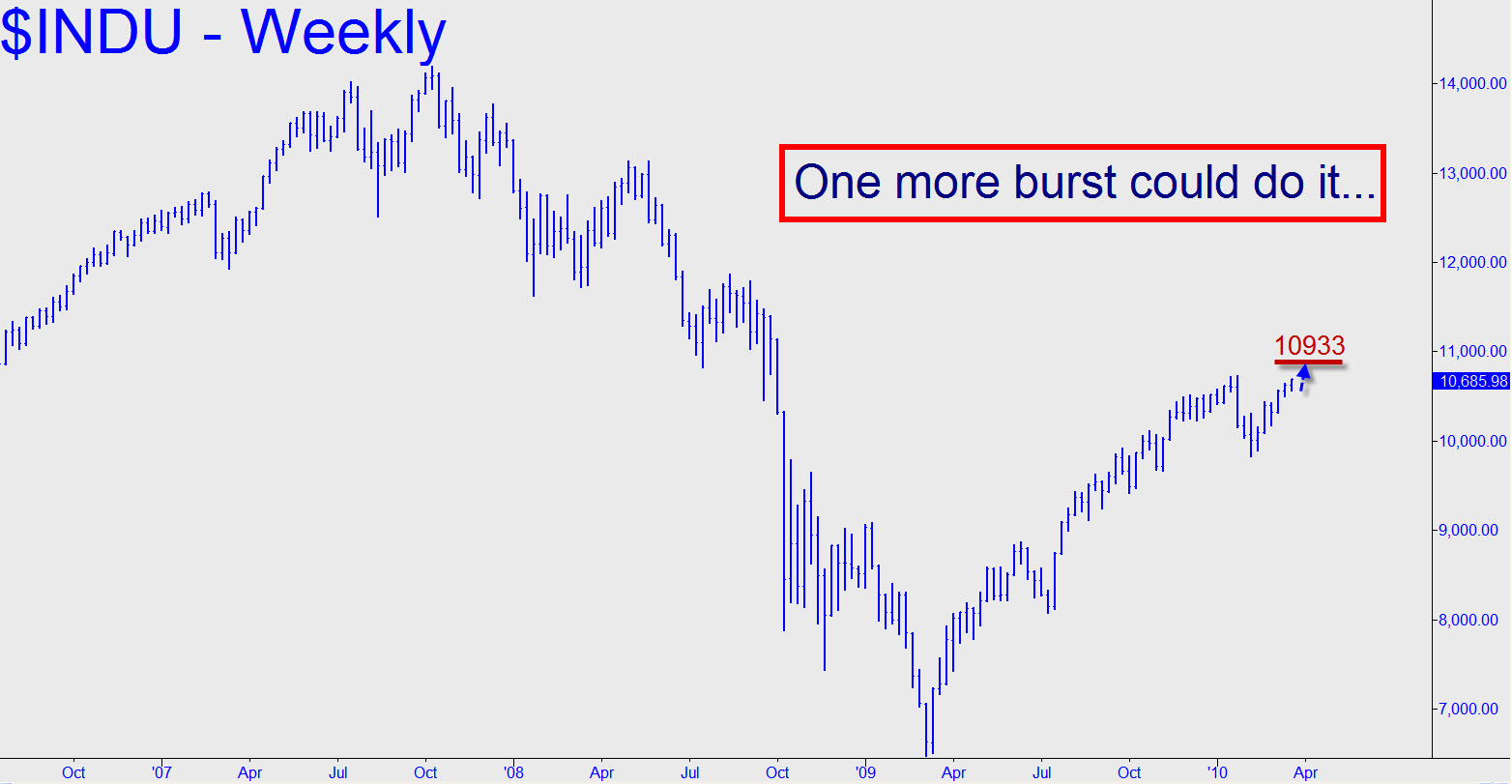
The 1929 comparison turned up in the Rick’s Picks chat room yesterday, posted by “Emerald,” who modestly categorized it as historical trivia. Perhaps not, since these numbers are all we’ve got to measure the tidal surge of euphoria that washed over investors once a financial shock of unprecedented magnitude had been fully absorbed. As we know, those who bought into the rally, and who stuck with it, were proven to have been fools; for the stock market would eventually lose 90 percent of its value. If this scenario were to repeat, it would imply a bottom for the Dow at 1420, representing a collapse of nearly 87% from current levels. Obviously, many of today’s investors are not reflecting on the lessons of history. For the record, the bear rally topped in April 1930, a fact that should give pause to those counting on springtime to fill investors’ hearts with lightness and song. Given the parlous state of the economy, which remains frozen despite a steroid-induced spike in GDP, it should be prayer on the lips of investors, not song.
A Bullish Tizzy
In retrospect, it’s hard to believe investors could have worked themselves into a bullish tizzy in 1930. Not that the average working stiff believed any of it. Then as now, it was mainly the House of Morgan that prospered in the surreal interlude between crash and false spring. Some today are convinced that the stock-market rally, now in its thirteenth month, is the real McCoy. But as Emerald noted, it can take quite a few years to build a base for an enduring bull cycle. “Fresh new bull markets such as the one born in August 1982 are usually preceded by corrective phases lasting 15 to 20 years which wring out any excesses in valuation and sentiment,” he wrote. “These corrective phases always have two components: an adjustment in price, and the passage of time. If we trace the beginning of the current bear market in real terms to the year 2000, we are about half-way to two-thirds through the process.”
(If you’d like to have Rick’s Picks commentary delivered free each day to your e-mail box, click here.)
Actually Cam, what we’re missing are the PEOPLE (particularly the 20-30 year olds) that went through the last crisis cycle. Memories and institutions put in place to prevent a repeat always fail due to the following generations thinking “it’s different this time.” Please research Generational Theory (Strauss and Howe) or Generational Dynamics if you want to learn more.
BTW, the book you mention is still available at Amazon.