
“Sell in May, and go away?” Any trader who plans to employ that time-honored strategy should take good look at the chart below before dumping his or her portfolio on schedule in a few weeks. Notice that investors who exited the stock market right on time last year, at the end of April, would have missed a 12% rally that saw the Dow rise from 8168 to 9172 by Halloween, the traditional time to jump back in. The adage that tells us to “Sell in May…” is based on the fact that, historically speaking, stocks in markets around the world have made their best gains during the period November through April; moreover, those gains would have been reduced substantially by holding from mid-spring to mid-autumn. While that is certainly true based on our own experience, some statisticians have demonstrated that the effect is negligible if, when considering the performance of stocks since 1982, you strip out the two crucial years 1987 and 1998.
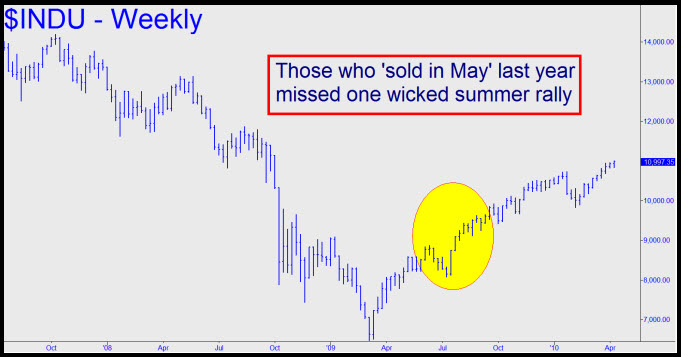
Whether you believe the statistics or not, memories of last summer’s powerful rally should still be fresh enough to dampen the ardor of sellers who think summer doldrums and seasonality are likely to turn the months ahead into a snooze. Summer or not, we are living in interesting times, and there is nothing to suggest that hot weather is going to slow the pace of interesting news of the kind Wall Street seems to thrive on these days.
Blowoff In Progress
So what are the odds that stocks will show the same kind of anomalous strength this summer and fall that they showed last year? It’s hard to say exactly, but our gut feeling is that, far from being ready to collapse, U.S. stocks are in a blowoff phase that is likely to steepen over the next month or two. We say that even though we strongly doubt the economy is in a sustainable recovery, and even though we believe that the most severe phase of the real estate collapse is yet to come. Quite obviously, the stock market is unconcerned about such things, and that is why the inevitable crash is a good bet to rival the one in 1929. For now, though, we permabears must be content to initiate speculative short positions at each and every significant rally top we can identify using the Hidden Pivot Method. On that score, we had viewed 1196.50, basis the June E-Mini S&P, as a promising opportunity. However, as of this very moment, a short-squeeze rally in thin Sunday-night trading is eating through our target with little effort. Under the circumstances, shorts looking to be backstopped by round-number resistance at 1200.00 had better not rely too heavily on that number for peace of mind.
(If you’d like to have Rick’s Picks commentary delivered free each day to your e-mail box, click here.)
Jim Grant:
How do we know when it is safe to own stocks again?
When CNBC becomes a sports station!