
Now we learn that the SEC split 3-2 over whether to go after Goldman Sachs in court. Supposedly, the regulatory agency prefers unanimous votes when bringing enforcement actions against the firms it regulates. Why the exception this time? The Wall Street Journal made it sound like it was simply partisan politics that carried the day – i.e., the SEC’s two Republicans voted against suing Goldman for civil fraud, but the three Democrats prevailed. That is superficially what happened, and it is as much of the story as the SEC is willing to divulge right now. But it’s bound to leave many observers, particularly Obama-ites in Congress who are out to pillory the bankers, with the impression that the two Republicans were merely looking out for their fat-cat buddies on Wall Street. This thought occurred to us as well, so we’d have to concede it is at least possible.
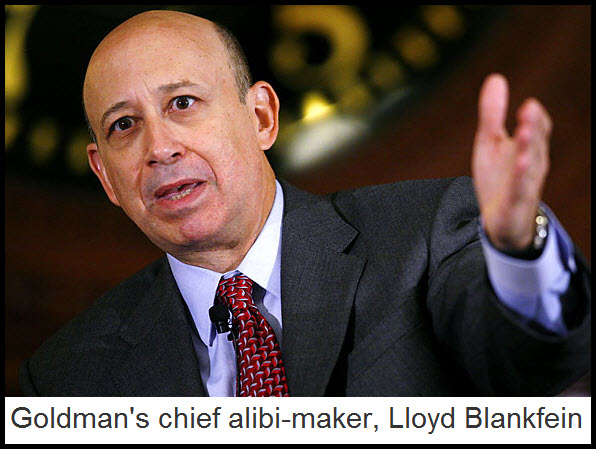
But might there have been another reason why the Republicans backed away from bringing formal charges against Goldman? We think there is and that it goes to the heart of the corruption in which the world’s largest banks have inextricably trapped themselves. For if you assert in a of court law that Goldman defrauded its customers, you have implicated every bank in the big leagues. Enabled by their respective central banks to create loans from thin air, every one of them – even banks run by otherwise spotless Swiss Burghers — have played the same Ponzi game as Goldman. Now, regardless of whether the charges brought against Goldman are civil or criminal, they will open the door to an endless flood of litigation with the potential to bring down the entire banking system. From this point forward, Goldman will be fair game for every aggrieved city, county, state, sovereign fund and class of investor with whom Goldman has done business during the last decade. The same goes for Bank of America, J.P. Morgan, Morgan Stanley, Deutsche Bank et al.
Lynch Mob
So it’s just possible the Republicans put politics aside when they voted, in effect, to quietly sanction Goldman behind the scenes. It must also have occurred to them that it would ultimately be impossible to mask the overwhelming stench of Goldman’s actions. The firm, after all, did sell an investment to the public that had been furtively created by someone betting on the portfolio to fail. There is no way Goldman can talk its way out of this one, although that hasn’t stopped CEO Lloyd Blankfein from trying. With Goldman reporting a spectacular $3.4 billion quarter yesterday, he might as well have tried to explain to a lynch mob that he has never, ever kicked his cat and that he always helps little old ladies cross the street.
Some see the charge of civil, as opposed to criminal, fraud as reflecting a compromise engineered by Mr. Obama to help expedite his takeover of the financial sector. “He stirs up the masses with yet another example of Wall Street greed and fraud,” wrote one contributor to the Rick’s Picks forum, “but offers nothing more than what amounts to a fine to his friends at Goldman. We all know how deep their pockets are. They are quietly happy that this is the extent of the fallout.” While this seems plausible, it doesn’t reckon with the fact that just one civil suit is capable of triggering a chain of events that could conceivably put the world’s largest banks in mortal jeopardy for years to come. If they should somehow dodge the bullet, it would be evidence that the corruption that permeates the banking system has engulfed our judicial and political systems as well.
(If you’d like to have Rick’s Picks commentary delivered free each day to your e-mail box, click here.)
And speaking of Banks….
Several weeks ago I wrote a letter that was published on Rick’s Pick’s under the banner “Canada won’t escape drag of the slumping US”. Since that time there has been a torrent of media analysis of Canada’s housing bubble from both within this country and from US media. There has been a surprising and candid response by the Chief Economists of TD Canada Trust and the CIBC, two of Canada’s large banks. Who knew that Rick’s site was that influential?
There is clearly a keen interest in the US though about the state of the Canadian economy and until now, few have questioned how we Canadians have achieved so much, so fast and turned in such an impressive economic performance, particularly as it occurred during a major global downturn. These additional remarks will hopefully shed some light on those questions and while written for a Canadian audience will likely resonate with our Southern neighbors who have already seen this story played out in their own backyard.
Within days of the publication of my letter to Bob Tor, a Rick’s Pick’s contributor, US bondholders of Canadian bank debt began demanding a risk premium as it became clear that a housing bubble was indeed forming in this country. The big four Banks here in Canada have now responded by twice raising mortgage lending rates over the past three weeks in order to cool the Real Estate market. The Governor of the bank of Canada meanwhile has strongly hinted of increases ahead for the overnight rate and analysts now speculate those increases could add up to 2 percentage points or more this year alone.
Inflation pressures in this country since the sub-prime meltdown have been primarily driven by the sharp increase in home prices and consumption related to housing construction. This of course was the result of cheap money policies enacted to stimulate consumption and drive the economy here as it appeared we we, like our American friends, were also headed for a deep recession. It was successful.
Too successful. Our recession never came and instead Canadians borrowed, bought and spent as if it were the best of times. That is now expected to end as a cooling phase has begun. Meanwhile, our dollar has now gone above parity and is worth more than the Greenback creating new economic risks as it now coincides with escalating interest rates. We have entered uncharted territory in Canada. My additional commentary now follows:
With recent interest rate increases and a rapid rise in home listings in the hot markets, slowing sales in others, a chilling signal has been sent and the tide is turning on the Canadian real estate scene. I sense there will be an abrupt change in buyer sentiment as the new costlier reality begins to sink in and a panic wave of listings as sellers suddenly find they cannot get out. Domestic concerns about rising interest rates, persistently high unemployment, a much speculated on dollar at parity to the Greenback and regulatory changes being introduced by government and CMHC (Canada Mortgage and Housing Corporation is our version of Fannie Mae) are now impossible to ignore unless you live in a cave.
There is uncertainty all over the globe as well that can and will affect our markets and our ability to sell products abroad at current prices. The number of risks at play now are mind-numbing. Nothing can be taken for granted anymore. There is no status quo that can be relied on as sustainable. The risk of sovereign defaults is an example. A Euro that could spin out of control if the likes of Spain, Italy, Portugal, Greece and a raft of others cannot get their domestic economies under control.
Britain meanwhile is in hock to it’s eyeballs with it’s own real estate markets looking to continue their free fall again in the face of rising taxes which could put that whole economy at risk. The US continues to deflate while parts of China are in a massive real estate bubble caused by cheap money and their own stimulus. What the Chinese have done is pour gasoline onto a fire and we can hardly imagine the consequences when it all unravels. The Japanese meanwhile are facing the specter of a Yen devaluation and possible hyper-inflation while German coffers are strained as it struggles to prop up others and come to grips with some of it’s neighbors going broke.
Every one of these problems should be taken into consideration before taking on a massive personal mortgage debt. Why? Because of global interconnectedness. Because of the risk of contagion. Because we lean on each other and if one falls all could follow. If the message has not gotten through yet, debt is the poison that the whole globe is drowning in right now and more of a bad thing cannot possibly be better for the average Canadian.
But those are only some of the looming threats. Some suggest that US commercial real estate could yet collapse the financial markets while others stay focused on the potential for more derivative unwinding. Which one of these triggers will be the one that takes down the whole house of cards? Nobody knows but any single one could do it. These are dangerous times. These are times to start stocking the larder, not buying into mortgage slavery. It is time to eliminate personal debt, cut back on non-essentials and get prepared for what is almost certainly going to be a financial hurricane and potentially a devastating deflation of asset values in this country. It will be epic.
For those who want to take the bullet for the nation though and help plump up GDP numbers so our Country can continue to crow about it’s economic strength, it’s low debt to GDP ratio and strong banking sector, then go for it. Best of luck. Some of us know better.
There are just so many compelling reasons to avoid buying most Canadian real estate right now, and so many more reasons to sell into this bubble and take profits if you can. You often hear the term “Timing is everything” and for those lucky enough to get that timing right the payoff can be tremendous. But timing is difficult to judge for most people. We are harsh when it comes to criticizing those who have called market tops too early with scant praise for those who got it right but in the wrong year.
Nonetheless, a trend is a trend and with clear evidence of a bubble fully formed in the R/E market and dozens of worrisome indicators casting shadows over the road ahead it is only fools who cry about having lost potential gains, about not having drained the last bit of juice out of a doomed market. So if you took heed of the warnings to sell your home and got out alive, albeit a little too early, then don’t worry. Consider yourself one of the lucky ones. The smart money has already bailed out of this market. Time has run out for everyone else.
So we are now at a crossroads in Canada. Our so-called economic strength has been built on the backs of an army of mostly young inexperienced real estate buyers who drove GDP numbers through home purchases, home services and consumption related to the construction industry. The kids have accomplished in two short years what no government could ever do; spend other peoples money like drunken sailors without a whimper from the media, the tax paying public or the banks.
And vast numbers of them made us all proud by gorging on mortgage debt. Much of it is guaranteed by the Government through the CMHC (that means you and me of course). There were of course sane voices warning of the risks but they were drowned out by agenda and a media drunk on a torrent of factual lies spit out by the likes of local Realtors with little more than a grade 12 education.
We truly have had a great success here in Canada. We are the marvel of the world with what appear to be strong banks and a vibrant optimistic economy, strong GDP numbers and low relative debt. It all looks good on paper but pulling the curtain aside you see there is another reality. A generation of Canadians who financed our economic marvel by borrowing and spending and driving the costs of the single most important investment in life to dizzying heights. By accepting mortgage slavery voluntarily and with gusto. And no warnings could stop them.
Too many folks have mortgaged their future from ignorance of the risks. From some perspectives though the stimulus and dirt cheap money incentives have been spectacularly successful towards creating the impression for the rest of the G7 that we are the pillar of strength. What nonsense! Just feathers and fur. As in the US Canadians have borrowed heavily against the newfound wealth in their homes. We bought new cars and trucks, cottages and lake front properties, overseas holidays and gadgets. All from money that only existed in terms of vastly inflated real estate, (some lucky few do feel fat and rich though for having cashed out and are now enjoying our strong currency). We have collectively gone deep into debt with lines of credit and credit cards buying things we never needed but could not resist because it all came so easy. Too easy. Now it will all have to be paid back.
In some corners of government and finance it was actually believed that if we could just hold on long enough it would all be OK. That easy low interest rate policies would be needed just long enough to get us over the hump. That the recession would pass and no real harm could come of the low interest rates. Granted, some of the kids would be in deep but overall it was for the good of the country and if employment held up, particularly in the home services, retail and construction sectors then all would be well. Government could bail out the real basket cases like the auto makers if only the army of consumers like you and I would do our part by borrowing, shopping and keeping everyone else buoyant and employed. It is a compelling argument actually. Too bad it was wrong.
Unfortunately the economic whiz kids did not look outside our own borders when considering this ruinous idea nor consider the threats a high dollar might pose. Nor were the dangers of eventual (and guaranteed) higher interest rates fully accounted for. Quite frankly, many of the best minds in this country labored under the same belief many Canadians still hold; that housing prices could not truly fall and that even if they did it would not be for long. We have after all seen recessions come and go and prices have always bounced back.
But there is something different this time around and that difference is the staggering debt levels of governments, corporations and individuals all over the globe. The difference is that we were piling on debts during a global recession as we watched one country after another lurch from crisis to crisis with some now on the brink of default. What were we thinking? That we could save the US economy from deflating? That we Canadians might rescue the Euro zone by going deep into debt here at home? What nonsense. The whole exercise has only led to damaging speculation on our currency that is surely going to destroy what remains of our manufacturing industries and lead to unemployment that will rival the estimated 22% jobless in America right now. Let’s not forget that for every position in manufacturing there are two or three jobs spun off in the service sector. (So who needs haircuts anyway, I’ll just grow it long again like it was in the 60’s, no problem)
And it is not as though we did not know we were already too indebted. The Vanier Institute for example has been warning for many, many years, since well before the sub-prime meltdown, that Canadians were digging a debt hole for themselves. They now report the average Canadians debt to income ratio stands at 147% and that number will surely grow on average if unemployment numbers increase. But who are they to tell us our business? Just some stale old think-tank guys and gals in suspenders who don’t know good opportunities when they see them! I am sure they would enjoy the last laugh if only they were not so disgusted that they’re warnings were falling on deaf ears.
The debt to income picture is especially dismal when you don’t have any income to speak of. So while it is a good thing that the real estate markets are now cooling we can only hope that there is no major interruptions in our countries commerce or day to day business brought on by events outside our own borders. With luck we can slowly dig our way out of the massive debt pile that was accumulated in the name of fighting off other debt problems. Like GM, Chrysler, the Banks etc. Does anyone see any irony there?
I am not optimistic though and sadly, the road ahead does not look to be paved with gold. The greater health of our country now rests on decisions we cannot control in countries we may have never been to. Appearances are that a race to the bottom is underway with currencies large and small all over the world. A global deflation may well be in the cards. This is not a race we can win as heirs to massive untapped natural resources nor at a time when commodities rule the markets. It is surely time to get our house in order. To start paying down debts in a serious way and I for one cannot feel any sense of ease at the number of threats to our economic well being that are now percolating outside our borders. A real estate correction is welcome but it is only a starting point in bringing some sanity back to this country. Some soul searching is in line too. We need to revisit our value systems from less heady days. And we need to take cover. The worst may yet be ahead.
Cam