 Financial stocks got goosed yesterday, and for a few blissful hours everything was right with the world. The shares of JP Morgan led the way, up 26%, followed by Goldman Sachs, which tacked on $10.80 to close at exactly $70. A while back, we promised to don a grass skirt and dance the hula in Times Square in the middle of winter if Goldman does not eventually fall to at least $29. However, yesterday’s wilding spree in the banking sector may have pushed back a day of reckoning till February of 2010.
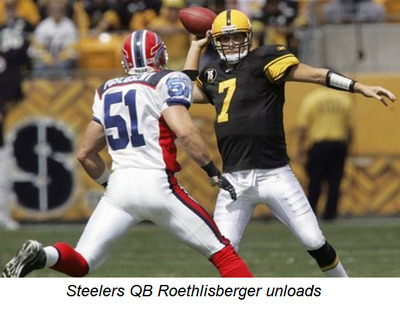
Meanwhile, every big rally offers a fresh opportunity to get short, even if the position is not one that you could simply forget about till 2010. Nor is there such thing as a buy-and-hold, as Apple shares have demonstrated time and again. The stock has gotten pummeled repeatedly in recent weeks because of speculation over Steve Jobs’ health. Yesterday, though, AAPL soared on great earnings news, trading up $12 after the close. We have trouble believing that the upbeat announcement could have been surprised anyone, though. We mentioned here the other day that Apple stores were packed during the holiday shopping season and have remained so since. The same is true for Verizon stores we’ve visited over the last couple of months. You could load up on Verizon call options ahead of earnings, but we like the Steelers more, even giving up seven points.
***
Inflation vs. Deflation
We were deluged with responses after we challenged readers to explain how inflation might emerge amidst the devastating asset collapse now occurring throughout the world. [ Click here to drop in on this lively discussion at the Rick’s Picks forum.] Here’s another great letter that offers much to enlighten, from reader Eric Andrews, to whom we are most grateful:
“I’ll take up the Inflationist challenge with two examples: Argentina and Russia.
“The problem under a fully fiat system is that inflation or deflation is ultimately a policy decision. I’ve been truly amazed by the choice to prevent inflation by refusing to aid anyone except the largest, most connected players, who have in turn held every cent of inflation to themselves. I would have expected that given the opportunity, Government would have been more than happy to give every bank, business, and voter free money. But locked in the belief the system is salvageable, they haven’t, and believing this do not want to erode their power by a single grain.
Parabolic Money Growth
“Despite this delay and denial, however, the ultimate problem is the same: Under the peculiar rules of a fractional-reserve fiat system, debt can realistically only be added and transferred, never extinguished; only the transfer of the actual commodity in a commodity-based system can fully extinguish debt. That being the case, regardless of how low the inflation rate – even 3% – at some point it is mathematically required that monetary expansion become parabolic. You could even mathematically predict the day the system collapses. This is not ‘something no one could have seen’; it’s obvious, built into the system, and has been commented on by dozens of (Austrian) economists. On this both Inflationists and Deflationists agree, and only disagree on the order and timing.
“Why will we have inflation, then? Clearly the system has already gone parabolic, and popped. No known bubble has ever been re-inflated, nor will this one be different. That’s because the language needs to be more clearly defined: generally ‘inflation’ – and here that also means price inflation – occurs because money is expanded faster than debt vanishes or goods are produced. But there’s a second and rarer kind: when people stop believing in the money altogether, usually as a sudden failure of confidence in the ability of government to force the acceptance of its fiat currency, from events such as bankruptcy or internal weakness caused by war.
A Form of Slavery
“This is similar to what happened in Argentina or Russia. In these cases the cause of hyperinflation was not Inflation, as we are using the term, but a consequence of the onerous burden of Debt and Depression like we have in the West today. It took many years, but once debt could not be serviced without near-poverty – a form of economic slavery – both governments made a policy decision to default on their debts. They chose their creditors, who were largely other nations and not their own people in order to create a new beginning for themselves, and this can happen when the majority of the debt is owed externally. In this sense it’s not so much a steady ‘Inflation’ as a willful repudiation.
“But how do they say: ‘there is no free lunch’? When they refused to pay, the other nations halted both credit and imports to Russia and Argentina, throwing their international trade into disarray. Overnight, the peso and ruble were unable to buy things such as foreign goods, and so had far, far less utility. Because they were accepted by far fewer people, they were not nearly as useful and their value dropped many-fold. This rapid decline in value is called ‘hyperinflation.’ It didn’t matter that wages never rose in either nation, or that credit was not extended by their national banks – the medium of exchange in each country was no longer in demand, so prices rose as everyone tried to discard their currency in favor of either real goods or an alternate medium of exchange -gold or foreign currency. Once this shift begins – and the change is psychological, not mathematical – it feeds on itself. This could also happen if foreign creditors
choose to cut us off before we get a chance to default. It could also be their policy decision as we saw in Turkey and the Philippines today, and increasingly Japan and China before today.
Hard Labor
“Granted, Russia or Argentina did not have to hyperinflate – no doubt they would have preferred not to. However, once in crushing debt, the only other alternative would be to repay foreigners with hard labor for decades, which is politically unlikely.
“This policy decision cannot be said to be either a natural process of inflation or deflation, both of which can happen without government intervention. Both Inflationists and Deflations tend to focus on the natural outcome, for intervention is unable to be modeled or predicted. If money were a government, it is like the collapse of that government with the slow, painful, and unpredictable imposition of another one. All those empowered by the former government lose their power, and although they may also be seated in the new system, they could lose everything as well. In either case, there is great disorder, power struggles, and shortages.
“For some examples, after 1997 Russia’s life expectancy declined from 65 to 59, or the wave of Argentine cartonaros – former engineers and managers who, in the capital of one the great food-producing nations, lived in cardboard boxes and picked food from garbage with their children to eat. That may be ‘hyperinflation,’ but it is also an economic Depression.
Classic Weimar Example
“This is also not to say which happens first. I would have expected government to be thrilled with inflation and to have allowed it to run out of control, followed by a economic Depression while the monetary system was replaced – the classic Weimar example. But they can and apparently have chosen to stop an inflation that must mathematically increase exponentially or collapse, which leads to a Deflation and economic Depression first. But when our own people are starving, I expect we will behave as Russia and Argentina and dispense with our foreign debts; and in a country that imports everything, including savings, it will cause money to become near-worthless in hyperinflationary repudiation of the currency.
“That the same thing must happen but can happen in two different ways is just to say, ‘There’s no such thing as a free lunch.’ If there were a way out of this, someone, sometime in history would have done it. ‘There is no means of avoiding the final collapse of a boom brought about by credit expansion. The alternative is only whether the crisis should come sooner as a result of a voluntary abandonment of further credit expansion, or later as a final and total catastrophe of the currency system involved.’ �’ Ludwig Von Mises
About Gold…
“We are in the process of choosing one of those alternatives.
“About gold, it’s true it is useless to buy things with. For one thing in places like Zimbabwe there are no longer goods for sale, while admitting ownership of gold would get you killed. The only thing it is good for is that when the ship you’re on sinks, it can hold your wealth until the new ship is functional. For the in-between, you’re still on your own! However for the purpose of allowing the enormous present wealth to squeeze into this tiny life-boat, its interim value in purchasing power terms could still be very, very high.”
Football history suggests that the Dow Jones Industrial Average is on the cusp of a 70%+ rally over the next couple of years.
The Pittsburgh Steelers won the super-bowl in 1975 after the Dow made its recession low in December 1974. From the December 6 low the Dow rallied 75.69% to top on September 21, 1976.
“Bush is the first president since Richard M. Nixon to preside over a net fall in stocks during his term” (Leah Schnurr, “Wall St rises on energy gain, financials cut losses”, reuters.com, January 16, 2008).
The Steelers have made it to the super-bowl this year, after the November 2008 Dow Jones low in the present US recession.
The high in 1976 was 1,014.79 – only 36.91 points below the 1973 nominal high of 1,051.70.
In this scenario history suggests that a yet future recession, leading to depression, will have its severest impact in a Republican administration to follow the Obama admin., in 4 years time.