The dollar’s bounce last week from a Hidden Pivot support that we’d drum-rolled here lasted all of four days, suggesting that more weakness is on its way. If so, we should look for gold quotes to blow past $1,000 by no later than mid-week. Our immediate target for the August Comex contract is 1066.40, subject to a “hidden” resistance just above at 985.80. A two-day close above that last number, or a trade more than $4 above it intraday, would be quite bullish for the near term.
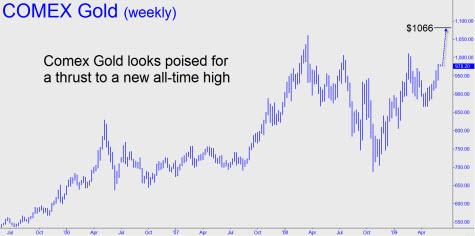
Will this be the rally that starts gold on its way into the stratosphere? We have our doubts, since gold’s short-term charts suggest quiet strength, but not yet explosive power. That could change overnight, however, if the dollar is about to go “kamikaze.” The fact that the Dollar Index has failed to gain traction at some key technical levels in recent weeks is ominous. The trade-weighted Dollar Index settled on Friday at 79.34 and looks primed to test a key support at 77.69 recorded last December. That would represent a 2% decline from current levels, but if the support fails, we might see some panic spread into other markets, particularly T-Bonds.
Scary Bond Picture
There are already some disquieting signs in the bond pits, notwithstanding a sharp rally in the price of Treasury debt at the end of last week. The price surge on Thursday and Friday partially recouped earlier, heavy losses sustained in the days immediately before and after Memorial Day. But the bigger picture is growing downright scary, since T-Bond yields have crept back up to where they were before the spectacular futures rally in mid-March, when it was announced that the Federal Reserve was about to embark on a program of “qualitative easing.”
That’s just a euphemism for direct monetization of Treasury debt, but the plan appears to be backfiring, and badly. For not only have yields on government paper risen to where they were before the announcement was made, but mortgage rates have blown up as well — to around 5.50 percent recently. That’s up from 4.875 percent just a week earlier, and it suggests that the Fed may be losing control of market-based rates (not that it would have been able to control them indefinitely). Keep in mind that mortgage rates are pushing higher despite the fact that the Fed has bought more than $500 billion of mortgage backed securities in recent months — part of a plan to suck up $1.25 trillion worth of mostly unmarketable paper. This has caused barely a blip of hoped-for inflation in the housing market; nor do we expect it to do much more.
Hyperinflation, Eventually
The (hyper)inflationists are almost certain to be right at some point, since the U.S. is headed toward bankruptcy and the prospect of having no one but the Fed to “buy” its debt. But we are not counting on fiscal stimulus, TARPs and all of the rest to bail out and estimated 40-50 million homeowners who are underwater on their mortgages. That is why we remain in the deflationist camp. We’ll join the inflationists if and when the government starts bailing out individual homeowners rather than banks. It could happen, but we don’t see any signs yet that Obama & Co. understand that this is the only way they’re going to inflate home prices. And incidentally, those who think that getting people to pay more for homes than they are worth is somehow going to put the U.S. economy back on track — a group of ignoramuses that includes all politicians except Ron Paul and a few others, the hacks they’ve appointed (i.e., Bernanke, Geithner et al.) , and most economists — deserve to perish in the Mindanao-deep bog they would create.
If you’d like to have Rick’s Picks commentary delivered free each day to your e-mail box, click here.)
Comments on this entry are closed.
Perhaps the distinction in the deflation/inflation argument should be sought in separating what’s occurring where.
The Asset deflation happening in housing is a healthy and very necessary process we need to go through.
It makes no sense that house prices should be some 50% above their long term average as they were some months ago.
Even the long term average is probably at an artificially elevated level due the excess money, i.e. long term loose monetary policy, chasing the same assets.
But this constitutes not deflation pre se, as it is just the hot air puffing out of a very unhealthy bubble in asset prices.
Only if, and when, it persists for a long time, and prices should drop way below replacement value, (although that is a fluid target as the price of land is also a factor) then you could talk about deflation, but not now.
But the REAL economy, where people produce, plant, harvest, manufacture, build, ship, distribute, wholesale, retail, serve customers, that’s where the argument lies, inflation of deflation?
Now it seems pretty clear what the answer might be to that question.
The confusion always arises for the lack of distinction as to where is occurring what.
Right on Rick. Although that group of ignoramuses you mention, are probably more criminal than ignorant – they are currently running the show and have surely orchestrated the crisis as well as all booms & busts, for the most part — and thinking they can fill the pockets of their banker buddies with our bailout money and keep inflation in check by crashing the markets & housing. But they will be the losers (bigtime) in the end — if we can just get a few more of the sheeple informed.
One big question: Assets crashing, right, so deflation (mainly) winning now and for the forseeable future, right? But food prices have continued marching up over the recent past. With most commodities and producers’ costs (energy) dropped, what do you think has pushed food up? Perhaps left over / slow reactions from previous price jumps and perceptions for inflation?? Thanks.
Rick,
Nice to see you give a shout to Ron Paul, and to presumably lump McCain with the loser ignoramuses.
Higher interest rates will indeed push housing down, while increasing commodity prices. If I end up selling silver at $50, I think it will be tough times all around. I’m not looking forward to that day, though I am preparing for it.
Did you see the Barron’s article last weekend about imagining McCain as President? They had to use a magnifying glass to find a few small differences between McCain and Obama. They are both big-gov’t and big-war liberals. Like Obama, John McCain is a gun grabber (see Senate bill 1805 from 2004).
Will be watching how they try to repel gold when it tests $1010 soon.
Best Wishes.
“qualitative easing.”
I think you meant quantitative easing? If I’m wrong please expound on it.
Will there be inflation or deflation? I believe the answer is both. I plan to take a pocket full of gold someday soon and buy a nice little house for myself.
Right on, Rick! But don’t expect gold to remain over $1K for long, if it gets there (in June, no less) or the FED to raise the prime rate any time soon. As for bailing homeowners, ‘they’ didn’t get the first time ’round (subprime fiasco), why on God’s green earth should we think that anything will be different with alt-a, option arm, or commercial real estates’ second tsunami?
ps. I’ll be very pleased if I’m wrong about AU.
Well August day high is 990.2 but couldn’t hold your pivot since then…now let’s see what the gold bugs are made of
Again struck by the cat got yer tongue dearth of comments found at turning points.
(Sir) Harry Schultz, self-anointed chevalier, former newspaper chain owner and chartist since the Sixties, wrote a book: How to Profit from Panics and Crashes.
In it he found The flight for quality. Works for us.
Are bonds, derivatives, dollars, equities, physicals or stocks highest quality here?
Long trend still our best friend as we say goodbye to GM while $BDI quadruples:
http://stockcharts.com/def/servlet/Favorites.CServlet?obj=ID3251493
Great points Rick,
Housing is certainly set for another fall. Higher interest rates will strangle off any possibility of a housing recovery sending thousands upon thousands more homeowners into default and derailing any hopes that the worst of this economy is behind us. We are in for an even nastier asset deflation than I would have predicted only a few short months ago. And as home values drop we are simultaneously confronted with “grocery store” inflation brought on by the commodity boom in progress. It is disconcerting to say the least that as wealth in the primary asset, our homes, is being destroyed we are also confronted with rising prices consumer prices. It is therefore inconceivable that as we become poorer and our costs increase that any quick return to the consumer driven economy will return. Quite the contrary. We are retrenching, saving, worrying and feeling ripped off. If hyperinflation does take hold we are in for a very painful period of adjustment followed by an even nastier depression. It’s a crazy world where you, Mish and Peter Schiff can all be right at the end of the day.
Cam