
The jury is still out on our favorite stock market bellwether, Goldman Sachs, since the shares of the well-connected banking firm failed yesterday to push above an important Hidden Pivot resistance at 151.24. Although the stock popped just high enough to stop us out of a profitable short position held from within a penny of the recent top, the rally fizzled after a head-fake on the opening. Goldman ended the day up just 56 cents, performing in-line with a generally turgid market. Yesterday we said Goldman could cruise all the way up to 171.87 if it gets past a lesser Hidden Pivot resistance at 153.50. Although Tuesday’s price action arguably left the stock in a bullish holding pattern, one might have expected more, given that ten of America’s biggest banks have been deemed sufficiently healthy to allow them to pay back $68 billion in TARP money that they borrowed from the Treasury.
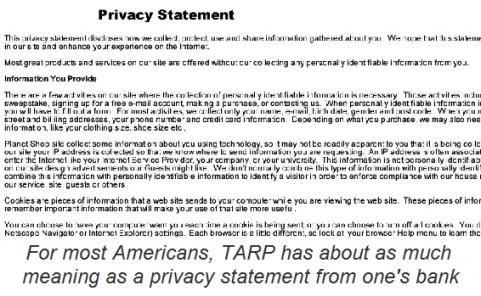
Perhaps those who bought the rumor of the banks’ return to nominal solvency were not impressed by the news, but in our opinion yesterday’s bullish TARP story should have given more boost to the financial sector as a whole. So why did the news fall flat? We’d like to think investors have figured out that the buzz can’t get much better for the banks. After all, the purpose of TARP was to pump up the share prices of banks so that they could raise capital by unloading said shares on the usual suckers. But now that that has been achieved, what comes next? The feds may be able to sustain the illusion that the banks are “healthy” for yet a while longer, but sooner or later it will become evident that would-be borrowers are not in such great shape themselves. That is an illusion far more difficult to create, let alone sustain. In fact, most households know just how deep the damage has gone: At least thirty million homeowners are still underwater on their mortgages and perhaps as many savers have lost 30% to 50% of their nest eggs in the last two years. For them, TARP has about as much meaning as the latest eight-page Privacy Statement from their banks.
***
Calling All Traders…
Ever found yourself sitting on your thumbs after the opening bell, waiting for the dust to settle? If so, then you know how much harder it becomes to trade profitably as the day wears on. That’s because once a market has established an opening range, trading becomes essentially a frustrating game of second- and third-guessing other traders who are trying to second-guess you.
But suppose you were able to predict the high or low of the opening range beforehand? Using your crystal ball, you could be waiting at the bell with your bid or offer, ready to pounce on what will later turn out to be at the high or low of the day. Wouldn’t that be a trick!
That is exactly what we attempt to do each morning, using the Hidden Pivot Method to spot predictive price patterns that may have occurred overnight. If you want to see how this is done, and how precisely, please join me for The Morning Briefing each day before the opening this week and next. Beginning on Monday, June 8, these 20-minute sessions will commence online sharply at 9:00 a.m. EDT. Our goal will be to identify trading opportunities for that day, with a particular emphasis on Comex Gold futures and the E-Mini S&P. The Morning Briefing will be open to all, but to sign up you will need to register by clicking here. See you Tuesday morning!
Comments on this entry are closed.
Yes, market liquidity and volatility drying up from the gigantic sucking sound of a hundred billion of new Treasury auctions, with trillions more to go by the end of the year. This is when big market moves may occur.
Our bet with buy and sell stops is a reverse Hindenburg Omen after a head fake down. GS and JPM can buy SP5s with unlimited Fed money until people wake up out of the trance.
How long can this market deny fundamentals?
Longer than our capital and patience can hold out.
Jim Grant this morning announced the Fed is operating not with its customary 5% reserves, but closer to 2% reserves, with $45 B of capital and $2.1 T in (somewhat toxic) assets, and would not survive a real audit as a going concern. JG repeated a timeless classic: There are no bad assets; just bad prices.
Rising interest rates already wiped out their capital, and Credit Default and Interest Rate Swap exposure approaching 200 T promises ACT II of insolvent banks. Goldman’s alleged derivative exposure ratio is 10.5 times capital. C, BAC and WFC are exposed.
We write ‘alleged’ because although quacking like a bank to get TARP money required 10% capital, leveraged off balance sheet derivative subsidiary operations may still dwarf actual capital many times more.
http://www.cnbc.com/id/31204170/site/14081545
We learned in the most recent Fed report the money multiplier fell from its decade long ratio of 1.7 to .867, meaning for each buck of funny money, we get less than 87 cents of bang.
Oh the times they are a changin’
http://stockcharts.com/def/servlet/Favorites.CServlet?obj=ID3251493
Good points Rick. And now we are headed into the doldrums of summer where thin trading will be the norm. Can dramatic changes really be expected? GS has dumbfounded all to this point but I think the ammo is just about used up. What, oh what might they still have up their sleeves to drive a fall rally further. They have a plan though (I don’t underestimate them at all, not one bit).