Although the Boulder, Colorado area where we live has been spared the Great Recession’s worst ravages so far, an unprecedented number of local businesses have nonetheless gone under in the last year or so. We’ve grown used to seeing our favorite restaurants fail one by one, and we’ve even accepted the likelihood that only a relative handful of independent restaurants and retailers will survive these hard times. But Sam’s Club!? We’d thought the warehouse club’s sales would remain rock-solid in hard times, but apparently not. Yesterday, the parent company, Wal-Mart, announced it’s shutting down the Louisville, Colorado Sam’s Club on January 22, along with nine other stores located elsewhere in the country.
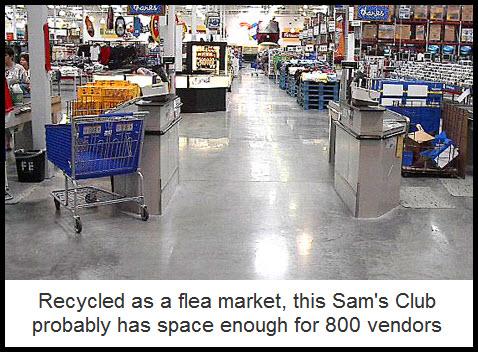
Like so many other local businesses that have failed in recent months, there often appeared to be enough shoppers in this particular Sam’s Club to keep things going until the economy improves. Apparently not, however. The store was losing money, according to a company spokesman, and there’s no way it can remain open under the circumstances. 128 workers will be affected, although Wal-Mart has promised to try and relocate them to other Sam’s Clubs in Colorado.
Binging Is Dead
The store itself occupies a 127,000-square foot building situated between a Kohl’s department store and an Albertson’s. What will become of this huge space? It’s hard to imagine, since few retailers generate the kind of sales it takes to pay the rent on a 127,000-square foot building. The same problem is likely to crop up in hundreds of towns across America: How will they recycle big-box stores when they go dark? The answer to this question, assuming there is one, suggests that America’s emergence from deep recession will not happen quickly. Ours is an economy than runs on consumption, after all, and it may be many, many years before Americans binge once again.
Even so, the spinmeisters speak of recovery as though it were happening right now and will be going gangbusters by spring. In reality, it could take decades for retail businesses in this country to grow into the huge spaces that have been vacated. When Lord & Taylor abandoned a huge, multi-story structure at the local mall, the space sat vacant for six years before it was subdivided for two smaller tenants. A bigger picture suggests the big- box concept itself may be dead, since the number of retail players who can turn a profit in a 100,000-square foot facility has dwindled to just a few. Will the unused buildings eventually be torn down? Or will they perhaps be subdivided for flea markets? Halloween has been bringing them back to life for a month or so every fall, but the costume business may have reached the saturation point in 2009. Maybe next year the “Halloween & Christmas Store” will be the thing?
(If you’d like to have Rick’s Picks commentary delivered free each day to your e-mail box, click here.)
Comments on this entry are closed.
FranSix wrote “negative overnight interest rates are going to take everyone by surprise.”
That would surprise me. I suppose if the Fed took short term rates to zero funds would go into longer maturity debt, commodities, and stocks.
What things do you see happening to cause this action of negative rates?
The paragraph below from Rick is the one yet to be properly addressed:
“Ours is an economy than runs on consumption, after all, and it may be many, many years before Americans binge once again.
Even so, the spinmeisters speak of recovery as though it were happening right now and will be going gangbusters by spring. In reality, it could take decades for retail businesses in this country to grow into the huge spaces that have been vacated.”
Indeed, by the spec sheet of our own government statistics (for how many years running?), ‘Consumption’ IS the Economy. Like, 70%+ ?
When the ‘consumer’ (we used to be called the ‘public’), has no further income to ravenously ‘consume’ – like a Pac-Man that runs around ‘consuming’, but does little in the way of Producing the same things he ‘consumes’ (that’s done now in the China-sphere of influence), there is no need for the ‘Big-Box’ stores to service that ravenous appetite for ‘consumption’ – and its attendant feature, Debt.
Most Americans have absolutely no idea of just how bad things are going to get – and that’s if we Don’t have a currency crisis thrown in for good measure… But to get an idea – or get one’s arms around the concept of what it Will take to turn our economy around, one need only look at how many years it took for us to transform ourselves from a primarily production-based economy, to a consumption/off-shored economy.
Was it 2 years? 5 years? 25 years perhaps…?
Even with a ‘crash-course’ in retooling huge, empty office & ‘Big-Box’ buildings into capable manufacturing centers that exported goods the world wanted to purchase, you would be talking years. Toss in myriad politics, environmental ‘impact’ studies, Bureaucratese and so forth – the concept of ever again having a vibrant manufacturing-based economy that supports a healthy middle-class becomes but an ethereal dream.
The Golden Gate Bridge was completed in (I think) roughly 3 years. With the aforementioned ‘special-interest’ roadblocks-to-progress, how long do you think it would take for us to re-tool – that is assuming, American business would even have the desire to re-tool here?
-CC
Of course, negative overnight interest rates are going to take everyone by surprise.
RA:
Interesting comments from Auerbach’s in your “just in” column. I think it is ironic that yesterday’s weakness started at London’s open and persisted right up to the end of Nymex trading. – and the dollar barely wiggled. I am shocked. Shocked. Just sayin’.
Ted Butler is spot on in his criticism of the lack of regulation of limits. Taking the the bankers argument to the extreme, no one would even mine gold. Too busy trading options, futures, swaps, sivs, blah, blah, blah. Who needs to produce when you can place bets? If you lose the bet just shove your losses on to the Fed and the taxpayer. Convince those that pay no taxes that those that do are screwing them and need to pay more…
The truth will set all free. We may have to go “Jack Bauer” to get it, though! Pass the blow torch and pliers!
Malls To Halls
I think the developers should consider taking this wasted space and converting it to schools. Where I live they are talking about spending a pile of money we don’t have to replace a very year old school. I am sure other communities have similar situations. Throw some solar panels on top and make BO happy, too. This probably makes way too much sense.
Besides, it wouldn’t create enough union jobs.
Theft by desperate (or not so desperate) people isn’t something we normally take into account when we see the face of shopping in some stores. Our local Wal-Mart is certainly no exception to this sad trend and perhaps the losses at your Sam’s were worse than it may have appeared. I appreciate your thoughts.
“Sam’s Club” stores are nothing more than a Wal-Mart Corporation marketing gimmick. Many of the items sold in bulk at my local Sam’s Club are available individually at the Wal-Mart Supercenter next door AT A LOWER PRICE.
Paying a $40 a year “membership fee” for the privilege of buying in bulk at high prices isn’t such a great deal. Seems like some folks are beginning to catch on.
WA-based Costco the better, fairer store, treating customers and employees better, catering to local small business entrepreneurs with Charlie Munger on the Board and Jim Sinegal at the helm. COST +61% and AR based WMT +54% from lows.
Schumpeter’s creative destruction just taking off to defy government moral hazard. Internet UPS basically putting big autos, boxes and offices out of business.
Two virtual futures:
A. Avatar or Robin Williams in Isaac Asimov’s Bicentennial Man while robots do the wars and work like Terminator for electronic credits and synthetics?
B. Growing our own in the sun?
The machine in the garden:
Drove a brand new ‘Green’ Ford Escape yesterday up and down the mountain in slippery snow to the Ritz. Nice, but I’d rather keep my cheap used car, cash and stay out of debt. Is that still an option when Uncle Sam is upside down and talking about taxing banks and healthcare?…
Look beyond the headlines… Sam’s is closing 10 stores but opening 6 new ones and remodelling others. I understand that for the employees and the local shoppers of the 10 closing stores – it all looks bad. But, the fact is that Wal-mart is just tweaking its warehouse stores.
The great thing about a big-box, esp one like sam’s club, is that there’s nothing to it, really; a bunch of steel rafters and some side walls, all of which can be dismantled and taken to your local steel recycler, maybe even for break-even if commodity prices go up. sell off the internal fittings (shelves.. what else?). recycle the copper wiring and lights. cash registers and self-serve-pay-stations, well, those we will need a lot less of, so that’s not quite as efficient as the rest.
for a Kohls or BB&B, there’s rather more wastage in the recycling but people will take just about anything for free.
leaving you with a bunch of concrete slabs. maybe those can be broken up and recycled for Obama’s public works projects building bridges to nowhere (or at least hopefully replacing 50-yr-old worn-out infrastructure).
Flint MI has showed us the way – via the bulldozer. knock ’em down and give it back to nature (or for those subdivisions of empty houses, give the empty lots to the remaining neighbors). more open space, cleaner communities, a quieter life.
is it value destruction? sure. but if the market is putting a value of near-zero on it cuz we overbuilt, is it really such a bad thing? or is it really better we just leave everything abandoned and end up with drug-infested ghettos heading into the infinite downward spiral we call Detroit?
we just have to be brave enough to fire up the Cats and put ’em in drive.
The empty big box stores will be perfect to fill with cots for the homeless, jobless americans of the future! Just imagine the post Katrina Superdome in every little town in America! The more affluent Americans will be able to afford Japanese style “cocoons”
with a TV and radio. Those will be the ones with 32 hour a week minimum wage jobs with no benefits! We’ll also need lots of warehouse space for the tidal wave of boomers with Altzheimers and kids too broke to take care of them. That’s some future for this country, isn’t it? I believe “Change” is the operative word involved!
The business credit and consumer credit charts produced by the (St Louis) Federal Reserve itself are telling the ugly story … but few want to see and/or listen. The recent and current Fed charts are OUTRAGEOUS.
Here are some other deflationist sites – Calculated Risk blog, Mish blog, Nate Martin blog, Denninger blog, Zero Hedge blog et al – that have regular articles that reference the official Fed charts.
Again: The recent and current Fed charts are OUTRAGEOUS. They are grotesque. Total bank credit is pancaking in a display that hasn’t been seen in this country since the 1930’s. Bank lending has ground to a halt and the band-aid applied by the Powers That Be cannot conceal the hemorraging of the patient much longer. We have entered a true crisis era in American history and we are now “re-normed” to conditions of extreme economic dislocation.
Rick
yes some businesses here have been struggling as well. (west suburban chicago). but how’s your Costco doing? most people around here prefer Costco. they seem to be doing ok. ?
&&&
More traffic than Sam’s, for sure. Don’t know why Sam’s allowed Costco to retain that edge. RA