
Homeowner ‘Rescue’ More Like an A-Bomb

Although Bank of America has won praise from the news media for offering to reduce the mortgages of tens of thousands of underwater homeowners, Rick’s Picks readers were less kind in their assessment of the new relief program. One reader who posted in the forum saw it as an act of desperation – B of A’s only hope of keeping foreclosed assets from being liquidated at street value. “[The bank is] leveraged so highly that they have no choice but to write down twenty percent rather than take one in the teeth,” wrote Mark L.  We ourselves had called mortgage modification the most consumer-oriented idea to come out of the banking sector since the real estate crash began in 2007. We hadn’t intended to sound so kind, since, no matter what kind of rescues are tried, we still expect real estate prices to fall by a further 35 percent before deflation has run its course in perhaps five to seven years.
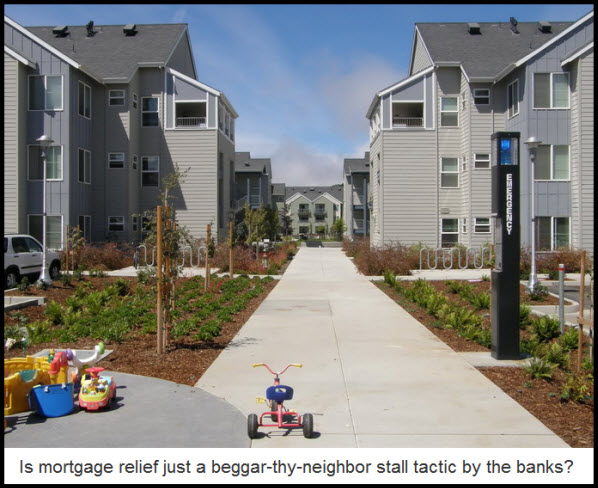
We also think that by bailing out homeowners directly, the banks have inadvertently made the underlying fallacy of mortgage relief transparent – so much so that even such as Paul Krugman, the aggressively obtuse economics writer at the New York Times, is likely to recognize the plan’s fatal flaw before too long. Krugman and his colleagues have come only halfway in describing the problem, noting the moral dilemma of rescuing homeowners who bit off more than they could chew with the tax dollars of those who were prudent enough to stay out of trouble. What the pundits have failed to point out, however, is that the prudent will pay an even bigger price when their homes drop in value by tens of thousands of dollars overnight after their “rescued” neighbors’ homes have been marked down by lenders.

$250k Markdown Overnight

That is of course the way home prices are established: at the margin.  Thus, if there are six homes in a cul de sac valued at $750,000 each, and one owner has to sell for $500,000 because he gets on the ropes, then all the homes in the cul de sac will effectively have been devalued by $250,000. It makes no difference whether the homeowner stays in the house or sells it, either, as everyone but Krugman, the banks, and mainstream pundits will already have figured out. What puzzles, however, is Bernanke’s decision to terminate the Fed’s buying of mortgages at the end of March.  It’s one thing for the Fed to spin the lie that the economy is recovering when in actuality the stock market and a handful of companies have merely upticked on $14 trillion worth of direct bailouts, pledges and loan guarantees. But it is quite another to act as though the recovery is real.  Can Bernanke and the crackpots who rule our economic lives actually believe that removing the pins now propping up a terminally weakened real estate market will not cause the entire, hollow edifice to collapse?  Although that is the only way the housing market can get unstuck , it surely cannot be what Bernanke and the feather merchants he serves intend.

(If you’d like to have Rick’s Picks commentary delivered free each day to your e-mail box, click here.)

  • gerry333_at April 3, 2010, 1:52 pm

    Hi,
    as foreigner I am not familiar with the mortgagebusiness in USA. I wonder what is the problem beeing “under water” as long as I can pay my monthly payments. Even when I cannot, why is it not in the interest of the bank to extend the loan for lower monthly payments.
    I would appreciate any comments on that.

    Regards Gerhard

  • cp March 30, 2010, 3:03 am

    Somewhere I read that part of the write down on loans would involve the loan going from a non recourse to a recourse loan. Not such a good idea if prices are headed farther. The advice was “Run as fast and as far as you can”.

    Could have been Automaticearth.com or zero hedge. Anyone else hear that or am I hallucinating again?

    cp

    &&&&&&&&&&&

    CP, here is the way “Jason” explained it in an earlier post:

    In many states, the first mortgage is a non-recourse loan. If the borrower defaults, the lender gets the property. The loan is secured by collateral or real property, and the borrower is not personally liable.

    If a loan is refinanced, or converted to an equity line of credit, for example, these loans can be made to be recourse. If the borrower defaults, the lender gets the property and likely sells the property. If the sale of the property does not cover the loan balance, the lender comes after you for the difference.

    The lenders realize that a large segment of borrowers cannot afford the houses, and it is just a matter of time before the default. If they can make the loans recourse, they can get more of their money back.

    …and he added the following:

    In general, when the 1st mortgage (non-recourse) is refinanced (including HELOCs), it is the intent to change the terms of the old loan with a new loan and new terms. The lender can change back the terms of the loan to favor the borrower, but why would they want to do that?

    When someone refinances a non-recourse loan, it would be prudent to try and get non-recourse terms on the REFI. If that is not possible, a borrower should weigh whether losing the non-recourse terms would be worth it to do a REFI.

    Many people are not aware of their state laws, the terms of their loans, tax consequences.

    For example, when borrowers who had recourse loans got foreclosed or did a short-sale, all of them thought it was all over. They get new jobs, get back on their feet, build up some savings. Suddenly, they wonder why their checks have not cashed; there is plenty of money in their account. Then, they find out that their lender is now coming after them for the rest of the balance of the loan.

    In addition, some states did not follow the Federal suspension of treating mortgage debt cancellation as income. So, the borrowers are also getting hit with a large tax bill.

  • FranSix March 30, 2010, 1:25 am

    A part of the housing debacle that is never discussed is the formation of unregulated risk cartels that set the agenda. Return the risk without liens to the owner.

  • Max NIGH March 29, 2010, 10:53 pm

    What is your problem with neighbors losing market value on their homes by helping distressed people by bringing their mortgages in line with reality.
    The reality is the neighbors have already lost their value in their homes. That occurred in 2008. It happened to me too. My condo in Naples was worth $250 k in 2007. Now it is worth $130k. I know because I am selling it. That is Real Estate and its market. Neighbors of foreclosed properties should be happy we are coming to proper values, and have people in houses to keep their neighborhoods attractive.
    bank of Anmerica, and other banks are the ones to be ashamed of for not being humane in their mortgage holdings. GREED GREED
    GREED.

  • JohnJay March 29, 2010, 8:51 pm

    Susannah, I believe most people already know how corrupt the system is.
    The problem is, how to bring about change when the political process is as corrupt as the system it governs. We are all waiting for a leader to appear, and it may not happen. Without real change real soon, the system goes bankrupt and collapses.

  • PhotoRadarScam March 29, 2010, 8:14 pm

    I think my point was missed. Market value is the price that a willing and able buyer and seller will agree to under normal conditions. However, in this market, particularly in the jumbo loan sector, normal conditions means distressed sales… non-distressed sales are rare (at least in my area). Distressed sales are the market. There are no buyers for non-distressed properties unless the non-distressed properties are priced at distressed levels. The people in your example at $750k are kidding themselves.

    so my point is that there is no or will be no loss of value due to mortgage modifications… the value has already been lost. The only condition where there would be extra losses would be if the mortgage modification were to happen at a lower level than current market value (less than $500k in your example).

  • Susannah Surgeoner March 29, 2010, 5:04 pm

    Hi,

    Having been a Realtor for 24 years in California and Nevada, I have seen 3 crashes in home values in my career. Foreclosures and short sales are now almost 90% of home listings in Southern Nevada. I have been writing a column for a little weekly paper on the real estate scene for a while now.
    Here’s the the main discrepancy in the works: banks are willing to take a 50%-70% loss on short sales and foreclosures but will not give the home owner the same break. This has caused millions to simply walk away from their homes.
    Market conditions ALWAYS rule the day. Values are based on supply and demand in real estate just like any other commodity. The supply of foreclosures and short sales far outweighs the number of buyers across the country.
    Residential Real Estate moved from a long term hold into a short term investment for many when Clinton lowered the capital gain tax rate in the early 90’s. We are so far away from the views of our parents that a home loan was something you paid off and burned the paperwork, that the idea of paying off a mortgage has become joke to most of the homeowners in the US.
    Like anything, values go up and down with market conditions. Just like corn or gold, a buyer either sells or buys as the market conditions dictate.
    Banks became the main players in the mortgage securities market when Glass-Steagall was trashed in 1999. That produced a huge demand for home loans that could be sold. They designed no-job, no-qualifying home loans to fill the demand.

    Everything went swimmingly for five or six years. But then, I think it was 2006, Goldman Sachs stopped buying mortgage paper and put the word out on the street that they weren’t buying any more. Their reputations as the smart guys on the street caused many investors to follow their lead. In the same year, GS sold $100 billion in mortgage backed securities, went short, and bid up the price of crude. I believe GS was the instigator of the violent crash that we’ve seen. The whole thing could have been unwound in a much different way except for the greed and immorality of GS. Of course, they were also the the top advocates of trashing Glass-Steagall through their golden haired boy…Robert Rubin.
    The banking sector owns this country. B of A giving a 30% break to homeowners is really an attempt to profit $20% to 40% over what they’re losing in short sales and foreclosures. It is disingenious in the scheme of things.
    When are Americans going to wake up to the fact that banks rule both the day and our elected officials?

  • JohnJay March 29, 2010, 4:44 pm

    Great macro economic view of the last 40 years at this link.
    http://news.goldseek.com/GoldSeek/1269458303.php
    What if the entire economy stocks, real estate, everything, was just one big bubble for the last 40 years? Take away the access to debt and it all slowly fades away.
    Sort of an economic Unified Field Theory. Or perhaps the ballistic curve of an artillery shell.

  • Mark Loeffler March 29, 2010, 4:30 pm

    Mr. Bernake knows darn well that the home shell game has no chance in surviving. Another huge drop in the Dow ahead will wipe out all gains from the last 13 months. Any home owners invested in retirement accounts thinking of using them as a sefety net will be vaporized when the Dow finally starts to unwind to the bottom. The Fed knows this and they also know they will not be able to use TARP II to save Freddie or Fannie from another takedown. Their goal will be to save the bond market (10x the Dow) from complete destruction and will gladly sacrifice the stock market to do so. Besides, without a stock market people will have no option but to put their money in Bonds, Gold, or Foriegn Currency. Why March? Well Rick I will leave that to you since you are the numbers guru. It looks like the impending doom may come sooner than later.

  • Rich March 29, 2010, 3:53 pm

    Bad apples can rot the whole barrel.
    Can’t fool mother nature or the markets forever.
    What’s annoying about this latest banker bailout disguised as consumer rescue
    (40,000 out of 6 million homeowners underwater with Obama Mortgage Mod Plan falling far behind targets of 2M), is that it taints everything else.

    Successful Silicon Valley Stanford Engineer MBA Entrepreneur close friend set to release the best battery replacement product on the market by a factor of 20 into Apple Stores to power iPhone, iPad etc with sun power, patent protected by the inventor of MP3 and hot.
    http://www.youtube.com/watch?v=rPkVUkePmPI 1:07
    He’s raising mezzanine working capital until sales ramp up.
    Three years ago the startup had people lining up with too much cash and they had to politely decline oversubscriptions. Now he’s got the $99 product ready, he’s stretching to close just $750K of 10% converts & warrants with $50K minimums for an end of the month closing before the Institutional Round at higher prices after sales ramp up. Too many smart people strapped by bad real estate and economy. Email him at warren@solarcomponentsllc.com for private placement memorandum.
    Meanwhile, our mantra still: Adversity creates opportunity. When the going gets tough, the tough get going. Many outstanding companies founded during depressions…

  • Other Paul March 29, 2010, 3:10 pm

    OMG, maybe the Feds and Govmint are going to let Mr. Market have his way with us!

    Or is it just that the Treasury’s payables to green ink and currency paper companies over 90 days past due?

  • Jeff Kahn March 29, 2010, 1:11 pm

    I agree the moral hazard explicit in all these bailouts is egregious. Economically Obama is hastening the destruction of this country. However, I could do without the cheap dime store psychology of the last article about how Obama’s relationship with his wife and mother proves he hates America. What’s next? An article proving that big noses show a lack of character? Let’s stick to trading and economics.

    &&&&&

    Spengler’s analysis was highly provocative, if not to say incendiary, but it was hardly dime-store psychology. The logic was, I think, easy to follow and persuasive. RA

  • donniemac March 29, 2010, 11:18 am

    Loan balances are either paid by the bank or the lendee. Therefore, the someone who is going to “pay” for the housing bust is the banking industry. And eventually the taxpayer probably will be called upon to prop up the banks. Maybe through very liberal tax write offs of bad debt or through another round of bailouts, who knows. What the collective we need to have happen is to have the current economic growth to be real. I know that doom and gloom attitudes seem to be the norm, but from my view, a return to a functioning economy is slowly becoming a fact. But there will be a large number of citizens who will have there lifestyles drastically altered. In particular, early boomers who are say 55 or older and who did not create any savings to speak of. I know as my wife and I have a family full of them. And some of them are running scared. But I am off-topic. As the economy starts to gain some momentum, the pain of deflating the housing bubble can be eased, hopefully enough to not put economic activity back in a tailspin.

    The big unknown, IMHO, is how are the masses going to react to not being able to satisfy their consumer itch at the flick of a piece of plastic. For the extension of unsecured credit, or credit lines secured by home equity, is surely going to greatly curtailed. This is being seen by raising of credit scores to get mortgages, or good car financing, or something other than am 18% rate on a credit card. What I think is going to happen is more of a stagflation period similar to the 70s as we unwind the debt bubble and return to a more 1950s/1960s-like period of credit usage. People will be employed (and hopefully learn how to save), real estate and real money (when I first learned of gold, this is what it was called) will appreciate in fiat money terms. And that will allow the bubble to deflate. At some time in the next 10 years or so, fiscal conservatism will become the norm. Those of us who have practiced that in our private lives will celebrate a return to sanity and the next bubble will be born. 🙂

    You are correct about those of us who will not see balances reduced as we did not allow ourselves to get into trouble being angry about paying for the sins of my irresponsible family members. But the reality is we all pay for the dummies. I used to be opposed to laws that protect people from themselves and create a nanny society. But I have slowly come to the realization that those laws also protect me from the irresponsible. So as I pay for some idiot who cracks his head open when he falls off his motorcycle, I become a supporter of that person losing a bit of his freedom through mandatory helmet laws. And thus is goes. For we all pay, one way or another, for the less mature and responsible among us. So back to the anger of seeing my brother get “bailed out”, I will get over it as that is better than the alternative which is to have him come live with or off me.

  • photoradarscam March 29, 2010, 8:39 am

    “What the pundits have failed to point out, however, is that the prudent will pay an even bigger price when their homes drop in value by tens of thousands of dollars overnight after their “rescued” neighbors’ homes have been marked down by lenders.”

    Nothing will drop overnight. In your example, if the guy has to sell at $500k, then that’s what the other homes are worth and have probably been worth for quite a while. They were delusional (or uninformed)if they thought their homes were worth $750k. There are probably comps to support the $500k figure out there already. Even if not, if $500k-guy can only get $500k, then none of the $750k guys could get $750k if they wanted to even before the $500k sale. Furthermore, if $500k-guy requires a short sale approval or is a foreclosure, the banks are still not willing to sell for much less than an appraisal shows. So at best, the other homes are worth $550k (not 750) and the bank is accepting a short sale for $500k.

    If there is a mortgage reduction, the reduction will be to the current value somewhere in the $500-550k range, and the neighbors won’t see much if any change… as their homes were worth only 500-550 whether they knew it or not.

    “What puzzles, however, is Bernanke’s decision to terminate the Fed’s buying of mortgages at the end of March. ”

    My guess is that we’ll see some news this week or next that will extend the buying of mortgages. The real estate lobby is powerful, and pressure from congress will be tough to ignore. That announcement, I think, will kick off a nice new move in gold Thursday or Monday.

    &&&&&

    See my note beneath your other post. RA

  • QQQBall March 29, 2010, 6:46 am

    So it’s in my best interest to pay off my neighbor’s home to support the price of my home? Ha! Sir, that is just plain silly & extending that logic (or lack of) to other areas of finance and commerce is a nightmare. So you write some guys mortgage down from $750,000 to $500,000 at 100% LTV and then the property value declines another $165,000 (-35%) – then what, more wealth transfer? Get your finger out of the market and let supply, demand and price equilibrium decide. Once again, the equity is already gone, pretending does not change that.

    Same principal I suppose with the FED? They should buy more toxic assets with a value of 50-cents for $1.00 so they don’t lose money on the crap they have already purchased? I believe the FED bought the paper at inflated prices to buy the banks time and put some lipstick on their balance sheets (and stock price) to allow them to tap capital markets and issue more shares – same with mark-to-myth via FASB – same with banks not foreclosing and realizing losses. Extend and pretend isn’t a solution, it’s a circle-jerk.

    I don’t think we are gonna agree on this and it’s your site, so I won’t beat this dead horse again. Good trading!

    What is happening is that everyone wants a loan mod – it’s seen as free money. People want to work off the books to show less income.

    &&&&&

    As far as I can tell, we agree, Q-ball. RA