
We’ve become used to jobless economic recoveries, since, more than anything else, it is the downsizing of payrolls that has caused corporate profits to rebound from recessionary troughs. In theory, this is part of the “creative destruction” that helps the economy get lean and mean: Workers who have lost their jobs migrate to stronger companies, many learning new job skills to meet the demands of emerging businesses. This time around, however, so many key sectors have downsized, especially finance, retail and real estate, that there are not nearly enough emerging growth sectors to take up the slack.
Which sectors of the economy seem likely to grow the most over the next 5-10 years? Unfortunately, signs point to health care above all, since, if Obamacare takes root, that’s where the lion’s share of new federal spending will be going. We say “unfortunately,” because investors chasing all those new Obamacare dollars will tend to misallocate capital so that it finds its way into what promises to be the most expensive and wasteful boondoggle ever undertaken by Big Government.
You can be sure that many companies are preparing for a boom in healthcare and that they will shift their resources into related businesses when the time is right. And just as every corporate Tom, Dick and Harry eventually found its way into some aspect of banking or finance during the boom in real estate and securitized debt, companies with no connection to or knowledge of health care will find pathways into its most promising areas of growth.
Doctors Stampede to Retire
We should like to think that the growth will occur in places that are crucial to the actual health of the population. An example of this would be the training of, say, 5,000 new physicians to practice general medicine, and providing incentives for them to open offiices in small cities and towns. In fact, that is most unlikely to occur, since physician reimbursement rates are all but certain to continue lower as the federal government’s role in health care expands. For their part, doctors have already started voting with their feet, retiring from the profession in vastly larger numbers than ever before. It seems predictable that those who remain will be corralled into assembly-line clinics and hospitals designed to achieve the economies of scale necessary to command federal (i.e., taxpayer) subsidies.
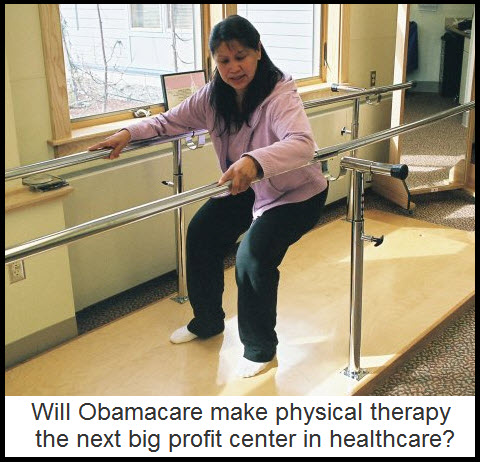
Just a tiny change in the government’s priorities will cause tidal waves of money to move from one place in healthcare to another. If, say, Washington should decide to increase the reimbursement for a home visit by an infusion nurse from $180 to $205, a thousand mom-and-pop infusion businesses will spring up in a matter of months. And if the government elects to pay a bit more for physical therapy, then outlets for such treatment will multiply like topsy. Nursing homes and assisted living centers will install their own PT facilities and run them as “profit centers” geared to compete with private practitioners. Aging baby boomers may benefit from an explosion in physical therapy, but the rest of the population will pay dearly for it. The Government is in business to make such mistakes – and now more than ever, since the only imperative driving it at the moment is growth for growth’s sake.
(If you’d like to have Rick’s Picks commentary delivered free each day to your e-mail box, click here.)
Comments on this entry are closed.
don’t understand why everyone is so negative re universal health care- with our Canadian system we go to the doctor when we feel sick and go to the hospital when required and it doesn’t cost a penny out of my pocket.
Sure we pay through our goverment but the costs are controlled by them -and sure sometimes there are some waites but anyone that has a life threatening problem is treated immediately .
I am middle class and the total incometax I pay wouldn’t pay for the costs of US healthcare insurance.
Our doctors do quite well thankyou and also enjoy living in our great country were they don’t have to have health insurance either.
Reg
&&&&&
U.S. private medical care has ramped up fees to accommodate the costs of subsidizing Medicare, Reg, and to nourish the nation’s uniquely entrepreneurial healthcare system. If you impose a significant new layer of government meddling, you can only wind up with drastic rationing. Bear in mind that the U.S. would not be starting with the same, relatively low-cost structures as Canada or Europe, and the only way to get costs down from where they already are would be to provide (much) less care. RA
Right now doctors and hospital prefer to be paid, in this order:
1. Privately insured
2. Medicare, Medicaid
3. Self-payers (generally uninsured, generally don’t pay)
After Obamacare and other social programs blow the dollar to smithereens, healthcare providers will be accepting patients in this order:
1. Self-payers with hard currency
2. Self-payers with barterable goods and services
3. Fiat currency holders (if by the barrel)
4. Gov’t insured, no wait, there won’t be any.
Probably the best insurance to buy now is a roll of sovereigns or the gold and silver coins of your choice.
One could say I took an enormous risk this past 14 years post-divorce with no health insurance. I suffered a serious neck disc injury of some sort between 5 & 6 vertebra, if I had been in the states at the time, it would have financially devastated me BECAUSE I was ignorant to not know that if you get such an injury without health insurance in America, you hop on a plane and park your ass in Thailand or China to get it taken care of for relative peanuts. And I do mean peanuts; $50 for CT-Scans, $120 for MRI, $10 for x-rays, $7 for therapy treatment sessions, $75 for a 3 visit root canal or tooth veneer….I kid you not.
Understanding the risk is important, otherwise self-insuring with the money you save is a great idea, particularly if you are able to go or live in Asia/China to get that care. I’ve saved well over $100,000 cold hard cash in 14 years between insurance savings and the radically lower costs I’ve paid for medical treatment and services here. But for some, that may be extremely inconvenient or prohibitive in some way, such as having to leave your wonderful wife and four kids back in the states for six months…not an easy thing. Medical “tourism” is big business and booming for all the right reasons. Consider it seriously as an option easily researched online.
Cheers, Mario
Problems with the cost of healthcare, problems in banking requiring the republicrats to pass/put up for vote legislation at 5:00 today on Banking Regulations.
Our collective problem is the 50% slice of the people who pay no taxes and vote for irresponsible legislators who will PORK anything. There are two pieces of ‘legislation’ that cure all problems if they are enforced:
Article I, sec. 8, cls. 5 keeps the current banking fraud from even starting. But, the legislator would not be able to engage in wholesale whoredom to fiat.
Article I, sec. 10, cls. 1 keeps the Governors of the State from selling their flesh to the federal territorial whoredom of the congressional rebellion.
At root, the ills of healthcare can be traced to money at 1-8-5, 1-10-1 via the most sinister of abuses at Article I, sec. 8, cls. 3 commerce wherein the african Obama says that he has an executive right to keep the slaves healthy, or the sickness will affect interstate commerce.
The only problem with the congress is the masses of corporate persons that elect the criminals, and the jury who will not prosecute the criminal legislator. Each legislator confesses to crimes of omission, or crimes of admission. Healthcare – there is a sickness in the country that was once a Nation of Freedom.
Forgot – prior to mobocracy only a ‘landed’ person was an elector. The reasons are many, and were abused by both the ‘robber barons’ created by the legislators, and currently by the illegal immigrants who own nothing, and have no loyalty to the Nation of Our Fathers – who vote for Pelosi and Frank, and Reid. The ‘robber barons’ could have been taken care of if it were not the intent of the legislators to have the crimes engaged by the likes of the railroads, and merchants.
All good (and quite true) points to make, Rick. Only thing is we don’t have to wait to see it, as many of those things have already been happening for at least the past decade (if we’re talking about noticable, but subtly over the past two decades this trend has been).
I don’t know about anyone else, but a high number of the adult branches on the ol’ family tree is in the medical profession, one way or another. Whether insurance, nursing (especially), physical therapy, billing (another especially), pharmacy… no doctors, though. Never a doctor, either, except the ones living in Mexico that my grandmother used to tell me about (lucky her, she had a massive stroke and now the therapists come by maybe once every couple of days to give her a ball to throw a few times before moving on (god bless those highly trained professionals who work under such pressures)
Anyway, because of that closeness to the medical industry, I’ve been hearing for years now about how nurses are increasingly called upon to act as doctors, among other problems. And then there’s the TV ads, junk email, and other internet pop-up garbage about how some school or another offers training in the fields of the future, those of nursing and/or physical therapy.
So it’s little wonder to me that I don’t even see my GP anymore and haven’t done so for nearly… Huh. Come to think of it, I don’t think we’ve ever met! When I needed to see him, there was a two month wait (minimum) and that was pretty much the case with any other doctor in my area. After so many ER visits, I stopped bothering with trying to arrange visits, and now rely on an RN to take care of the referals and prescribing/refilling of the drugs.
And given my experiences, as well as those of my father in recent years… You can pay good money for good insurance but that doesn’t mean diddly squat. Quite simply, people get put through hell in the constant war between who should get paid what. Rationed care is already here, and I suspect it has been for some time, just worsening with age as one would expect in this already government-dominated, coverage-oriented system we have. Even when sick or injured, you have to bend over backwards at least a few times before anything half serious is done (and all for the low, low price of 4-6 grand a year do you get to experience this hell!)
True, hell probably doesn’t await everyone but yes the decline in quality will not be deniable. At least I friggin’ hope it won’t be denied, because if it takes anymore than that we’re doomed for sure.
Oh, and as always I say on the matter of medical coverage… If the problem is doctors and insurance companies bickering over who gets paid what, then maybe we should all ask ourselves what the best insurance policy really is. In our eternally limited pool of capital, do we have need for _doctors_ or coverage (however provided)? Is it true that without so-called wide-spread access that coverage supposedly provides that few of us no-good free people would become doctors (yours truly would have, btw)? Or do liberty-challenged, government money-pigging people become nurses by the droves instead (while the trough is still being filled, til the time physical/mental therapists do what nurses do today because of a doctor _and_ nursing shortage)?
&&&&&&
I’ve been close to ground zero myself — all my life, including a stint as a recruiter of physicians, PTs and nursing home administrators. My mother was a (volunteer) nurse, my father was a physician, and, growing up, my doctor visits were comped under “doctor’s courtesy,” a quaint tradition that disappeared more than a generation ago. Over the last 20 years, I’ve seen the value of my health insurance dwindle almost to nothing. When my wife taught at a California college, we had nearly-free care, and two $20,000 pregnancies cost us all of $200 out-of-pocket. “Frills” like eye care and dental were covered 100%, and the insurer didn’t blink when I ran up an $800 tab with podiatry visits needed to get a pair of $500 orthotics for my running shoes. It bothered me that state employees had such ridiculous benefits, and I knew there would come a day when California realized it could not afford to provide them, but because I was on the receiving end I learned to simply enjoy them while they lasted.
Now, 20 years later, and following a succession of a dozen insurers, I am on the same track as everyone else: You get a huge premium increase every year, you look around for another insurer that will give you a better deal, you find only an insurer that will give you a merely somewhat higher price, but for less coverage. The last good policy I had was a COBRA with CIGNA that offered all of the benefits that were available on high-end company plans in 2003, when I briefly worked for someone else. A few years ago, CIGNA jacked the premium from $360 a month to $1100, so I had to leave the plan (as I’m assuming nearly everyone else insured in Colorado would had to have done).
With my current insurer — a high-deductible plan — I pretty much assume that virtually nothing is covered other than prescriptions with a big co-pay, and perhaps one or two visits a year to my primary physician (with a co-pay). I am rated 30% for a minor, chronic condition, and excluded for anything related to prostate because, at age 60, I have visited a urologist once a year. The coverage stinks, really, and for all who are self-employed as I am, Obamacare threatens to only make it worse.
It’s horrendous on the physician end, too, and no wonder doctors are retiring in droves. You’d have to be nuts to go to medical school these days, since the handwriting is on the wall for the specialists and the medical elite who are still making good money at it. To rationalize going to medical school, you’d have to “know” that you will be one of those elite physicians who will be able to build a practice with patients who pay privately. I doubt that it is even possible to build such a practice nowadays, since it takes ten years of word-of-mouth from satisfied patients before you reach the stage where you can tell patients you don’t “do” insurance.
RA
Thanks for responding, Rick. I just wasn’t expecting a response, let alone one of that length.
Nice to hear how things used to be. Heck, I never had a home visit. Sounds so strange to me, the idea of my doctor coming to my house… I’m not sure I would want that becuase it sounds weird. And California… yeah, sounds about right! No wonder they’ve always been so laid back and relaxed!
But as for the disappearing act, I think it’s like the irony of trying re-inflate. For all the new money created, the old peaks have yet to be surapssed. We’re spending too much money on healthy people, those infernal policies, so something has to give.
Oh, and on the med school blues… Yeah, I’ve been at that gate. I never did go, and more than anything, it was because I didn’t want to deal with insurance. Oddly enough, though, it wasn’t because of any inside knowledge about it, or anything like that. It’s just that for a long time, just by how people regard it (manicaly)… I never did trust it. Just didn’t “smell right” to me and I didn’t think it could possibly be conductive to what I wanted to accomplish. Yet, I didn’t see any way around it. Sad, but true. Lots of talent does go elsewhere, and not nessecarily as medical professionals. Me? I became a truck driver. Strange how these things work out, huh?
Rick, just to put some numbers on the doctor problem from a place where a national system has been in place for years (not as horrific as Englands….).
In Germany, a physician, not just a GP, treating an in-system patient receives EUR 25 per QUARTER.
That is the equivalent fo $134 per year for this patient, whether he comes once a year or once a month, etc.
Compare that to the $100-150 a single visit usually costs these days stateside. More and more are finding the profession unattractive, just as you point out.
And, to keep these physicians from prescribing too uch, they have a prescription allocation per quarter.
When its exhausted, they either do not prescribe till the next quarter, or they make up the difference from their own pocket.
FYI, you are mandatory in-system if your monthly/yearly income is below a certain threshold, similar to how social security works here. If you make above that level, prob. about EUR 6500/month, you can insure privately.
Needless to say, healthcare costs are much lower with these strictures (eye doctor visit about $50), but far from being a good thing, it is just price control, with the long term consequences of that.
To go another step further, you visit England, with its horrific “go-to-the-hospital” carem abd joing the waiting room throng for anything other than GP-stuff: “when would you like the appointment, in 6 months or 5?”
We knew that America was on a destructive course before any of us heard the name, Obama.
Denninger weighed in with a rant on Obamacare and suggested shorting insurers. His thesis was: If the insurers have to insure you, yet your penalty for not taking insurance (if caught) was only $2,000, then why not pay for your minor health issues with cash and if you get catastrophically ill or injured, then get insurance. Try getting insurance for $2000 a year. It sounds like a recipe for extinction of US health insurers. Seems pretty logical.
It won’t be long until the govt is giving tax credits for weight loss. Buy Jenny Craig? Weight watchers? Nuts.
&&&&&&
The hole in the logic is the $150,000 in bills a stroke victim will run up before he can get coverage. Anyone who opts out of insurance will face this risk. RA
That’s what people should have been doing all these years, imv. Coverage is nonsense. We need doctors, and that’s it. Insinuate a policy that insures the frailty and mortality of human beings… Well, limited capital strains to even educate enough of them, let alone give them incentive to stick around. We’ll see how that dead paper policy does on the operating tables.
But what worries me is that once doctors (and probably nurses) start to quit for the want of pay, if government won’t get more iron-fisted. Throw a war into the mix, say, and it may well be “justified” to force them to work for free. And war needn’t be in Iran…
“It won’t be long until the govt is giving tax credits for weight loss. Buy Jenny Craig? Weight watchers? Nuts.”
Nuts, but already true, I’m afraid…
http://junkfoodscience.blogspot.com/
I can’t recall where and when, exactly, but Ms. Szwarc frequently brought those sorts of progams to light, both proposed and already implemented in some states/towns all across the dead republic. For a thousand reasons they don’t work, but the important point here is that they’ll tell you that you spend too much money on food, but will spend lots of money to cut calorie intake. Nuts, nuts everwhere… but not a single expensive one to eat! lol