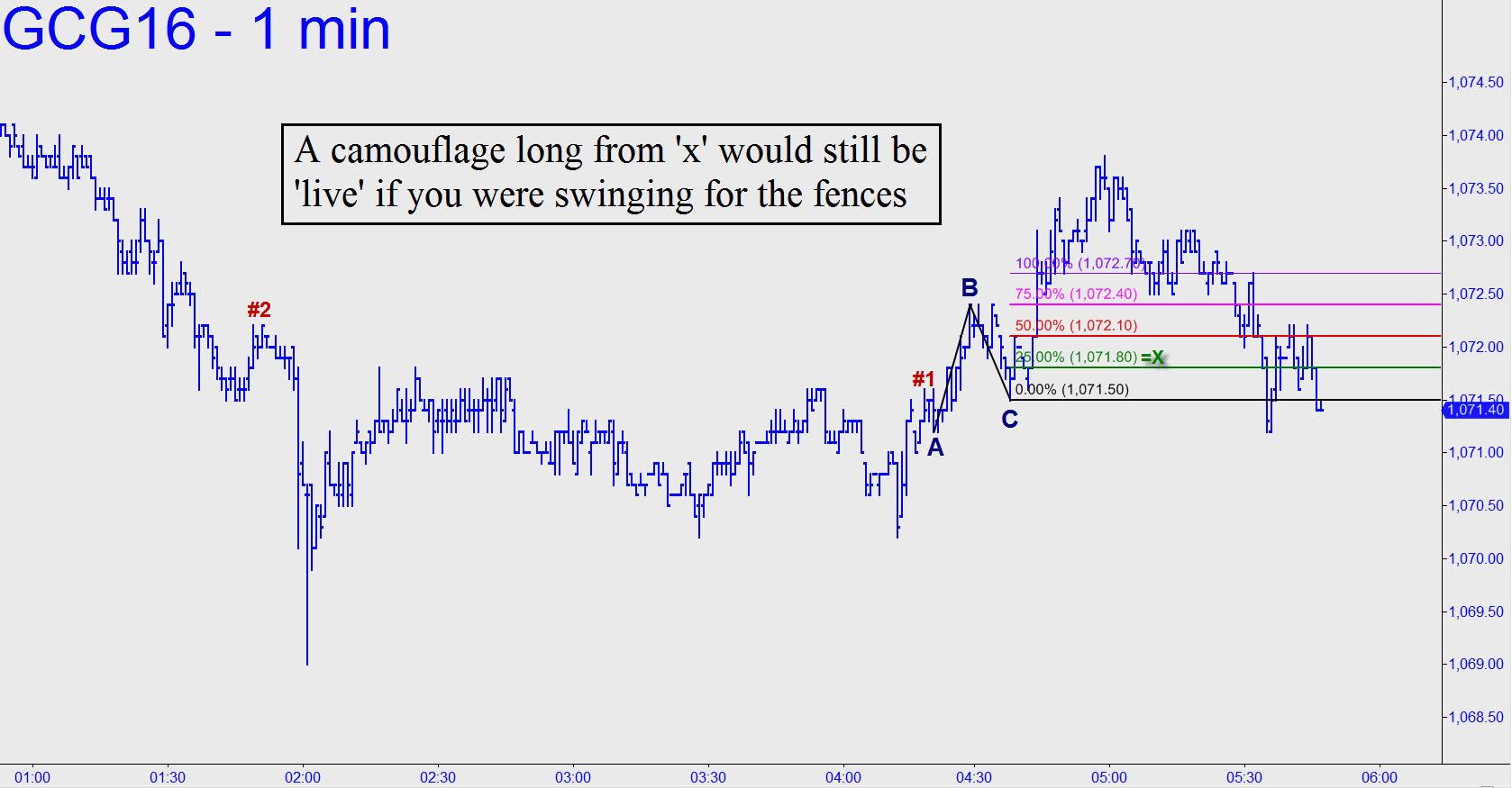
 Bulls retained possession on Monday, extending Friday’s sharp rally with another. Subscribers reported getting aboard ahead of the move using the ‘mechanical’ bid I’d suggested on a pullback to 1068.25. I subsequently advised exiting half of the position at 1073.25 via an update to the tout; then, cashing out a third contract at 1078.90, the ‘secondary’ pivot shown in the chart. This has left us with a tracking position of one contract and an effective cost basis of 1047.60. Bulls were no worse than an even-odds bet to hit 1089.60 by Wednesday, but night owls may need to craft their own bid to get aboard if they aren’t already, since there was no ‘mechanical’ set-up to use for this purpose when we went to press. (I’ve sketched one hypothetically, however, for your further guidance.) Ordinarily I would recommend cashing out what’s left of the position if the futures get close to 1089.60. This time, however, we’ll go for long yardage by implementing an ‘impulsive’ stop on the hourly chart when 1088.20 is hit. That implies exiting the position if a down-leg exceeds two prior lows without a visually significant upward correction. _______ UPDATE (December 22, 8:50 p.m. EST): We remain long a tracking position consisting of a single contract. Gold gave up a little ground Tuesday, but not enough to suggest that any damage has been done to the hourly chart, which remains quite bullish. Belated buyers, please note: a mechanical buy on a pullback to p=1068.20 would require a 1061.20 stop-loss, but you can cut the initial risk dramatically by using a ‘camouflage’ set-up on a chart of lesser degree. Start looking around 1069.00._______ UPDATE (December 23, 7:52 a.m.): The futures rallied $4.80 after bottoming overnight at 1069.00. Using the one-minute chart, the first ‘camouflage’ entry signal one could have used to get long occurred at 6:39 a.m., at 1071.80. The initial theoretical risk would have been four ticks, or 0.40, using this pattern: A=1071.20 at 6:21 a.m.; B= 1072.40 at 6:29; and C= 1071.50 at 6:38. Half of a four-contract position would have been exited at p=1072.10 for a small gain; and another contract at D=1072.70. The single contract remaining would have a profit-adjusted cost basis of 1070.30. If you used an impulsive stop-loss on the one-minute chart to manage the position, you’ d have been stopped out for a $120 total gain at 7:35 a.m., at 1071.40. If you were swinging for the fences, a break-even stop at 1070.30 would have left you in the trade. For the benefit of Pivoteers, I’ve drawn a new chart that summarizes the above visually. For those who are unfamiliar with ‘camouflage’, the chart offers a rare glimpse of a proprietary trading tactic.