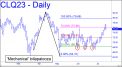
The unorthodox reverse-pattern shown has worked so well, generating three profitable 'mechanical' buy signals at the green line, that we should confidently expect it to produce yet another winner when it trips a 'mechanical' short at D=79.68. The trade will require some adroit calculations in real time, however, since the most efficient trigger interval that I can come up with at the moment is 78 cents, implying entry risk of at least $780 per contract.
Jim Grant, the financial word's adult in the room, says the bear market in Treasury bonds could last for decades. Do the long-term charts bear him out? The one reproduced above suggests that it's at least possible that we are in the early stages of such a move. Most immediately, the chart projects a further rise in 10-year rates to at least 5.5% over the next 2-3 years, a 45% leap from the current 3.9%. If this were to occur, it means the deflationary bust I have long predicted will have to wait. That's because rates that high could not possibly co-exist for long with falling asset values. Think back to the real estate crash of 2007-09, when home prices across the U.S. plummeted by more than 10% per year. This subjected property owners with 5% mortgages to crushing real rates exceeding 15%. If credit stimulus had not bailed them out and stabilized property values starting in 2009, millions of homeowners would have been pushed into bankruptcy. All Bets Are Off This will happen eventually when deflation 'cancels' public and private debts that long ago became too large to repay. For now, however, inflation will continue to rule if nominal rates are in fact headed to the 5.5% 'Hidden Pivot' target shown in the chart. Thereafter, all bets are off, since nominal rates could fall below 2% and still be asphyxiatingly high in real terms. The corresponding rise in the price of Treasury paper would bring about a bull market in T-bonds. That's not what Jim Grant envisions, although the outcome, a U.S. and global economy reduced to ruin, is congruent with things he has been writing about for decades.
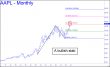
Permabears should curb their hopes, since AAPL's upward stab through p=189.07, although still tentative, was unambiguously bullish. It is also bullish that the stock has closed for two consecutive weeks above this crucial resistance. The extent of any correction remains to be seen, but a particularly brutal selloff down to the green line (x=156.62) would create a back-up-the-truck buying opportunity. Assuming the stock doesn't leap from the starting gate on Monday and run away this week, my gut feeling is that it could spend much of the summer pussyfooting near the red line (p=189.07). We can focus on short-term option strategies in the meantime, since even minor, meaningless swings hold opportunity if we get the timing of them precisely right. We still hold a few 14 July 180 puts with a cost basis of around 0.50. They are a distant longshot at this point, but you should nonetheless be offering half of them for 1.00, g-t-c.
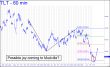
The downside 'D' target at 98.44 (see inset) is so compelling that a tradeable bounce from somewhere very near there is all but certain. Will it be sustainable? Probably not, since there is no indication that Fed policy is about to change significantly. However, we'll monitor the presumably corrective rally closely, since the creation of an impulse leg, even on a chart of lesser degree, could portend a potentially important tone change. To play the bounce, use call options expiring no later than July 22, pegged to the 101 or 102 strike. If I'm in the chat room at the time, I may be able to provide more-detailed guidance.
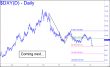
The dollar was plummeting when the week ended, so I've changed the view to graphically display a 99.72 target we can use as minimum downside objective for the near term. It is tied to a 'D' target at 93.55 given here previously that would equate to an 18.5% drop in the Dollar Index since it topped at 114.78 last September. This would leave it just a tad shy of 'official' bear-market territory, but considering the size of the market for dollars, it has suffered damage commensurate with a Category 5 hurricane. The dollar will have its day eventually when debt deflation rears up, but until then, debtors should be relieved that a strong dollar is not compounding their problems from higher interest rates. _______ UPDATE (Jul 15): Last week's hellish plunge brought the Dollar Index down to the 99.72 target almost precisely. This is the midpoint Hidden Pivot support of a pattern projecting to as low as the 93.55 target noted above, and it must hold like a rock if the dollar is going to avoid diving anew in the months ahead. _______ UPDATE (Jul 18, 6:29 p.m.): The support is holding, but only barely. It is not a bullish sign that sellers have been pounding on it for a week.
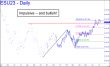
The week ended with a thud, but the futures still failed to take out any lows on the daily chart. The first lies 66 points below Friday's close, but it would take a further drop exceeding early June's 4305 low to create even a hint of menace. In contrast, there are numerous bullish signs whose significance is beyond question. For one, a clear and compelling Hidden Pivot resistance at 4471.00 has been exceeded twice. This might look like a double top to some, but the fact that so challenging an impediment was exceeded at all suggests that any weakness will be merely corrective. Also, all price action since early June has occurred with the futures trading above a key 'external' peak at 4409 recorded last August. Under the circumstances, I'd suggest treating any further weakness, if it occurs at all, as a buying opportunity. Set an alert at 4305 if you like, but don't let nutty intraday swings faze you or encourage excess in the meantime.
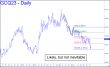
August Gold has struggled for loft after bouncing from just beneath a Hidden Pivot support at 1903.90 that I'd flagged on June 29. Bullion tends to taunt us with weakness before rallying sharply (albeit fleetingly) to nowhere in particular. In this case, however, it looks like it wants to go lower in order to get better footing for a sustained uptrend. We can use the 1875.00 downside target shown for now, but we'll switch to a more bullish outlook for trading purposes if buyers can push above an external peak at 1949.00 recorded two weeks ago. _______ UPDATE (Jul 13, 10:15 a.m.): The futures tripped a 'mechanical' short when they came within a hair of x=1969.30 at 8:35. The subsequent $12 dive could have been shorted with a reverse-pattern trigger, but I am suggesting only that you paper-trade this one. If it is stopped out with a rally above the pattern's 'C' high, that would be the most bullish event we've seen in a while. Even then, we shouldn't trust the rally until it has created a series of impulse legs on the lesser charts.
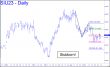
Silver has more stubbornly resisted the tug of gravity than gold, but the 21.44 downside target remains a logical short-term price objective nonetheless. An unexpected pop to 23.90 would trigger a 'conventional' buy signal, but until such time as that occurs, we should trade this contract with a bearish bias. Although it seems unlikely the 22.34 low recorded on June 23 will prove to be an important one, it is capable if it endures of launching the futures to as high as 28.56.
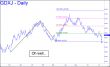
GDXJ would give gold-stock bulls reason for optimism if it can pop above the 'external' peak at 37.68 recorded on June 16. However, it is more realistic to expect additional slippage toward the 32.25 low that has shaped the pattern shown. A breach thereof would create a buying opportunity, even if it were merely to take advantage of a likely fake-out rally that doesn't get very far. Please note that GDXJ is still on a 'mechanical' buy signal from June 20 that we passed up.
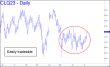
August Crude's histrionics have been easily tradeable, most recently via a nasty dive on Thursday from within three cents of a rally target advertised here when fresh touts went out to you last Sunday evening. The futures rampaged to a strong close on Friday that could get legs, but more immediately they will face resistance from the 74.29 Hidden Pivot resistance shown in this chart. Pivoteers familiar with reverse-pattern (rABC) trades can try it with a trigger interval no greater than 16 cents, but be alert to a possible short squeeze that blows the target to smithereens when trading resumes this evening.


