
Friday's plunge brought TLT down to within a hair of a compelling Hidden Pivot support at 95.13, but also to a voodoo number conducive to tightly stopped bottom-fishing. It remains to be seen whether this presumptive correction splatters the midpoint support, passes through it with ease, or reverses direction. Two consecutive daily closes beneath it would imply more slippage to at least 91.87, the pattern's 'secondary' support. Still worse would be a decisive penetration the first time it is touched, since that would open a path down to d=88.61. All of this would be occurring in a balky bull market that could see TLT climb to 105.49, a big-picture target identified here previously. It shouldn't surprise anyone that Treasury debt has been getting pounded. The Fed recently began to ease with stocks and real estate in a vertical climb and the job market, such as it is, showing no sign of weakness. This could not but lead to more inflation, even though I still expect it to be snuffed by recession and the far more powerful debt deflation that a return to hard times will bring. Finally, I'll mention that T-Bond futures are in a similarly precarious position, having plunged on Friday to within two ticks of an important prior low at 121^23 recorded on August 8. If the December CBOT contract should breach the low, that would create a strong impulse leg of daily-chart degree. This implies that any subsequent rally would be corrective rather than destined for new highs. Here's the chart.

TLT's tortuous ascent still looks bound for 105.49, a Hidden Pivot target derived from a bull cycle that dates back to October 2023, when this proxy for the long bond was trading around 82. A corresponding fall in long-term rates would bring them down to 3.64%. The trajectory of both charts suggests the targets could be reached by late this year or early in 2025. It is logical to infer that a recession would be well under way with rates at those levels since the Fed could not conceivably force them down by purchasing massive amounts of Treasury debt. Foreigners could do the job for them if there is a global flight to safety for reasons beyond imagining,
TLT got hit hard last week, all right, but not in the way I'd predicted. The selling followed a feint to 101.39, a few ticks above a peak recorded back in January. Actually, the feint that ended the rally was the second, following another that had occurred a week earlier. Very tricky, indeed. However, the bottom line is that buyers have generated a powerful impulse leg on the daily chart. This means that however hard T-Bonds get wacked in the days and weeks ahead, the weakness should be viewed as corrective. My rally target remains 105.49, as previously given here, and a pullback to 91.88 should be bought aggressively, stop 87.33. A red-line 'mechanical' buying opportunity could also materialize at p=96.42; it would require a stop-loss at 93.39.

My confidence in the pattern shown is high. It is that pretty, and the 'mechanical' short triggered on Friday when a two-day bounce touched the green line is therefore likely to fall to at least 99.90 before TLT could find traction. However, a decisive breach of the red line would imply more slippage over the near term to as low as 98.56. The bigger picture remains bullish and points to 105.49 over the near-to-intermediate term, with long-term potential to as high as 150.12 (!). The much lower interest rates this implies should not be regarded as good news, since yields could fall to those levels only in the throes of a very deep recession or a depression.

I presented a daily chart here last week that implies chances of a rally to at least 105.49 are excellent. That would correspond to yields of around 3.64% on the long bond. The weekly chart shown is far more bullish and offers a glimpse of what eventually could unfold in the market for Treasury debt. With a potential move in TLT to 150.12 (!), the projected low on rates would be 2.53%. This seemingly could come about only in the context of a very deep recession or a full-blown depression. There is no predicting what the real rate of return would be, although it seems likely that with asset values deflating, a 2.34% rate would impose a crushing real burden on debtors. More immediately, expect a drop in TLT, and a corresponding rise in rates, after the latter touches 3.84%. That is the midpoint Hidden Pivot support of the pattern projecting 2.53%. _______ UPDATE (Sep 13, 11:31 a.m.): A rally to x=100.57 would trip a compelling 'mechanical' short, stop 101.25. The downside target thereupon would be D=98.56.
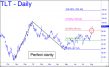
Buyers ripped through the midpoint Hidden Pivot (p=96.42) of the pattern shown with such force on Friday that there can be zero doubt where they are taking this vehicle, an ETF proxy for the long bond. The 105.49 target looks all but certain to be achieved, presumably within the next 5-7 weeks. A move of such magnitude would equate to a fall in long-term rates to 3.64% [restated from 3.67% to correct Tradestation glitch) from a current 4.11%. This will not be caused by anything the Fed does, but by the recession the banksters have kept at bay with massive quantities of funny money even when they supposedly were tightening. Another potential source of lift could come from a stampede into safety precipitated by the sight of a mushroom cloud billowing over some G-d-forsaken city or nation. _______ UPDATE (Aug 31): The spearing of 'p' earlier this month still makes TLT a good bet to reach the 105.49 rally target -- eventually. For now, though, buyers will need to screw up their courage as T-bonds weather gale-force headwinds caused by the prodigious borrowing needs of the U.S. Treasury. A nearly 5% drop to the green line (x=87.34) looks increasingly likely before deep recession intercedes with what no one will call 'relief'. Here's the chart.
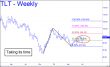
TLT is taking its sweet old time getting airborne, and even surmounting the small distance remaining to p=96.42 cannot be assumed. The last upward stab failed to take out any external peaks, and that is an additional factor to consider. My gut feeling is that the October 2023 low at 82.42 was a major one and that it will endure for the foreseeable future. Regardless, we'll need to see a strong push past p=96.42 the first time buyers encounter it in order to infer that the D target at 105.49 is likely to be achieved.
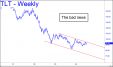
If T-Bonds continue their hellish slide into the abyss, this ETF proxy for long-dated Treasurys should be hitting 70 around election time. So much for Wall Street's misplaced "hopes" for a helping hand from the Federal Reserve. That won't stop speculation, every time the Open Market Committee meets, that perhaps a smidgen of easing is coming toward the end of 2024. Will they never learn? Europe's moribund economies desperately need a global monetary blowout to revive the illusion of growth, but Powell isn't playing ball. Tom Luongo thinks they will stir up a banking crisis this fall in order to scare Powell into complicity. Under the circumstances, it's hard to imagine that they won't try this. If the crisis is scary enough to cause Powell to capitulate, the Davos crowd may regret getting what they wished for,
Last week's descent to the green line (x=105.03) has triggered a 'mechanical' buy there that rates a 6.4 on a 1 to 10 scale. That means the trade looks moderately appealing and has an approximately 64% chance of rallying to at least p=106.07 before DXY could dip below C=103.99, stopping out the pattern. A return to p would not necessarily be the end of the bull cycle begun from 100.62 last December, but the dollar could still spend months in tedium with little progress in either direction.
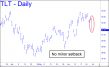
Friday's power dive was more than a minor setback, especially since it occurred before TLT was able to test March 28's key 'external' peak at 95.02. The kamikaze dive was the equivalent of Punxsutawney Phil seeing his shadow, meaning it portends yet more weeks of winter before bulls could conceivably recover the gumption to try again. That's assuming they do, but the outlook would worsen if last week's two-gap downtrend continues more or less unabated until it exceeds 90.65, an 'external' low recorded on June 10 that begs to be tested.


