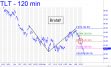
T-Bonds got crushed last week, reversing precipitously from within an inch of what would have been a bullish breakout. The gap down through p=91.82 all but guarantees the downtrend will continue to a minimum D=88.78, a Hidden Pivot support that can be bottom-fished by interpolating the target for March T-Bond futures. The reversal is likely to work precisely if at all, so you can use a stop-loss as tight as 3-4 ticks (or a 'camo' trigger) to get long. If the target is easily penetrated, that would be bad news for bonds and correspondingly bullish for interest rates. Higher rates would of course keep pressure on gold.
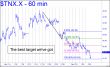
With TLT poised for a breakout, I've lowered my target for rates on the 10-Year Note to 4.094%. The pattern is pretty nutty but still good enough for government work. That means D can be bought with a tight stop, using whatever vehicle you favor for trading the swings in long-term rates. Also, a decisive penetration of the Hidden Pivot support would imply rates are likely to fall even further. Could this indicate a recession is imminent? We'll worry about that after we've seen interest rate bears -- i.e., those who expect yields to fall -- interact with the support.
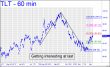
The weekly chart I posted last week set a high bar for bulls. I've downsized this week to the hourly chart, which shows TLT about to test the resistance of a Hidden Pivot midpoint at 94.64. The rally has come far enough since November's sub-90 low to warrant the benefit of the doubt. As always, a two-day close above the red line or a decisive penetration of it would imply more upside to at least p2=97.18 or even to d=99.72).
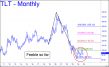
The big pattern shown in the inset is too ambitious to frame the so-far timid gyrations that have lifted T-Bonds from their bear-market low. However, I have used it anyway because lesser charts magnify TLT's indecisiveness even more. Regardless, the gyrations have triggered a theoretical 'buy' signal that will require a follow-through to at least p=116.27 for validation, TLT is tradable in the meantime, but only by way of short-term signals on the intraday charts. A breach of c=82.42 would be discouraging news for the few bond bulls who have bucked the tide, although not necessarily for those who have been waiting for a washout to load up the truck.

The ferocious but badly mistaken rally in the days after the election petered out as expected, giving way to a relapse that will soon test crucial support at p=88.01. That is my minimum downside target for the near term, but it is also where the brutal slide from mid-September's 101.64 peak could end. That would imply nothing less than the resumption of the bull cycle begun 13 months ago. I have adjusted p, as well p2 and D, downward to correct an erroneous coordinate used in my calculation of Hidden Pivot levels on the weekly chart. Respectively, they lie at 81.20 and 74.38.

Last week's series of gap-up rallies may have seemed impressive, but the move should be regarded as a dead-cat bounce until it starts exceeding 'external' peaks such as the ones shown in the chart. So far, it has exceeded no such peaks, even on the lowly hour chart. This means the rally is not even faintly impulsive. If you want a wake-up call to tell you when the uptrend becomes significant, set a screen alert at 102.99. That's a single tick above the first 'external' peak buyers will encounter on the weekly chart. It was recorded in July 2023 and is almost unnoticeable, but it is technically significant. Alternatively, if TLT relapses below 88.42, look for more downside to at least 81.80 and a worst-case low at 75.19.
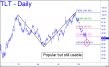
Several subscribers identified the 88.41 downside target of the reverse pattern shown. It sits in a messy voodoo zone, and that's why it will be usable despite its apparent popularity. Bottom-fishing should be done with a reverse-pattern trigger on the weekly chart, where a= 96.47 (August 30). This trade will make you money regardless of whether TLT bottoms at 88.41. It is an 'Eff you, Mr Market' trade, recommended to Pivoteers who are familiar with 'camouflage' set-ups. More immediately, the downside should be exploited as well, since the decisive penetration of p=95.03 implies TLT is very likely to achieve d=88.41.
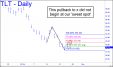
Last Wednesday's low at 91.66 triggered the 'mechanical' buy that had been noted in the previous tout. Simultaneously, a second such buy signal occurred at the green line (x=93.21) of this smaller pattern. It carries a commensurately smaller stop-loss, but we'll back away from the trade nonetheless, since the pullback to x came after TLT had barely reached the red line. Ideally, the retracement for a 'mechanical' set-up should come from our 'sweet spot', which lies midway between p and p2.

Two consecutive gap-up rallies last week sevened-out at the midpoint resistance of this reverse pattern. The failure of TLT to break free of gravity does not necessarily ordain a further correction down to x=91.88, although it has made it more likely. That would generate an appealing 'mechanical' buy signal, although we should limit our expectations thereafter to a one-level ride to the red line (p=96.42). The 105.49 'D' target would still obtain, but without the high confidence we typically seek.

The daily chart (see inset) lacks sufficient power to push TLT significantly above the 105.49 target over the next 2–3 years. However, the tailspin that has followed mid-September's 101.64 top is likely to end on or around the green line (x=91.88), where a 'mechanical' buy would be in effect. I'll guarantee at least a one-level profit thence, although there can be no guarantees the decline will even reach the green line to fill your bid. The bigger picture is iffy but allows for a move to 116.43, the midpoint Hidden Pivot resistance of the long-term reverse pattern shown here. The rally to the green line has twice signed such a move, but the signal is weak, and a relapse to new depths is possible even if TLT reaches 105.49. Don't cheer too loud for this, since it could only happen via a debt deflation that would turn real rates as low as 1%-2% into a crushing burden, as occurred during the Crash of 2007-08.


