
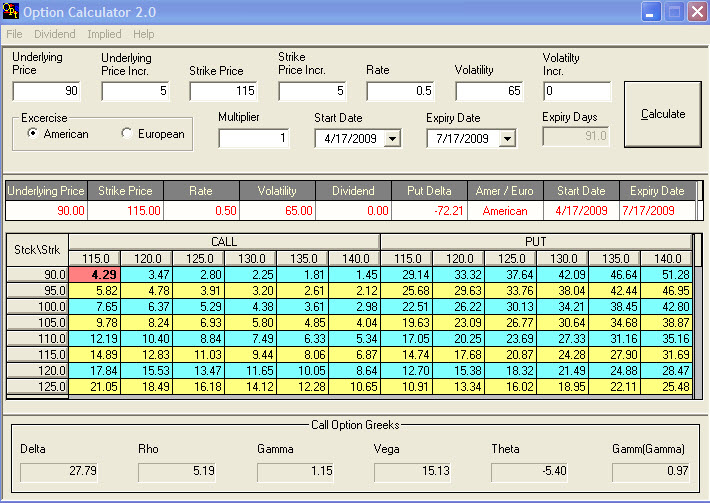
 A 6.00 bid for two July 115-April 115 call spreads would have come all to easily the other day, so I’ll track and record the position for your further guidance. We were sleazed out of the further short sale of an additional April 115 call yesterday for 2.60, since someone stepped in front of us with an offer at 2.56, the high price of the day. No matter; we’ll try again, greedily raising the price to 3.80. If successful, we will have legged into a bullish ratio calendar-spread that will produce a profit over a very wide price range when the April calls expire. How wide? You can
calculate the answer yourself by referring to the option calculator at left. Let me assure you that your diligence in this task will be rewarded with insights into the way that certain types of spread positions work. Assuming we had sold the extra April call for 2.60, here’s how to calculate: The left-most column shows approximately how much our July 115 calls will be worth at April expiration if the underlying stock is trading at various prices between 90 and 125. Since the April 115 c alls would be selling for intrinsic value that Friday, the July 115-April 115 call spread would therefore go out at 11.05 with Goldman shares at 125. That would give us a profit of $1010 per spread, less a $740 loss on the extra April 115 call we’d shorted for 2.60, for a net gain of $270. That implies Goldman would need to rise by about $3 more, to $128, before our position would begin to lose money (at $100 per point).
Our maximum profit would come with the stock trading at 115. As you can see, our July 115 calls would be worth 14.89. Since the April 115s would be worthless, that would make the spread worth 14.89, or $889 more than we paid for it. The two spreads, then, would show a total gain of $1778. But we would also reap another $240 of profit, netting a total of $2018, since the extra April 115 that we’d shorted would be worthless. Working the numbers the same way with the stock at $90 would produce a net loss of $82. Below $90, we’d lose only about $28 for each dollar Goldman fell. That is calculated from the 27.79 “delta value” shown in the lower left-hand corner. Thus, we see that our position can produce only small losses at $90 or below, but gains of as much as 2018 if the stock rises moderately over the next four-and-a-half weeks. A floor trader with a long-term inventory of options might seek to spread against this position by doing spreads and combos that would produce a maximum loss near 115, but big gains above or below that price. The net profit would come from the edge the trader gets building positions, one against the other, that are profitable across a wide spectrum of prices. One common way to to this is to net out frontspreads against backspreads, doing the former at relatively high implied volatilities, the latter at relatively lower volatilities.