Greenspan Denial Shows Real Chutzpah

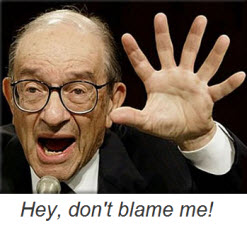
We try to read the editorial pages with an open mind, but sometimes it’s more than we can stomach to have to imbibe opinion pieces at all. For instance, there was this repellent headline atop the Wall Street Journal‘s op-ed page yesterday: “The Fed Didn’t Cause the Housing Bubble.”  Can you guess who the author was?  None other than Alan Greenspan, who during his tenure made a point of referring to inflated home values as “wealth.”  He also apparently never met and adjustable rate mortgage he didn’t like, probably because they were a key factor in making homes “affordable” for those who could not really afford them. Under the circumstances, for Mr. Greenspan to deny the Fed caused the housing bubble shows real chutzpah, a yiddish term for brazen effrontery. It’s like Michael Corleone testifying that he knew nothing about the deaths of Sollozzo, Tattaglia, Cuneo and Barzini because he was too busy selling olive oil.
greenspan5-small1

Mr. Greenspan trots out a novel argument in this latest effort to gain exculpation. He asserts that mortgage rates had a mind of their own, and that the easing of administered rates by the Fed did not directly cause them to fall. While this may have been be true in the narrowest technical sense, it is undeniable that Fed-controlled rates set the pace for all types of credit. Moreover, when the Fed charted a course of easing, it created an environment in which financiers grew increasingly confident, if not to say cocksure, about borrowing short to lend long. More dangerous than the easing itself , however, was the Fed’s role in legitimizing and promoting the notion that the country’s obvious borrowing binge was healthy and normal. In plain fact, the borrowing grew promiscuously, because it was tied to home values that were rising much more steeply than U.S. incomes.

We’ve Learned Nothing

Unfortunately, bailout-mania makes clear that we have failed to learn any important lessons from the housing bust. Here’s a letter from one Michael Harrington to editor of the Wall Street Journal that explains why with perfect clarity:

In New York Governor David Paterson’s defense of the president’s housing plan in ‘Obama’s Mortgage Plan Is What We Need’ (op-ed, March 7), we read a lot about reversing ‘the decline in property values,’ but nowhere is there a discussion about how to determine what the true value of homes is. Let’s get cause and effect in order here. Our financial crisis is rooted, not in the decline in values, but in the original distortion of prices.

“Gov. Paterson’s argument that we must save existing property values or else we all suffer is an oft-quoted canard. It assumes that current values are correct and must be maintained with subsidies. This is just more of the same bad housing policy that got us into this mess — another indication that the political class is not up to the task of formulating economic policy.”

Entrenched Foolishness

Just so. But the foolishness is an entrenched political fact at this point, and there is therefore no escaping its consequences. President Obama’s plan would purport to “rescue” about 11% of all homeowners. Our guess is that at least three times that many homeowners are underwater, and there is no reason to think that even that scary number will not eventually climb much higher.

  • GlennK March 12, 2009, 8:48 pm

    To think Greenie was once worshiped like he was some kind of Demi-God no less. If there was any Justice left in this country, Greenie would be Madoff’s cell mate today, not writing op-ed articles for the Wall Street Journal.

  • TKO March 12, 2009, 6:27 pm

    Great picture. You have to laugh. I suppose that this means that the tripling of house prices in five years and the leveraging of trillions of dollars of risky debt by a factor of 60 did not appear to be outcomes worthy of any scientific investigation. This excuse joins the others in the hall of fame viz:
    “The dog ate my homework.”
    “I shot my wife 8 times believing she was a racoon in the garbage can”
    “I am not late for work today, I am arriving early for work tomorrow.”
    and now
    “I was not able to see obvious objective reality because the quadratic equations got in the way.”
    If a Marine security guard, through some negligence, allowed some damage to taxpayer property in the amount of $1,000 he would be reprimanded, his pay garnished, and maybe he’d be given a week in the brig to think things over. These guys just went through 10 trillion and the offer up “What, me worry? explanations! Especially, Bernanke, the expert on the Great Depression. Now that he missed the lead up to this Great Recession, is he waiting around to see if the S&P 500 will mimic the chart patterns of the 1930’s?

  • Rich March 12, 2009, 6:23 pm

    Aloha All

    Enjoying the fresh baby’s breath of a Spring Market?

    As CNBC’s House of Cards RE horror show so graphically illustrated, AG, sax player Ayn Rand Objectivist gold standard advocate in 1966, flew over WTC ground zero in a Fed helicopter on 9-12-01 and decided after the Jubilee Generational Peak what America needed was more debt and usury money from nothing.

    Like others decrying derivative time bombs, but using them nonetheless, and suffering their markdowns in earnings falling 96%, AG et al perhaps forgot Vince Lombardi’s perennial stress on winning fundamentals.

    Newsflash: Here’s an investment fundamental: Assets are worth what they earn or yield, nothing more, nothing less.

    While the few closely held quality growth values we own in our Private Portfolio sold as low as one times earnings when we scooped them up, housing still sells at price/rent ratios well over a 27 year norm, and most certainly do not reflect 1932 lows or real wage realities yet:

    http://4.bp.blogspot.com/_pMscxxELHEg/SMAGJbFYWKI/AAAAAAAADak/cQUwiM1ccV0/s1600-h/PriceRentNationalQ208.jpg

    No amount of funny money government bailouts can normalize much larger markets, particularly $800+ T derivatives.

    Bernanke, Geithner and Summer can only distort markets temporarily, the way the Fed/Treasury did with 2.5% 30 year Treasury Bonds creating reciprocal Price/Earnings and Price/Dividend ratios of 60 for a brief moment in time.

    We still suffer a $800 T derivatives implosion, budget and trade imbalance that continue to degrade dividends, earnings and rents in real terms.

    So now Mr Clarence Dow’s 17 P/E and 26 P/D are down from 60 and 49, still a long way from 10 with 10% in 1932.

    The current PE ratio reciprocals suggest bond yields of 5.8%, and 10% at eventual market lows when economic reality, instead of current political neoKeynesian fantasy is again realized….

    http://www.tradersnarrative.com/why-the-price-dividend-ratio-is-better-than-pe-ratio-1947.html

    So TBT looks like a fairly good Rick Ackerman Subscriber Pick, albeit the current M1 deflation could briefly retest TBT lows of 35.

    Regards*Rich

    http://stockcharts.com/def/servlet/Favorites.CServlet?obj=ID3251493

  • Wyz March 12, 2009, 2:53 pm

    Many confuse the ability to get a loan with “affordable”. Is a house affordable at $100,000 or at $250,000 with an ARM? Same with automobiles, HDTV, cell phones and many other consumer items.

    A related, confused argument is “When Wall St recovers, Main St will recover”. WRONG!!! Main St and industry must recover first, Wall St depends on it for it’s very existence!

    To borrow a cliché, too many in our world are “putting the cart before the horse”. Most are no longer even aware of the need for a horse to pull that luxury carriage they are sitting in!

  • jp March 12, 2009, 12:41 pm

    Bravo, Mr. Harrington!
    Let’s draft that guy and put him in charge of something! He’s got horse sense AND the ability to communicate it!
    Ahhh, he’s probably not interested… probably busy running some profitable enterprise in the private sector and being a blessing to his family and community
    🙁

  • Carol March 12, 2009, 11:54 am

    Good article, Rick, thanks. Nothing like cementing inflation. Who says bribing the politicos isn’t a good investment? All of us may have contributed individually to our candidates of choice but they’ve all been bought by bigger money. So long as Buckley v. Valeo remains the law of the land and the politicians of both parties and giganto corporate donors remain in bed, the lesson remains “Steal Big”.