With the U.S. sinking hopelessly into a black hole of debt, and households facing an avalanche of tax hikes that will at best postpone the nation’s day of bankruptcy, we are all hard-pressed at this point to see a way to a happy ending. Lo, along comes an anonymous e-mail that describes a way to solve everyone’s debt problems painlessly. If you think the plan can work, I would urge you to forward it to your congressmen. But if you see a fatal flaw in the logic, please drop by the Rick’s Picks forum to explain. The forum can be accessed by clicking on the word “Comments” under the headline on today’s commentary. Here’s the magical plan to cure America’s”Accounts Receivable Crisis”:
“It is the month of August, on the shores of the Black Sea . It is raining, and the little town looks totally deserted. It is tough times, everybody is in debt, and everybody lives on credit.
“Suddenly, a rich tourist comes to town.
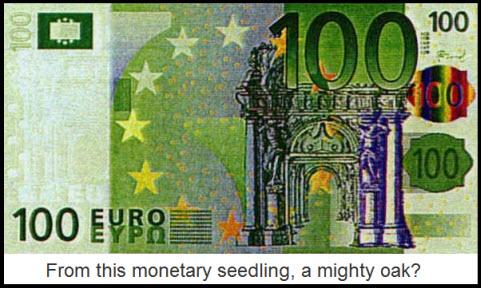
“He enters the only hotel, lays a 100-euro note on the reception counter, and goes to inspect the rooms upstairs in order to pick one.
“The hotel proprietor takes the 100-euro note and runs to pay his debt to the butcher.
“The butcher takes the 100-euro note and runs to pay what he owes the pig farmer.
“The pig farmer takes the 100-euro note and runs to pay his debt to his supplier of feed and fuel.
“The supplier of feed and fuel takes the 100-euro note and runs to pay his debt to the town’s prostitute that, in these hard times, proffered her ‘services’ on credit.
“The prostitute take the 100-euro note and runs to the hotel to pay for the rooms she rented when she brought her clients there.
“The hotel proprietor then lays the 100-euro note back on the counter so that the rich tourist will not suspect anything.
“At that moment, the rich tourist comes down after inspecting the rooms, takes the 100-euro note off the desk, tucks it back into his wallet, and explains that he did not like any of the rooms. He then leaves town.
“No one earned a penny. However, the whole town is now without debt and looks to the future with great optimism.
“And that, ladies and gentlemen, is how the United States Government is doing business.”
Come to think of it, that is almost exactly the way Uncle Sam is handling the debt problem. Your comments are welcome at the forum.
Comments on this entry are closed.
This is a humorous tale, but it is NOT a trick. This is exactly how money works. It does not matter where the money comes from or who creates it or who destroys it or who puts it into or takes it out of circulation. The humorous start of the tale makes it appear as a trick, but it is not. It simply and clearly shows the role of money (no matter what is used as money) as a medium of exchange – remember Econ. 101?
The Hotel owner might just as well have printed up a counterfeit 100 euro note and the whole tale would have worked. He might also have written his own 100-IOU and as long as everyone accepted his IOU as a medium of exchange the whole tale would have worked. Even a computer program that they all tapped into for purposes of bartered economic exchange between themselves would have worked without the transfer of any item as money. It would be a computerized system of barter thus without the need for a medium of exchange.
The tale could have used a 100 euro note that the hotel owner already had and we could have seen it transferred around the group and come back to the hotel owner. All the 100 euro debts would have been paid exactly as in the tale, but of course there is no humor in that.
It is really quite easy to come up with humorous tales about the function of money as a medium of exchange, because most of us can get easily confused (including me a retired prof. of economics) by the functions of money.
All of these would work just like the tourist’s 100 euro note, but perhaps these methods would not be qui
Rick, You hit the jackpot on this one (65 comments) and YOU get the bogus 100 schmirroro note! So choose door #1, #2, or #3 (or #4, etc.) No hankypanky!
Paying off debt this easy is NOT how the US is doing business otherwise everyone would be debt free this is how it would work under a micro loaning system where people loaned to each other bypassing the banks and fractional reserve system.
There is a reason this does not work. Debt is not owed between individuals its owed to the banks somewhere down the line and when you pay off debt to banks the account is zeroed and money is taken OUT of circulation meaning this situation meaning we are always kept at zero point as insane as it is its literally designed to prevent the creation of wealth real wealth that is.
I am trying to bring to peoples attention the importance of a new technology which is currently being used only as a charity but I think people have not grasped the potential yet and that is micro loaning sites such as Kiva.com
In this type of credit debtor system the creditor(you) has already earnt their credit giving it value and they loan what they have earnt unlike banks who create out of thin air what they loan, therefore when the debtor pays back the money it does not get taken out of circulation but instead the process has created more wealth all round so like your story where debt can be paid off this easy value can also be created this easy, so much abundance would be created it would be hard to grasp.
Paying off debt this easy is NOT how the US is doing business otherwise everyone would be debt free this is how it would work under a micro loaning system where people loaned to each other bypassing the banks and fractional reserve system.
Simplistic models are good!
The game is easy to see when there are 10 guys in a room with 9 chairs – obfuscated when there are 20 million with 19,999,000 chairs!!
If you work with a simple model, it’s also clear that debt amongst ourselves is of a different order than debt owed to the banks. The “magic” of GDP does indeed work as described in the fable, (albeit temporarily / cyclically), but we enjoy no such advantage (leverage) in paying off the initial loan – the one that “created” the money / debt in the first place.
We always hear about debt as % of GDP – makes no sense at all.
GDP may create “virtual wealth” within an economy, but it has nothing to do with creating wealth regards the initial loan, (zero sum game + interest).
And the linkage of the economy and finance is another great way of confusing the issue.
Re. The gold standard, can you gold / Austrian School guys please explain how you create money? I cannot find this information anywhere, (i.e. is all your money debt too? Gold-standard debt ??).
And has anyone out there investigated CAFRs?
I am assuming on a macro level, the tourist represents foreign bond/treasury purchases and the town is the US economy.One fatal flaw revolves around the assumption that the tourist situation is new, when in fact we have been relying on an ever growing number of tourists doing precisely the same thing. No new tourists or even a decline of tourists leaving their “deposit” (consider it taking treauries or bonds) means the bills do not get paid and the townspeople are stuck with their frozen balance sheets because noone is paying their debts or able to (a bit of an assumption here)
On a micro level where the tourist represents the taxpayer via government guarantees of zero cost money to the money center banks, or worse, through the fed, guarantees the swap of toxic assets for treasuries. At first everyone seems to be getting paid, but the government,representing the taxpayer or hotel manager is increasingly dependent on deposits or swaps to keep the system going. Eventually the tourists whether internal taxpayers or external bond buyers become afraid to leave any kind of deposit for fear of never getting repaid.
There are several points to be made here from this parable.
First each party is making two transactions. First he has income in the amount of 100 euros. Next he is making a de t service payment in the amount of 100 euros. Therefore he has had 100 in income and his balance sheet is showing 100 less in de t which means his net worth went up by 100. The tourist is like a taxpayer in that he made an involuntary loan. Unlike the taxpayer he gets his money back. Since these were unreportable cash transactions the government never got it’s cut. If the taxman was in each locatio and took a portion to finance govt activities like giving the hooker an aids test and inspecting the butchers meat and checking the hotel for bed bugs, the tourist may have only gotten 50 euros and an IOU. Just like taxpayer.
But let’s take it a step further. If our tourist goes to each party and says you’re owed 100 euros and there is virtually no chance you will ever get paid. So he buys each debt for 10 per ent of face value, then he redeems each debt for 100 euros worth of service or product from each debtor, at the end of the day you will have a well fed, well rested and sexually satisfied tourist at highly discounted price. And the town’s people will have a little bit of money and a lot less debt.
Dale just illustrated the “tendency to hoard” – which is an issue many deflationists are not taking into account.
Interesting little story about a moneychanger gamechanger called Goldman Sachs:
http://forums.somethingawful.com/showthread.php?threadid=3159732&pagenumber=1
Rick,
The root cause of our national disaster to come has to do with the banksters and gangsters that surround our president. As a stand alone guy he is a decent man completely surrounded by deceptive people who advocate fiat currency and bank fraud. Our forefathers warned of this exposure and the outcome that it brings.
“If the American people ever allow private banks to control the issue of their currency, first by inflation, then by deflation, the banks and corporations that will grow around them will deprive the people of all property until the children wake up homeless on the continent their Fathers conquered…I believe that banking institutions are more dangerous to our liberties than standing armies…The issuing powers should be taken from the banks and restored to the people, to whom it property belongs.” Thomas Jefferson
It’s a good short attempt at the financial analogy that exists and as John Silvera said.
I believed the hotelier got screwed when I first read this.
But he didn’t!
He paid a debt at the start…remember!
The system is flawed. What if the hotel proprietor took the euro note and left town?
Or the prostitute was a lousy piece? Then, there’d be chaos. The best solution is to have more lawyers.
Re the rich tourist
The tourist makes a prepayment which finances the reduction of debt but the prepayment has to be repaid which means the hotel manager has to borrow from the butcher etc and the vicious circle starts again It is basically a demonstration of how powerful the principles of double entry are versus creative accounting.
In bookeeping terms, apart from the tourists, the others are creditors to each other whilst the rich tourist is a debtor ( either in money or service terms)
In other words, if you know an institution which has the money equivlent of the total toxic debt to deposit in a bank and then every creditor pays every other creditor off the final creditor must deposit that money in the bank so that the original depositor can cash its cheque for the final withdrawal.
The joke is an accountsants trompe l’oeuil
B mendes F C A
A delightful explanation of the role of money as a medium of exchange in almost any economy except perhaps the most simple where barter might work.
I like the sequel to this tale. The tourist, who is loaded with a suitcase full of 100-euro notes, continues his world sailing tour, but alas is shipwrecked and stranded with one other survivor on a deserted island. The only food is a fruit that hangs securely from 20ft tall trees. You get the picture. Who would you rather be? The tourist with the suitcase stuffed with soggy 100-euro notes or the other survivor with the 30ft extension ladder?
This can be done ONLY inside the US. Debts owed outside of the US are a different matter.This is where the real problem is? If it was that easy why would anyone bother to work? The US has no real money left. One thing might be true.They do have a huge military.They might entertain the idea of “Stealing IT”. After all has it not been the way of all past empires?The other problem is that many eyes are looking.Good luck.
Awesome post. This shows how our economy really works. Everyone that says “got gold” has no reality of an idea. Gold does not work either if you still have debt. Then you are only replacing the gold for the dollar (which both have a value.) The REAL issue is the debt. If everyone (Consumer’s,Businesses,corporations,governments,etc) were forgiven all the debt they had instataniously and they outlawed debt as a world law then everyone would prosper. Make a law that you must pay for goods and services when rendered. If you want to buy a house you save for it and pay in full. Now I know what your thinking “banks would collapse” Just the opposite. Since it would not be able to lend money it would have less of a risk collapsing. Banks collapse because they over extend themselves. This law would put a stop to credit “debt”.
If I took all your wealth and cashed it in and turned it to gold and gave it to you you would be no richer than you are today. Example. If right now you have a million dollars in the bank and we do away with the dollar and switch to gold then you would still have a million. You would just have less bars because they are worth more. Gold does not change a thing. If you have a million in the bank and owe a million in debt (because of a house) are you richer? No actually your poorer then the first senario. You still owe the million, So you actually have a net worth of 0. So debt is a wealth killer. Get rid of your debt and pay for everything as you go. If the government owed no debt it would bring in over half a trillion each year. What it would be able to do with that money…. Well let your mind ponder on that.
Jim
Anti-Debt Advocate
“The Debtor is slave to the lender.”
There is just one problem. There isn’t enough money around to pay off all the debts. If you borrowed money to buy a $500,000 house, and it’s now worth $250,000, you still owe $500,000.
Now, if the government were to print lots of worthless money and give it away so people could pay their debts–that would go a long way to erasing debt, only it would make the economy collapse.
There is only one ‘honest’ way to solve this problem. Let everybody who can’t repay their debts go bankrupt, and write off all the bad loans. Anything short of that will just make a bigger and more complicated more prolonged mess.
MKG
&&&&&
Your solution is the deflationary one, Ghandi, and it would visit pain on sinners in accordance with their sins. The inflationary solution — adding two or three zeroes to everyone’s bank account — would wipe out savers as a class and destroy all of the institutional conduits of saving, including the bond markets. RA
Interesting comments. (most of them) To all who say the the Hotel operator is out the 100 Euro’s, you forget that the Hotel operator paid the butcher.
The “FATAL FLAW” is that the hotel proprietor is OUT 100 euros. He recorded income from the prostitute, but then the rich tourist came downstairs and took it away. He now has a negative balance…end of ingenious plan….and when OUR creditors come downstairs and TAKE THEIR money…our GAME will be OVER!!!
If any of the creditor/debtors in the story had just 100 Euros before the tourist came, then the circuit could have been completed and everyone would have already been debt-free. I don’t see how this is analagous to the situation in the US where our problem is definitely not a shortage of 100 dollar bills. This “story” must have come from some long out of print Federal Reserve pamphlet that justified Helicopter Bernanke’s raison d’etre.
Great and highly intelligent comments to an oversimplified storyline!
There is no way around the fact that in our present situation one player benefits disproportionately from the private central bank system, namely the criminal syndicate of private central bank owners, who control their army of well-paid, but crooked secret-handshake-obedience-cult helpers by fear of death: “look what we did to the private-central-bank-haters Lincoln and to several of the disobedient Kennedys (Hitler, who was mentioned by a blogger above as some kind of a central bank hating hero, was in reality the syndicate’s agent and lived out his life in an estancia near San Carlos de Bariloche, Argentina, after a job well done delivering the second k.o. punch to Germany, which brought that country into the syndicate’s full control to this day)”.
The Syndicate is presently benefiting from everyone’s desire to “borrow time” from them and will oblige their hapless host of sheeple as long as they can still find borrowers for the necessary increase of the debt bubble. They can grant more time until everyone is maxed out and until there is no one left who is creditworthy enough to borrow from them. As long as there are still future income streams to be had from tax increases or new taxes (e.g. value-added-taxes), and as long as the rating agencies can still give their (fraudulent) blessing to the worthiness of government debt, this last great bubble of government borrowing can be kept going (with the help of the traitorous double agents in our governments).
God help us when this last bubble pops! The syndicate has also prepared for that eventuality: see Google (U-tube) the US concentration camps and more than 10,000 installed guillotines.
By the way: can you still buy tins of corned beef in the US? We can no longer get it here. The supermarket owner, where I bought it last, told me that his supplier told him that it was banned for reasons of mad cow disease. I doubt that this is the real reason. The real reason is more likely to be that governments and insiders are stocking up at the expense of regular consumers, because they know what’s coming and when. (Corned beef is ideal for safe long-term storage.)
On a more “cheery” note: the Dow broke down convincingly from an uptrend line today. This uptrend line was 64 trading days old (13 weeks) yesterday and has given an amazingly strong support on 10 “touchdown” days. I suppose the Plunge Protection Team of the Syndicate used this trendline to intervene at appropriate points. The clumsy footprints of the PPT were clearly visible on many of those days, when the market was “squeezed” upwards during the last 30 to 90 minutes of trading or in overnight futures trading (cheaper when most traders are sleeping). This pattern is no longer discernible during the last few weeks or so. The banks have been (partly) recapitalized by this sucker rally. Now that they have gotten their money cheaply, their stock prices are free to fall again. Buy FAZ, SKF (triple resp. double short financials) and SRS (double short real estate) and DXD, SDS, QID (double short the stock indices). As a precious metals hedge I prefer AGQ (double long silver) at this time.
I’ve indicated on another occasion that the Syndicate may be betting on a “murderous” depression (avian, not swine, flu, straight from the bio weapons lab in Fort Dettrick, Maryland, delivered by chemtrails and then by vaccines, as a solution for “depressed conditions”). Their ill-gotten US Treasury bonds , notes and bills (purchased with thin air) could quadruple in market value as well as in price-deflation value in such a depression. So could their trillion dollar derivatives positions (short gold, stocks and whatever else). I hope I’m wrong and some friendly aliens or some courageous insiders do something to foil some of these plans.
I used to be much of a Bible believer and remember something about usury money lending with a legally binding little safety valve, namely the 50th year of Jubilee, at which time the loan was forgiven. If we had some variation of that system today, we would not be in the trouble we are in….. There would be no usurer syndicate ruling the world, because it just wouldn’t be profitable enough. Maybe we can hire Sir Alan Greenspan to throw his weight behind such a reformation of usury laws. He could do this “pro bono” as an atonement for his blatant complicity in the latest housing bubble crash……
I agree with Bud. The hotel owner got screwed, and the whore ended up getting her room for free.
I guess the moral of this story is that only whores can make money during hard times.
This parable needs one more element, if it is going to match our current circumstances. When the whore pays the hotel owner, he quickly runs downstairs to his state-of-the-art printing machine and prints up an impeccable copy of the note. He puts THAT one on the counter, and pockets the real swag. The rich tourist (like our own taxpayers, who are willing to be paid in counterfeit notes) is too dumb to know he has been had.
Two morals, then, for our revised version. Only whores and counterfeiters make money during hard times.
You know, the method as suggested would work just fine if everyone in that community was in collusion, nobody gave any change, and it was all seamlessly orchestrated so debts could be cleared in a couple of hours. But even if all those elements are not present, quite frankly, in the big picture this is really how it all works anyway. As long as the buck circulates we can have wealth, build equity stakes, utilize services and generally come out ahead. And that’s why credit and velocity work hand in hand. It is a brilliant concept until one chain in the link gets broken.
Off the subject now……That was a brilliant call on gold at 918 Rick. You keep impressing me.
Cam
This is very similar to the plight of farmers here in Aust during the depression. My grandmother used to tell the story of their local community. The banks could not foreclose on farming properties if the farmer could produce one pound. The five surrounding farms all shared the one pound. The banks could only travel by road as they arrived in a car, and could only complete the route one way. The pound note was kept at the first house and after the bankers visit, the horse was mounted and galloped across the paddocks to the next farmer where the pound was hounded over to the next family and so on. This method kept the five farmers out of foreclosure for three years but my grandmother warned that the responsibility always rested with all five of them not to spend or lose this note. She said that it created life long bonds, trust and co-operation between their neighbors which saw them through many tough times
I just want freaking gold to go up one of these days…..is that too much to ask for?
This is not how our govenrment finances work. True, they do print money out of thin air with no backing of gold (there is none in Fort Knox now) but they give it to the bankersters who then charge us interest to use our money and we have to pay the taxes to the bankersters to pay them back plus the interest. This is the greatest ponzi scheme of all time. There is no way the American people can win. When it is done, the off shore bankersters will own all of America if the American people don’t catch on. Now, if the government gave the fourteen trillion bailout money to the American people, then we would pay all our debts and live happily ever after but that’s not what happened. So our taxes will be going sky high.
The problem with the US is that it is a net debtor which must be paid from future production thereby impoverishing future generations at the pleasure of existing ones. The actors in this episode have all rendered past services to pay for past pleasures. None of them were net debtors; they had effectively extinguished their past debts through barter. Fiat money had become irrelevant.
That scheme works if each player has assets to cover their liabilities. Should a player have more liabilities than assets, then the scheme breaks down. Expand that to something bigger — to countries – and U.S. liabilities are bigger than the assets, China’s assets bigger than liabilities, can’t square that off.
Very well written. Printing of so much money as the past two administrations have been doing will only lead to the value of the dollar falling and hyperinflation setting in at some point down the road. The pricing of oil in some other currency will finally ring the death bell for the US Dollar. Unfortunately, greed will lead to the destruction of the US. We have seen the beginning of the end of this Ponzi financial system.
God Bless the USA.
Awful comparrison. A more honest assesment would have read something like the foreigner coming to a town where there is apparently no money, and giving his 100 to the bank, who could then turn around and keep the 100 and force the local govt to levy taxes on the people and their kids and grandkids to raise another 100 that the towns people didnt actually have. Even this is a crude comparrison, but it’s alot more honest then the above.
The fallacy is that the rich tourist NEVER PAID for the room. He only put his money up as a temporary reservation. Never sealed the deal and pulled out at the end. Not sure how this relates to how business is being conducted now tho….did find this on another site….
“I thought Arnie already went to Obama for a bailout last week, and he indeed did turn Arnie down for exactly the reason you suggest.
As far as what else Obama is doing, I’m reminded of a time when I was just starting to rollerblade… I got rolling down a gentle slope, and found myself going uncomfortably fast, and saw a speed bump approaching. My braking skills were pretty weak at that time, so my choices were to deliberately crash before hitting the speed bump, hit the bump and crash anyway, or attempt to jump the damn thing and hope I landed it. I took my chance with jumping it, and (to my amazement) landed still upright on the other side.
The analogy should be obvious: things are out of control. If he “levels” with everyone, we crash before we hit the bump. If he just keeps going, we crash a little later. I think he’s going to try jumping, but he can’t jump until the last moment. Whether he’s able to land it on the other side remains to be seen.”
this whole system falls apart when the hooker takes the 100 euro and blows it at vegas instead of paying her debt. the hotel owner is now insolvent and loses his hotel to the rich tourist, who is a foreigner from china.
The difference between the “town on shores of the Black Sea” and the good ole USA – is that here everyone owes to one entity – Banksters. Debt payments, unfortunately, trickle up. The great transfer of wealth from the middle class to the super-rich is happening now
Basically, everyone in the equation has netted their receivables (100 euros) with their payables (100 euros) – Net worth is the same for each participant before and after. If none of the participants had an outstanding receivable, the receipt of 100 euros without an economic income factor, would have resulted in an additional liability to the participant.
The fallacy here is that the example is an extreme oversimplification as well as being an isolated case of debtors owing debtors. In the real world, the vast majority of debt is owed to central banks, i.e. the central banks are not a point in the debt circle where the money goes back to another creditor … they have NO creditor since they can print any money they want. I.e. there is no circle.
Yes, there would be a few examples like this in the real world. Emphasis on few. Note that in such cases, however, the rich tourist is not needed. Those people, upon figuring out the existence of the debt circle, could all simply agree to cancel said debts.
If the example was alluding to maybe a central bank placing $ on the desk (in the system) such that prior knowledge of the circle was not necessary, then the assumption is that the money will actually be used to pay debt. There is no way to guarantee that beyond the hotel proprietor, i.e. he can be given the $ with the condition that he pay debt with it, but beyond that the use of the $ is up to that individual, i.e. the feed store owner might decide to have another fling w/ the prostitute instead of paying a creditor. And if the idea is that the $ would end up back at the central bank anyway, then the simpler solution would be for the central bank to simply forgive the debts of its debtors, with the requirement that any such payments otherwise made be made to the debtors other creditors, at which point those can pay theirs more, etc etc.
The ultimate simplification would be to print as much as is necessary to pay everyone’s debt, period. The problem with this is, of course, inflation, and thus everyone was paid with depreciated money, and of course nothing *real* was produced.
The example fails to adequately describe what the US government is doing. If the “rich tourist” (the chinese), loaned the hotel keeper money, (the US Gov), (by putting it on the counter), he wouldn’t be doing it without requiring interest on the loan. He would also not be very content if what he was paid back was worth less than what he put on the counter (weakening value of the dollar). He might insist on being paid back in gold or services, or perhaps by being given a lien on the hotel itself, and if the process were repeated over and over, he would end up owning the hotel. Perhaps all of the service providers would survive, but their future would be in the hands of the tourist, and as we all know, tourists tend not to hang around too long, especially if things are tough at home as well…
Interesting that everyone had only one debt, that throws the solution out the window. Also, human nature is not so as to the fact that each ran to pay his debt to the other person. Also, what would have happened if even one person had saved the money. Remember when the US govt handed out free money last year it was used to draw down debt or was saved.
Summary – there is no easy out. The current problem is way too complicated for a quick shot solution. Consider 1.5 quadrillion dollars in derivitives that need to reconciled. No one has the money for that.
Obvious solution, make China the 51 st. State. 3 billion people to tax, eliminate trillions in debt being held.
The problem with this story as an anology for our economic system is that the debt most individuals and businesses are buried in is owed to banks, not to other businesses and individuals. In the real world the hotel owner goes and pays his bank, then the bank LOANS it to someone else, but not just the original 100 — the bank, through fractional reserve practices, loans out 10 times the amount, so total debt in the system just increased, not decreased, and the chain of debt repayment created in the story stops just got longer, not shorter.
The tourist was just ripped off and never got the money back. Is the tourist the American tax payer?
John Biggs (no, not the famous one)
Well almost everyone was paid but in the end the hotel manager lost his 100 euro that he was to have made from the hooker oops working girl for renting the room. The hundred euro that was kept by the rich tourist will buy less of a hotel room tomorrow or in the days following. I would think that he (the tourist) should get to know the butcher, farmer, and prostitute since he will eventually need credit also when his 100 euro looses 90% of its value. The hotel owner should be fired for running a negative account balance, lending hotel time to prostitutes without collaterel and not keeping a portion of the rich tourists deposit since there are loss of business issues for the hotel manager for not filling the hotel. Shame on him for wanting to pay his debt.
I enjoyed these comments tremendously and the information about Weimar Germany and how it remarkably extricated itself from the tyranny of the central bankers under Hitler. As a practicing astrologer of 30 years, the u.s. is most certainly going down an economic black hole and will not recover. This fall and early winter will see another horrific dip in the economic structure, which will be followed by an unprecedented economic spiral that will last several years at least. The united states is done-the wealth of the people sacrificed on the alter of the globalist bankers hell bent on world domination and complete enslavement of the peoples and resources of the earth.
While this is indeed the way the US Gov, and especially the Fed do business,
the present reality clearly belies this fairy-tale view of the world peddled by the
economics profession. At the most elementary level, by the time the $100.- has
completed the circuit it has been trimmed to one-half its original nominal value as each recipient exacts a fee of some sort, and the nominal value of the debt increases
by the millisecond due to the miracle of compounding interest. It is only in the fantasyland of economics and central banking that Cargo Cults can be expected to
extinguish debt.
The transactions could be all legally recorded in Adam Smith’s “Bill” of exchange, and the 100 Eruo note could incidentally (in Smith’s time) be exchanged for gold.
What is the address of this hooker that takes credit?
Hi Rick, I’m keeping this e-mail in my live section since I’d love to see a lot more of the comments.
That said, it’s clear that eventually the “US Ponzi scheme of finance” will collapse. When… who knows!! To be on the safe side, I’ll continue to put my money on physical gold.
gerry
The town has become debt-free, but has no (real) money. In order to conduct business from now on, folks will have to go back into debt by extending credit to each other as before!
“THIS NOTE IS LEGAL TENDER FOR ALL DEBTS, PUBLIC AND PRIVATE”
This “statement” appears on all the “money” printed in the USA. The story above proves one thing above all else: There is no “real money” anymore, ONLY DEBT.
Real money is Constitutional, better known as Gold and Silver.
David above said it best: “…by creating “money” out of thin air and introducing it into an economy based on debt, the very real debts get wiped out by very fake “money,” leaving everyone supposedly richer in the process. The reality is that nobody gained anything in the process. ”
Got Gold?
all you need to do is watch the movie “Rollover and u will know what is going on.
john
So far, everyone has missed it. The hotel proprietor is out 100 euros. He recorded income from the prostitute, but then someone (the rich tourist) came downstairs and took it away. He now has a negative balance. Everyone else is even, on paper.
This illustrates that someone, somewhere, ALWAYS gets screwed in such a transaction.
TANSTAAFL!!!
Andy
In other words…
There is no collective or individual net debt in the town. If the US government is able to manage that other than through print and pay, great!
A nice little story but it does not describe debt retirement; it describes a clearing system.
Fiat $ is dead, worthless, just as this example portrays. Soon we will all be forced to accept a new system of payment, a cashless society just as was revealed to us over 1900 years ago by our creator Jesus. This current financial mess will culminate with a cashless economy as described in Revelation chapter 13. A “mark”, not cash or credit will prevail. Under the guise of protecting us against terrorism/drug trade, see patriot act, we, being those humans who utilize electricity, will be forced to accept a “mark” in order to buy, sell or trade. IT IS COMING!!!!!!!!!
The Bible in the book of Revelation, given to us over 1900 years ago, foretold of a time in which the world economy would be governed by a cashless society. Just as this missive of Rick’s Pick shows the uselessness of current cash, Jesus foretold the future many years ago. Jesus, our creator, tells those who have ears to hear and eyes to see that a man will come who will ” causeth all, both small and great, rich and poor, free and bond, to receive a mark in their right hand or foreheads: And that no man might buy or sell, save he that had the mark, or the name of the beast, or the number of his name.
Here is wisdom. Let him that hath understanding count the number of the beast: for it is the number of man; and his number is Six hundred threescore and six. (666)” See the Bible, Revelation chapter 13 verse 16-18.
Don’t believe it? Go to your refrigerator and grab a gallon of milk, or to your pantry and grab a loaf of bread or a box of rice-a-roni. Look at at the bar code. See those first two lines which match the middle two lines in that bar code which match the last two line in the bar code. Those two skinny equally spaced lines in the front, middle and end of the bar code, the ones that are longer than all the rest represent the number “6”!!!!!!! That’s right!! 666 is incorporated into all product bar codes for retail sale or trade. Soon to be incorporated into your drivers license and then YOU!!!! These bar codes are already in animals!
Research for yourself and see what the Bilderberger meeting held this past year had to say about this issue! They want every human being implanted with a RFD chip, for our safety of course!
I’ve been reading Risk’s Picks for over two years faithfully and this is my first post. With the the help of Rick, Jim Willie, Bob Chapman, Peter Schiff and mainly Jesus Christ I was fortunate enough to withdraw 90% of my stock investments at DOW 13875 and invest totally in gold and silver related assets.
When the “mark” is implemented gold and silver will be mostly in the hands of the Illuminati ie. Goldman Sachs, JP Morgan, federal reserve, Rothschild s , but we the precious few who read Rick’s Pick and are not part of the evil as described in Ephesians 6:12 will be rewarded greatly
If you have trouble believing these truths I have presented above I urge you to contact me for mathematical proof to what I have stated above. Mathematics do not lie an transcend all cultural and racial barriers. 4+4 always equals 8 in every language and culture. I can back my statements above with mathematical truths.
Feel free to contact me personally at my email: steveghp@hughes.net
Jesus is the way, the truth, and the life! He is all you need in the end, gold and silver is Biblical money and will help you, but Jesus is KEY!
One major flaw in this concept, is that this theory assumes all debt is internal debt with no money owed to forign debt and no real products are bought from foriegn nations. Such debt can bot be settled under this theory.
THis makes no sense…………this is all assuming that the amount of debt the hotel has is what other owe it. The way things actually work in this country right now is that every one has debt but no one is owed anything. When the savings = the debt , then this might work, but then again if the savings = the debt, we wouldnt need this theory to begin with.
This is the scenario the gvt envisioned when they handed over the treasury to Wall St. The problem is Wall Street is the hooker, the pig, and the casino and the money never left their pockets. (Except to pay themselves bonuses for the biggest con job in the history of the world.)
If the gvt had given a small fraction of that to the people the velocity of money would have played out as described and the peoples problems would be solved.
Wall Street would have a hole in their pocket because of their greed for leverage.
I have to admit, this article here caught me off guard at the end, and had me thinking… “How is the guest decidnding to take their business elsewhere analogical to what the government does?”.
Then it hit me… What matters is that the whole town was in debt in the first place, until the government came along and reversed it! This analogy seems to SUPPORT fiat currencies, painting the picture that it can reverse (presumably) a recession, ie extinguish debt withouth anyone being harmed by such actions as passing paper with ink sprinkled on it. It doesn’t show the creation of default on debt, ie. That is something that fiat currencies simply can not do. Fiat currency can only transfer debt to another party. So the question is… Who assumed the town’s debt, and how much did prices rise to create more debt through the inflation the passing of that note caused?
Had it been a gold coin, on the other hand, the whole thing would have made sense as gold is the ultimate extinguisher of debt. Or better yet… can debt even exist when gold is money, since it is no one’s obligation?
But an even better question… If I make the best point among all the posts here, do I get a prize or something? lol
Mark has it right.
The townsfolk weren’t in debt.
They owed and were owed the same amount.
Now if our government had just given every man, woman, and child in the USA the $30,000 each (which totals what the bankers gave themselves), then the economy would fly, debts would be paid, and taxes would eventually repay the government.
We’ve been suckered into the same old trickle down con in a new disguise.
Baaa Baaa Bleat!
The main fallacy of this problem is the rich tourist is the one to whom much of the debt is owed, i.e., that debt can only be extinguished by domestic production.
I think most of the comments above missed the point of the story. Leaving aside the legality and the minutia of who owes what to whom, it illustrates the fact that, by creating “money” out of thin air and introducing it into an economy based on debt, the very real debts get wiped out by very fake “money,” leaving everyone supposedly richer in the process. The reality is that nobody gained anything in the process.
And that is the exact problem with the USDollar and the massive debts in this country: we might get paid more (thanks to inflation) and we “qualify” for more credit … er… debt, we are no better off than before. The USDollar is a massive kiting operation wrapped in a Ponzi scheme supported by massive amounts of bulls**t from the Fed.
Got gold?
The problem with the “Ingenious Plan to Pay All Debts” as described above is that the example shows that victim gets his money back and is none the wiser.
I reality our tax dollar (future debt obligation) is going through FRONT COMPANIES like AIG AND BANK OF AMERICA but is ending up in BLACK HOLES like GOLDMAN SACHS and MERRILL LYNCH.
We will never get it back.
Few of the victims (taxpayers) are wise enough to see this so it will continue.
Had the feed supplier been married and not needed the services of the prostitute, he would have pocketed the Euro, whereupon the Hotel owner would have been tossed in jail for theft.
Hey wait a minute…
Each person in the circle had an equivalent debt and asset (IOU) when the transaction is over each person has neither. The sum difference is the same, each balance sheet is unchanged.
Well..Rick..it seems the banks did indeed pass the money around from bank to bank allright; but some how or other we were not in the loop and still have full liability for our debt and theirs.
We would be much better off using the Hitler plan. We were taught that it was the German government that caused their inflation, but we are finding out it was really the central banksters.* Hitler shut down the central bank in 1933 and issued honest, debt free script in payment for labor and services rendered. Prior central bank debt was disavowed as illegal. Fractional reserve banking outlawed. Trade was carried out through BARTER. In a few years Germany was the most powerfull nation in Europe. Not a pleasent sight for the banksters. Germany had to be stopped and since the victors write history we never heard a word about how Germany went from basket case to world power in 8 years.
When we finally get to “basket case” maybe we too can find a goverment who will give us honest money, shut down the central bank, disavow our illegal debt, tax cosumption only, outlaw fractional banking, etc. etc. The only problem is the banksters will do to us what they did to Germany and 100 years from now posterity will watch movies about the “unimaginable atrocities”committed by that traitorous, evil, renegade United States.
* http://www.webofdebt.com:80/articles/bankrupt-germany.php
Rick, this is an excellent example of liquidity in action and by itself is not the causative problem. The problem begins, let’s say, when the pig farmer raises far more pigs than he can sell creating a bill with the feed and fuel supplier of, again let’s say, 500 Euros which he can not pay. The 100 Euro note can go on thru, but the remaining 400 Euro debt will soon enough cause a contraction in that money flow which begin our problems. The tourist who makes his money from investments in food and fuel suppliers doesn’t show up any more because the business had to fold since the pig farmer couldn’t pay his debt.
The contraction cycle begins and likely won’t end until the pig farmer brings his business back in line with demand. The bank can lend out money more easily, but does that discipline the pig farming business? Will or should the government take over the pig farms? What if the banks slow down their lending because they can make more money using TARP, TALF, or whatever handout money in other ways?
In other words, I hold to the old time view that the excesses simply have to wash out before we can get the economy going forward again (getting more rich tourists back to that hotel).
This little story you cited, by the way, can be used to make a second point. If Congress were to enact a vat tax at, let’s say 8%, the prostitute would come back to the hotel and leave only 65.91 Euros on the table. (8% on five successive transactions). Such is the effect of taxes on money flow and why Reagan insisted we could grow our way out of debt by cutting taxes. Certainly, the government needs to maintain liquidity, but I suspect keeping taxes and government spending down are the best help we can expect — though we will likely get just the opposite from politicians.
That shows the velocity of money I guess, but the hotel proprietor never gets paid because the money is returned to the tourist. Meanwhile, anyone wishing to conduct business would once again enter into a transaction based on debt. It seems this would be analagous of the taxpayer paying taxes to the Treasury, the Treasury lending the money to the Fed, the Fed giving the money to the banks(TARP). The banks repayng the Fed, and the Fed asking for more money from the Treasury via the taxpayer.
Dear Rick,
The hotel owner was not within his rights to take the $100 from the counter without an agreement known as a loan. Without such, he spent something that was not his to spend- he stole it. So, since no interest was paid by the hotel owner, the tourist was not compensated for his blind act of kindness. The flaw is that the cancelling effect depends totally of FREE money. Who loans money for free and why would anyone?
Thank you,
GMG
Perfect logic assuming no one pays or enforces the collection of taxes on income or services rendered.