
The Wall Street Journal’s op-ed page is probably the only place left in America where Wal-Mart’s predatory pricing model is viewed, without irony, as a good thing. Of course, the Journal doesn’t see it as predatory at all. In the eyes of the newspaper’s piously pro-capitalism editors, Wal-Mart’s everyday low prices are freeing up more disposable income for the working man. And retail space, too, since vendors who can’t cut the mustard in hard times are the first to go when Wal-Mart targets them in its crosshairs. This is creative destruction at its cruel best, and we supposedly should welcome it, since new and better-run businesses are waiting to take the place of those that have failed to meet the needs of the American consumer.
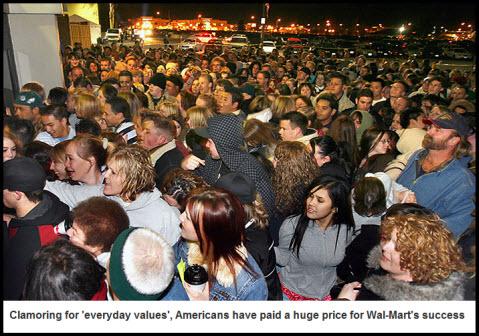
At least, that’s the theory of it. In practice, however, Wal-Mart has decimated Main Street in hundreds of towns across the land. While consumers were enjoying everyday low prices, their neighbors were closing their shops and trying to figure out how to survive. Some did, albeit barely, by going to work for…Wal-Mart. The company’s slash-and-burn jihad across the retail landscape would not have been much noticed in the big cities, nor in such elitist redoubts of capitalism as the Wall Street Journal editorial room. But that’s about to change, since Wal-Mart has trained its heavy guns on booksellers who have long been among the solidest anchor tenants at the street level of downtown shopping districts.
Unbeatable Price for Books
The giant retailer’s shot-across-the-bow – offering the top ten best-sellers for $10 — came just in time to devastate book stores during the holiday shopping season. Stores of every size will be vulnerable — from independents who have been savvy enough to survive competition from Amazon, to the largest vendors, including Borders, Barnes & Noble, Target, and even Amazon itself. No seller will make money at that price, not even publishers, but that is of little concern to Wal-Mart, which seeks only to demonstrate in as brutal a manner as possible that it will not be undersold. Nor can independent booksellers simply buy copies from Wal-Mart to resell, since $10 best sellers are being limited to just a few copies per buyer. The predictable result six to twelve months down the road is that many book stores both big and small will be closing, adding hugely to a retail vacancy rate that is already approaching depressionary levels.
Wal-Mart is all good cheer in promoting its everyday values, but there is no longer any denying that its primary goal is to drive all of its competitors into the ground. This strategy will no doubt be abetted by Chinese manufacturers eager to unload goods into a weak U.S. market at any cost. When Wal-Mart eventually succeeds at it, we can be certain that “everyday low prices” will be superseded in practice by prices reflecting whatever the traffic will bear. Wal-Mart has the reach, the naked ambition and the pricing power to bankrupt nearly any competitor in any business, from consumer electronics, to Halloween costumes, to funeral services, to pharmaceuticals, to lawn furniture. A decade ago, a grassroots movement to hold the line against Wal-Mart’s relentless expansion died after the retailer won some local skirmishes. Now the company is too big to oppose, a vital appendage of nearly every town in which it operates. America has paid a huge price for those everyday values.
(If you’d like to have Rick’s Picks commentary delivered free each day to your e-mail box, click here.)
re. money to retool.
America has unused capacity that can be used to make the goods; you know, the plants were no one works any more (Ie. US steel at less than 50% capacity, Ford, GM, Chrysler, Catipillar, GE,etc.). Increased production lowers costs and produces profits that are used to build the manufacturing sector back. . This is what the free entrprise / democratic system is all about. Goverment can lend trillions to the banks so why not to the sector that will return revenue – silly idea, right.
Keep buying foreign, utilization goes down, unit costs go up and we are more uncompetative. Our autos are competative now even when facilities are underutilized and would be very profitable if fully utilized.
Soooo, Make what we need or we go down the tube
All the new powers, China, india, Japan,Russia control what comes into their countries- (Try to sell US grown rice in Japan were the selling price is 10 times as high as here -not allowed by the Japanese-we can compete but are not allowed to )we are the dumb ones that only care that we can save a dime on a $10 item and don’t care if if it’s made off shore.
THE US TRADE DEFICIT IS ABOUT 600 BILLION A YEAR-ie. 10 YEARS= 6 TRILLION NATIONAL DEBT. so cheap goods are not so cheap after all.
One day the factories here will be producing again but the new foreign owners will not have to even pay the wages that they pay workers in their country.
Just one last thought- uncontrolled imports have done more damage to the USA than all the terrorists could every dream of doing and we go to war because of them..
&&&&&&
Read the story in Monday’s Wall Street Journal about Japan’s new $11B Sharp plant if you think we can simply convert old factories in the U.S. and be competitive. One more point: It takes actual savings, not government funny money, to produce capital investment. RA