
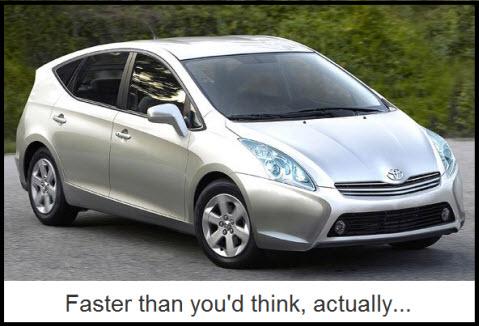
So, are we now supposed to believe that every Toyota that runs off the road, or plows into another car, or leaps a concrete berm in a Safeway parking lot, is a runaway? The latest report of a Toyota wilding spree – supposedly caused by a faulty Prius gas pedal — surfaced the other day in California. The driver said the car reached 94 mph, although we’d never have imagined the tortoise-shaped vehicle was capable of exceeding the speed limit, even on steep downhill stretches. Another Prius crashed into a stone wall in New York, but we’re awaiting the accident report before we blame Japanese engineers. The automaker said it was going to look into both incidents, as well as some others, and we hope they do. The investigation would not come a moment too soon, since every Toyota driver who gets stopped for speeding these days could tell the cop that his car, apparently possessed by demons, had simply willed itself to violate the law.
Toyota’s competitors must be breathing a sigh of relief. BMW, for one, has engineered such unnecessary complexity into the car’s driver controls that one practically needs an engineering degree to activate the heater/defroster. If BMW’s throttle linkage were to experience a congenital problem with sticking, determining the cause would be like trying to trace the source of an intermittent humming sound in a NASA space shuttle. A hundred guys with stethoscopes would probably drive themselves crazy after a few weeks of fruitless listening, tapping, plinking and toggling.
The Bimmer Myth
Full disclosure: I’ve been driving Japanese cars myself for the last 35 years, having lost my fondness for BMWs while a charter member of the BMW Car Club of America. (Old-timers may recall that BMW drivers used to flash their headlights at each other back in th Sixties.) As far as I’m concerned, the Germans would still be building horribly unreliable, overpriced cars if the Japanese hadn’t showed them how to do it right. Before I came to that revelation, the relatively rare model 2000 that I owned and maintained had racked up parts bills equal to half the car’s original cost in just a few years. The delicate, exorbitantly priced, three-part O.E.M. exhaust system, for example, was good for about 25,000 miles, and the rubber sleeves that shielded some crucial suspension bearings cracked and dried out at around 8000 miles. An engine rebuild begat a collapsed piston ring that turned the car into a smoker. But the final straw was a six-month wait for a “gooseneck” thermostat to replace one that had gone bad. To make things worse, it was connected to a 7/8-inch heater hose that was 1/8 of an inch wider than anything available in American auto-part shops at the time. (I had to improvise with a section of washing-machine hose.) I finally gave away the car to a friend of German birth who lived in Bellingham, Washington. He sent a one-legged, ex-Luftwaffe pilot to San Francisco to pick it up – I am not making this up, honest – and it was good riddance. To speed his long journey home, I threw in a box of spare parts including an alternator, some radiator hoses, a fan belt, spark plugs, fuses, a head gasket and voltage regulator.
The Honda Accord that I bought to replace the Bimmer was the best car I ever owned – at least, until the time I bought a Lexus eight years ago. It’s got 130,000 miles on it and still runs like the proverbial top. And that’s why it makes the hair on my neck bristle when I see Toyota executives called on the Congressional carpet to face an inquisition on quality control. It’s mass hysteria, as far as I’m concerned. Toyota has engineered some of the safest and most reliable cars on the road. You never seen one stranded on a highway, and I’ve yet to see one whiz by me, out of control, at 90+ mph. For every paranoid Prius owner eager to dump this supposed killer car for half its Blue Book value, there are probably at least a dozen buyers just as eager to take if off his hands.
(If you’d like to have Rick’s Picks commentary delivered free each day to your e-mail box, click here.)
My 1995 Honda Accord has 205,000 on the clock and it has a lot of miles left in it. Six years old, it cost more than all the other cars and trucks I’d ever owned, put together. And it was worth it. I should be looking for 2004 in the next few years, just in case. Toyota’s quality was measurably better than Honda, but they both are head and shoulders above anything made in North American or Europe.
&&&&&&
I traded my 1969 BMW for a Honda Accord when, one night in 1979, it failed to pull Russian Hill and I had to ask my passengers to disembark. With Honda’s zero maintenance costs and perfect gearing for San Francisco, it were as though I’d gone to heaven. I drive a Lexus SUV now, and I’ll take my chances as far as the alleged rollover problem is concerned. RA