
T-Bonds and stocks came down so hard today that I now give my ‘outrageously bullish scenario’ (see above) no better than a 50% chance of surviving. Putting aside gold’s globally unnerving price surge, June T-Bond futures bulldozed a path down to as low as 100^12. If that were to happen, the implied rise in interest rates would be sufficient to tip the U.S. and global economies into deepest recession. A reported $7.5 trillion in Treasury debt needs to be refinanced over the next three years, with much of it due in 2025. It is therefore a particularly bad time for the Masters of the Universe to lose control of long-term rates. Beleaguered consumers will struggle even harder, and an already tottering commercial real estate market will finally give up the ghost. Residential real estate is about to deflate as well, putting a potentially economically rejuvenating refinancing cycle so far out of reach that Baby Boomers might not see another in their lifetime. Trump will get the blame, and deservedly so. Usually, economic cycles of boom and bust are much bigger than the presidency, but in this case, if stocks continue to fall, Trump will surely have been the catalyst. _______ UPDATE (April 25): Last week's rally left the futures a hair shy of an important Hidden Pivot midpoint resistance at 116^14. A decisive move through it would not announce that the bear market is over, but it would quietly suggest an important turn may be nigh. It would also imply the futures are on their way to 121^11, a Hidden Pivot that would leave the June contract just short of a breakout. The pattern will not be comfy-cozy for seasoned Pivoters, but I am using it nonetheless, in part because of its obscurity. (Always keep in mind our rule concerning

I've arbitrarily selected the bullish 'reverse' pattern shown because today's rally triggered a buy signal that allows a projection of p=110.94 as minimun upside for the bounce. Other such signals have failed, but this happened when TLT was not looking quite so dismal. The ETF proxy for the long bond has been looking so bad, actually, that giving it the benefit of the doubt for once in a rare change seemed like the decent thing to do. Don't pass up an opportunity to get long 'mechanically' if TLT pulls pack to the green line after hitting our sweet spot between p and p2. _______ UPDATE (Sep 8, 9:55 p.m.): Wow. The imminent failure of the buy trigger noted above is impressive, even if we already knew that every conceivable factor acting on the long bond is bearish right now. No question, investors take the fraudsters at the central bank more seriously than your editor. Wll TLT ever rally? Stay tuned.

The so-far nascent rebound blew out a cautious attempt to get short last week with such ease that we should think expansively about how far it could go. The pattern shown allows for a run-up to 160^07, and my gut feeling is that the futures will need all of that room over the next 7-10 days. That implies 'mechanical' bids will enjoy favorable odds all the way up. There's about $1750 of implied entry risk per contract, however, but w can cut that down to size with 'camouflage' set-ups that reduce our theoretical exposure by perhaps 90%. Pay close attention to price action at 156^14, since that is the 'D' Hidden Pivot resistance of a lesser pattern. If it's easily surpassed, that would be warning bears to step out of the way. _______ UPDATE (Jan 24, 8:31 p.m.): The futures reversed sharply after topping four ticks above the 156^14 resistance billboarded above. No one mentioned wanting to trade this vehicle, so I provided no further guidance.
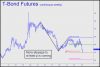
The March contract struggled for a foothold all week and now looks likely to continue lower to at least p=152^05. A tradeable reversal at or very near this Hidden Pivot midpoint support is predictable, and bottom-fishing there will undoubtedly be easier than attempting to short the downtrend. Not that we can't try, but let's plan on using TLT for this task, and for bottom-fishing as well if preferred, since it's a cheaper way to play. In the unlikely event that sellers crush the red line, the secondary pivot (p2) at 144^21 would be in play. _______ UPDATE (Jan 11, 8:33 p.m.): The pattern shown here is too gnarly not to work in every possible way, so don't hesitate to try tightly stopped bottom-fishing if the futures swoon to x=155^20. Sideways action this evening appears to be a consolidation for a push to D=156^21. However high it goes, the rally will be corrective. ______ UPDATE (Jan 12, 5:16 p.m.): The futures fell to 155^21, missing our bid by a single tick before rallying moderately into the close. We'll just watch, since I am not recommending buying a relapse that touches the green line. _______ UPDATE (Jan 13, 8:56 p.m.): Today's spike exceeded the 156^21 target by seven ticks, enough to earn the uptrend the begrudging benefit of the doubt at least for the time being. _______ UPDATE (Jan 16, 4:21 p.m.): So much for the benefit of the doubt. T-Bonds are way overdue for a bounce, but if last week's little dribbler is the best bulls can do, yields are going higher, and the blithe idiots who have been pumping stocks will eventually have to pay heed. _______ UPDATE (Jan 19, 10:58 p.m.): A rally to x=155^12 would trigger an appealing 'mechanical' short. This trade is only for subscribers who understand why 'x'
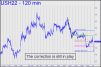
I still expect the futures to fall to the 'D' target at 158^14 before the correction ends. That's because the downtrend's first contact with p=160^01 crushed the support. The implication is that a rally to x=160^26 would trigger a 'mechanical' short with the potential to achieve 'D'. I am not advising the trade, however, unless you know how to initiate it with a 'camouflage' set-up that would reduce the theoretical entry risk per contract to no more than about six ticks. Alternatively, if the bounce stops out C=161^19 of the corrective pattern, that would be bullish for T-bonds. _______ UPDATE (Jan 3, 9:55 p.m. EST): We bought into what turned out to be an avalanche, suffering a loss of about $220 per contract before stopping out. The futures went significantly lower thereafter -- no surprise, given the way they'd turned our robust-looking Hidden Pivot support into chop suey. I'm tempted to try again, assuming the futures fall into a void that will produce maximum discomfort at around 156^04. Go for it only if you've attended enough Wednesday tutorial sessions to understand what I'm talking about. _______ UPDATE (Jan 5, 8:55 p.m.): The 156^05 'magic number' flagged above caught the low within a single tick. Depending on what kind of set-up you used, the trade has gone on to produce a profit of as much as $1700 on four contracts with the futures currently trading at their high since bottoming at 115^05. If you still hold a fractional position, use D=156^21 as a price objective, implementing a trailing stop if and when it's hit. _______ UPDATE (Jan 6, 7:59 p.m.): The bounce went as high as 156^20, a single tick below where I'd suggested implementing a trailing stop. That's close enough to have kept you out of trouble and gotten you out

I've used a composite chart for the now-defunct December contract to project a rally target at 166^27. Its equivalent, basis the March, would be around 165^10. I've also used a 'reverse ABC' pattern for this projection because it yields a lower target than one where 'A' is lower than 'C'. My reason for being cautious is that the impulse leg of the pattern did not exceed any distinctive prior peaks. It is properly impulsive and therefore bullish, but not impressively powerful. Although my long-term outlook is bullish, I'll be tempted to try shorting for a scalp near 165^10. Stay tuned to the chat room if you care.

The 'not exactly bearish' T-Bond chart featured in last week's commentary was intended to make the point that the usual eggheads, pundits and nearly all forecasters have had bonds figured wrong for quite some time. They should be even more embarrassed and mystified by Friday's spectacular rally, which made the daily chart look still less bearish (while paying off pass-line bettors with a quick, 'mechanically' earned $11,000). The same yo-yos have attempted to cover their tracks with talk about how bonds are moving higher because of a global 'flight to safety'. But where, we should ask, was such talk back in November, when a steep rise in bond prices drew only skepticism from inflationistas? Looking ahead, the 168^15 rally target has been in play theoretically since mid-October, although the difficulties of overcoming p=162^25 have made the attainment of D any time soon less than certain. Whatever happens, the unwinding of overly enthusiastic bets on inflation will continue to lend buoyancy to Treasurys, presumably until a bear market in stocks creates a true flight to the safety of U.S. bonds. _______ UPDATE (Dec 1, 6:44 p.m. ET): The March contract is headed toward a short-term top at 163^30. Short aggressively there if you've been long for the ride up. Here's the chart.

Treasury Bonds are more than holding their own, considering the Fed is in the throes of the biggest monetary blowout in U.S. history. Last week's rally came from just a few ticks below a 'mechanical' bid I'd advised near the green line (x=159^30). The 'mechanical' trigger implies that the futures are bound for a minimum p=162^26, but we'll wait and see how buyers handle this 'hidden' resistance before we assume significantly higher prices are likely. This week's commentary notes that a ratcheting down of interest rates to 1.70 or even 1.54 could occur if T-Bond futures are in fact just warming up. _____ UPDATE (Nov 22, 10:04 p.m.): There's no getting around the worrisome fact that it would take just a small decline from here to generate a nasty impulse leg on the daily chart. A print at 159^14 would do it, exceeding one 'internal' and two 'external' lows. Regardless, a very tight 'reverse ABC' pattern can be used to try bottom-fishing before, or just after, the lows have been breached. _______ UPDATE (Nov 23, 6:15 p.m.): The trade showed a small profit of $240-$450 before it was stopped out with the creation of a menacing impulse leg on the daily chart. A further drop into the no man's land above the October low at 157^03 is coming next.

The chart is bullish, but not very. A strong rally from the 157^03 low recorded on October 22 looks spent without having taken out any old highs. This suggests the pullback begun last week will need to correct for perhaps another 4-7 days before the futures can attempt a new launch. If the selloff comes down to the green line (x=159^30), it would trigger a mildly appealing 'mechanical' buy, stop 157^03. The implied entry risk on four contracts would exceed $10,000, so check the Trading Room for guidance before you attempt this. _______ UPDATE (Nov 15, 6:52 p.m. ET): In a chat room post this morning, I ratcheted up my enthusiasm for the trade suggested above. I'd wait till the futures touch the green line (159^30) before fashioning a 'camo' entry trigger, but here's an example with just $100 of theoretical entry risk per contract that triggered and is profitable at the moment. The purpose of these camo trades is not to make a pile of money, but to take advantage of bigger-picture opportunities with initial risk reduced to a practical minimum. ______UPDATE (Nov 16, 5:20 p.m.): The futures have tripped two profitable 'camo' trades off a big-picture 'mechanical' X at 159^30 that would be stopped at 157^02. Neither went the distance, but the goal is to hold 25% of the original 'camo' position for a swing at the fences. I will vet similar trades if there's interest in the chat room. Our expectation is to make at least a little money even if the bigger trade doesn't work out.

Friday's pop through a key midpoint Hidden Pivot at 162^26 was the most bullish sign we've seen in this vehicle in a long while. The close slightly above the pivot added further encouragement, but another on Monday would offer more conclusive evidence that the move is for real. Use p2=165^20 as a minimum upside objective if that happens, but no trades are suggested for now. A rally to p2 would equate to a fall in long-term rates to 1.70 from a current 1.88%. ______ UPDATE (Nov 10, 10:34 pm.): If the pullback comes down to the green line (x=159^30), it would trigger a 'mechanical' buy with a stop at 157^02. Theoretical entry risk would be $12,620 on four contracts, so you will need to 'camo' your way aboard to do the trade. Ask in the chat room if interested.


