
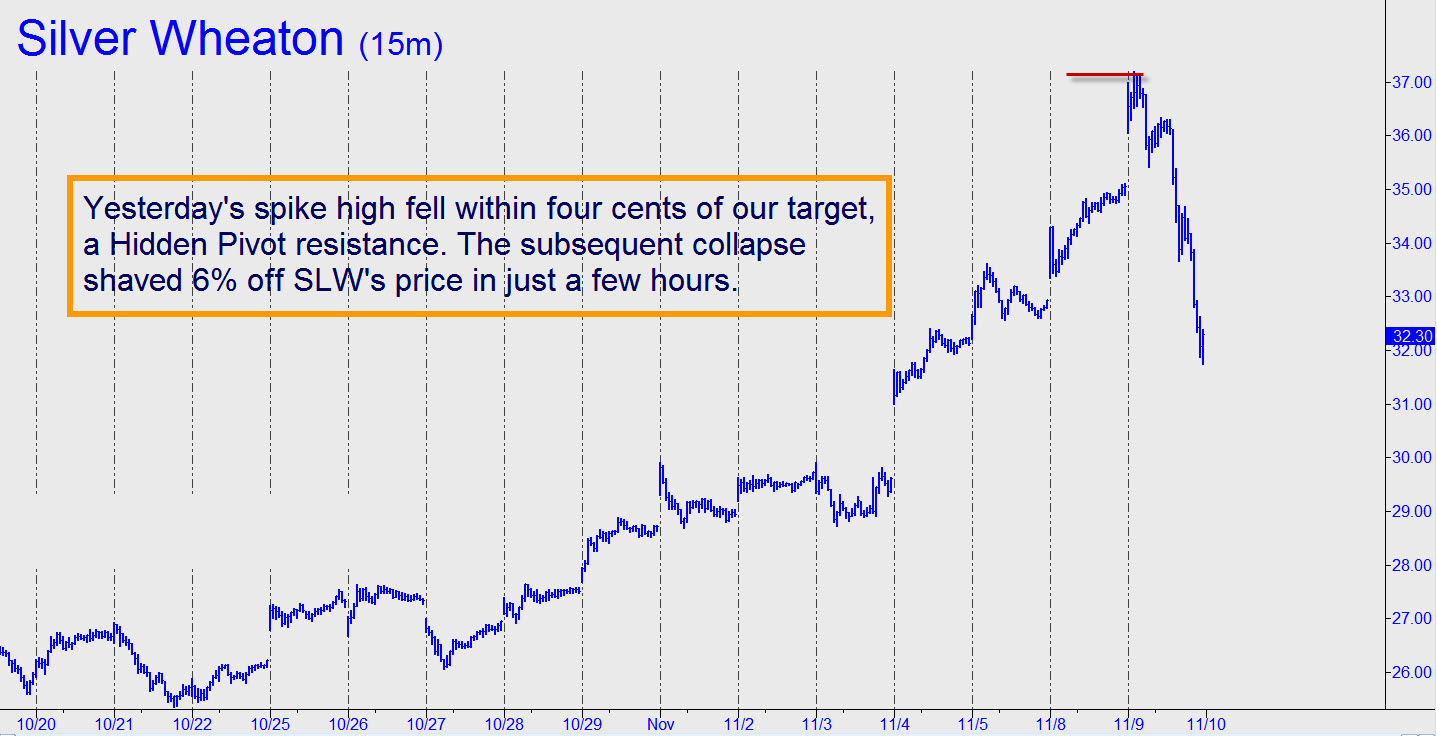
Silver Wheaton shares lost a sixth of their value in mere hours yesterday when they reversed sharply after spiking to a record high. Fortunately, we were a step ahead of the plunge, prepared to short December in-the-money call options if the stock came within ten cents of a promising Hidden Pivot target. The actual high, at 37.20, was just four cents from the top we’d projected.
Going into Tuesday’s session, anyone holding SLW would have been concerned, as we were, that the explosive rally of the last two weeks was too steep to sustain. The stock had risen by nearly 30% in just the last week alone, and it began the day yesterday on a take-no-prisoners, $2 gap, peaking at 37.20. As it happened, that was just four cents from the Hidden Pivot rally target we’d disseminated to subscribers the night before. Here is our advice, exactly as it went out to them late Monday night:
“We hold a long-term position of 800 shares with an adjusted cost basis of 13.07 and a theoretical profit of $17,600. One can never be certain exactly where a parabolic rally will crest, but let’s use a Hidden Pivot resistance at 37.16 as a possible target.”
The trading advisory went on to provide a detailed strategy for protecting our gains if the stock’s ballistic surge terminated at or near our number. The idea was to leg on a “butterfly” option spread at prices that would leave us with no risk if SLW eventually went much higher lower, but which would yield profits of as much as $500 per spread if the stock dropped back to around $30 and stayed there for a few weeks. Here’s how we laid it out for subscribers:
[Determining precisely where the stock is most likely to top] will give us the wherewithal to try to leg into a December 25-30-35 call butterfly spread that would give us cheap protection against a relapse. To implement this plan, we’ll start by shorting the December 30-35 call spread eight times if and when SLW gets within 10 cents of the target. My rough estimate of how much the spread will be selling for is 3.85, so if you can get that much or more for it, you’ll be doing great; if five cents less, still not too bad. If we are able to sell the spread, we’ll be looking to buy the December 25-30 call spread on weakness. Our maximum risk on the short spread alone, assuming a sale at 3.85, would be $115 per spread, but that would be more than doubly offset by our corresponding gain on the long stock position.”
In the actual event, the call spread we shorted yesterday could have been sold for as much as $4.00 credit, reducing our exposure to a greater extent than anticipated. However, someone in the Rick’s Picks chat room reported being filled on the spread for a 3.80 credit, so we used that price as our cost basis.
By day’ end SLW had traded as low as 31.76, representing a fall of $5.44, or 16%, from the intraday high. The second leg of our spread was trading close to 3.80 at day’s end, but there was no urgency to buy it, since we may be able to improve on the price if SLW doesn’t trampoline higher in a V-shaped recovery. If we can buy the spread for less than 3.80, we’ll have legged into the butterfly for a net credit, meaning not only that no loss will be possible on the spread, but that we’ll make a profit equal to the credit no matter where the stock is trading come December expiration.
(If you’d like to have Rick’s Picks commentary delivered free each day to your e-mail box, click here.)
Off topic, but; is GM playing the same old accounting schemes it used years ago to make a great IPO? Any car out the door and on the way to some dealer is Unrealized Profits. Top that with projected future stock prices [the day the I.P.O. goes public under QEII] and allowable projected 10% phantom gains on their pension fund liability, and Wow – 2 billion in quarterly profits. That game worked before Government Motors Bailout, why not now? Corporations seem to be selling stock to pay off their ‘bailouts’. And it seems Bernanke is providing the jucie for buybacks, or IPO’s. Miracle how G.M. makes 2b this quarter. Wonder if Joe has any money after buying gas for the car? Or, is this all smoke and mirrors for banks and the fed?