
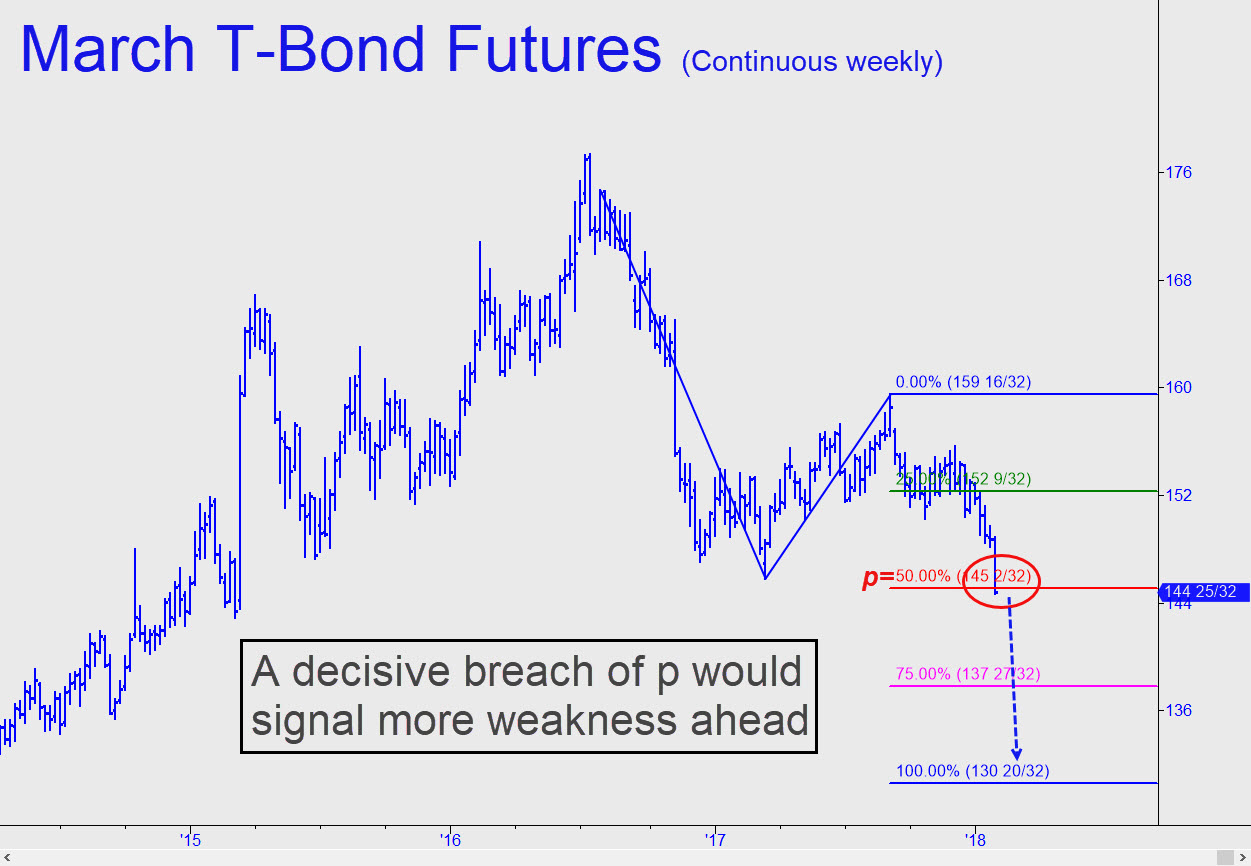
 The chart is one of the most important we have considered; for if T-Bond futures are about to fall to the 130^20 target shown, we will be living in a very different world, economically speaking. For one, it would imply that rates on the 30-Year Bond, currently around 3.1%, are headed to at least 3.6%. Could the economy handle this? The answer, manifestly, is yes, since the implied rate rise could not occur in the first place if at some point along the way it sends the economy into recession. But it would surely bring the economy to the brink of one even under the most optimistic assumptions, since mortgage and auto lease rates would be at asphyxiating levels. The most likely scenario I can imagine: The economy, far from booming as the current, shrieking hubris would have it, stagnates at 2% real growth or less. As for a serious outbreak of inflation, I am still very much in the deflationist camp, extremely skeptical that inflation is possible other than in stocks and real estate.
Returning to the technical picture, the 145^02 midpoint Hidden Pivot support shown in the chart must hold if the futures are to avoid a collapse down to 130^20. Friday’s breach of the support was slight, and its location is inexact because the chart is blended from many contract months. My guess is that the ‘true’ support lies about a point lower, near 144^02. In any case, we’ll be watching this vehicle closely for a nasty downdraft from these levels, since that presumably would signal a steep rise in interest rates. (Note: My earlier forecast for 3.11% on the Ten-Year Note still obtains. On Friday it hit 2.85%, up from 2.55% when the forecast first appeared here.) _______ UPDATE (Feb 5, 7:03 p.m. EST): The futures bounced sharply, driven by a flight-to-safety stampede, but not before breaching a key support at 145^02. The overshoot was a full point, but I’ll wait until the futures close for two consecutive weekly bars beneath 145^02 before I assume that a further fall to 130^20 is likely.