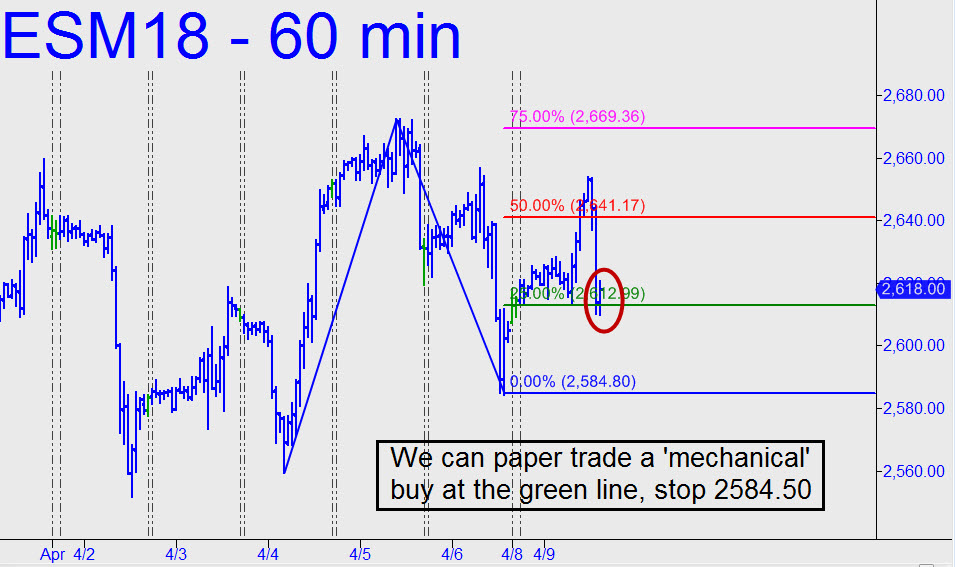
 Volatility has been challenging lately, to put it mildly. On Monday, the futures gave back more than three-quarters of the 50-point gain they’d achieved with a running start on Sunday night. The end-of-day result was an ostensibly bullish pattern and a ‘mechanical’ buy signal at 2612.99 (the green line), stop 2584.25. In general, mechanical signals are intended to make the most of wild swings, and to tame them. However, I’ll recommend paper-trading this middling opportunity, since the falling-piano effect was quite palpable at the close. The theory behind the trade is that we would be getting in after many bulls had gotten crushed by this afternoon’s selloff. But the required 28-point (i.e., $1400 per contract) stop-loss seems too rich, considering we’d be leashing ourselves to a rabid badger. ______ UPDATE (April 10, 8:37 p.m. EDT): The trade worked exactly as it was supposed to have worked. Now let’s see if the futures can achieve the pattern’s 2698.00 target — a further supposition of the original trade. In practice, half the position was to have been exited at p=2641.63 for a $1400 gain per contact. Another 25% should be cashed out at or near 2698.00, with 25% held for a swing at the fences (i.e., 2900+).________ UPDATE (April 11, 5:15 p.m.): Zzzzzzzzzz. No change.
________ UPDATE (April 12, 1:00 p.m.): After screwing the pooch for three straight days the futures finally lifted off the launcher, presumably bound for the 2697.25 target shown. A pullback to the red line (2640.88) would trip a ‘mechanical’ buy, stop 2622.00.