
 Desperate to drum up business, America’s largest theater chain has made a last-ditch offer to moviegoers: Pay a monthly fee of just $19.95 to see up to three movies per week. This is a variation on MoviePass, which at one point offered four movies a month for under $10 at participating theaters. That may sound unbeatable, but it didn’t stop AMC from trying. Their pass has fewer restrictions and better perks: discounts on food, no online booking fees, advance reservations for up to three movies without having to visit the theater, etcetera. Either offer is a no-brainer for customers, especially fans of the Marvel comic-book heroes who dominate movie fare these days. Teens and millennials who see each new Marvel film many times will save the most, albeit with dead zones between films that could last for months. (Marvel is hard at work solving this problem, by the way, producing more and more movies based on minor Marvel characters, sometimes even characters who have never appeared in a comic book.) Meanwhile, movie choices outside of the action-hero genre are likely to remain meager, and none of the other big studios will dare any longer to release even an action-hero franchise-film (i.e., Star Wars or Deadpool) in the U.S. or abroad within two weeks of the release of a competing Marvel picture.
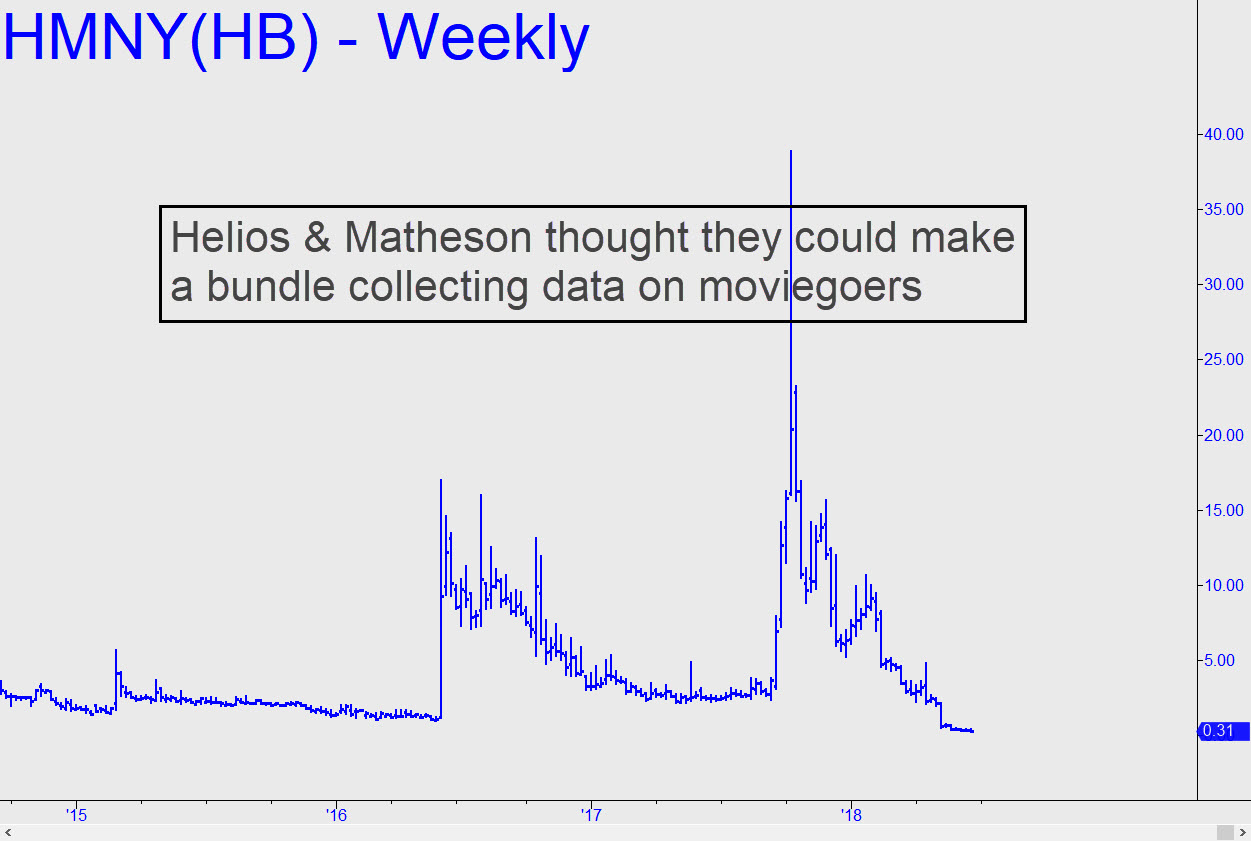
It is predictable that neither MoviePass nor AMC’s new-and-improved version of it will succeed. The AMC chain, with more than 8000 screens and not nearly enough ‘product” to fill them, may be able to reduce operating losses and slow its rapid death spiral by selling more popcorn and beverages. But the current owners of MoviePass, Helios & Matheson Analytics [Nasdaq: HMNY], will bathe in red ink until the company goes bankrupt. Their business model was so badly conceived to begin with that investors in the company might have done better drilling for oil in suburban bowling alleys. H&M evidently thought they could make money by mining data on pass-holders. But really, how much is it worth to know that 90% of them like Avenger movies — the only game in town for exhibitors these days — or that their beverage loyalties are evenly divided between Coke and Pepsi? HMNY’s chart (click on thumbnail inset, above) provides a sobering answer to that question. For firms other than Facebook, Amazon, Google and a few others that have mastered the science of web-based marketing, the value of consumer ‘data’ is diminishing with each passing day. We’ve all been data-mined to death by now, and the backlash is starting to take the form of privacy-law revisions that will make it increasingly difficult for marketing firms to intrude on our space in order to ‘monetize’ our eyeballs.
Customer-Loyalty Delusions
Enter the customer loyalty program, an alternative tactic that is hugely in vogue at the moment. It is used by purveyors mostly of services, but sometimes of goods, to hold onto customers by giving them incentives to stick with the provider exclusively for a certain period of time. As practiced online by big-time vendors, however, the tactic seems destined to fail. That’s because, when customers choose between two companies that offer more or less the same item or service, they choose mainly on the basis of price. Lyft is the latest to jump on the marketing freight train, with a monthly pass that yields a variety of discounts and clever incentives. The idea is to make customers commit to Lyft rather than to Uber their next ride just because Uber at a given moment is offering a better price. But loyalty programs are already so ubiquitous that they wind up competing on value, which for most users will come down to…price. The inevitable result is that Uber and Lyft will continue to beat each other’s brains in by lowering the cost of a ride, whether through loyalty incentives or adjustments in everyday fares. Price wars initially will be of little concern to investors, since they tend to giddily ignore the bottom line of any publicly traded company that excels at ‘economic disruption’. The impact unfortunately will fall mainly on Uber and Lyft drivers, who will be caught in disruption’s deflationary vise, unable to make more than a few bucks an hour after costs. Bottom line: If a good or service can be offered online, it is a given that its price will be subject to this downforce; moreover, the price pressure will persist until only the lowest-cost provider is left standing.
Comments on this entry are closed.
There has been an extreme shift towards human behavior over the last 20 years, the 90-100 million out of the work force numbers are at the extremes. The above mention companies have been the headlines of growth and ‘how good it is’ Jackie!
Customer-Loyalty Delusions..as Rick suggests is because of this change that has taken place. On one side we have fewer now really supporting ‘what is in’ and what is seem as profiting from the trend. The other (Tent Cities) from the growth of the mid 1980’s is in full bloom.
When was the last time (or a in time history) when a wealthy person dislocated himself from the his aristocratic society and choose to make his base of the poor? It was an important trend change to that society.
Elections coming will start to have police increasing, even the military being place a polling places to protect the voting process in the future.
The INDU is falling and has analog itself with the 2001 market, a Jan/ and May high with a systematic fall in pricing into the Sep part of that year.
Great post Rick have a great day.
The last two movies I paid to see in an old fashioned theater were “Mad Max Fury Road” in 2015, and before that “The Three Stooges” in 2012. I only went to see those two for “Old Times Sake” and they were both pretty good in that sense.
Other than that, I don’t bother with that propaganda grind house media. I would rather watch TCM or Retro etc. on cable. Apparently the other age groups would rather watch Netflix or play video games instead of going to “The Movies”. Entertainment Darwinism at work!
As far as Uber versus Lyft, that seems to me to be just another case of “The race to the bottom” that Globalism mandates.
Finally, POTUS Trump is gaining more and more support from “The Deplorables’ as he is beginning to resemble Peter Falk’s Columbo character. Acting like a distracted loon while he works his plan to achieve victory!
That the anti-gun Howllywood celebrity class, well, howls over every “immigrant crisis” they’re told to isn’t going to help the film industry’s dying future, either. As for comic book movies… They said Star Wars would always sell, but Disney has proven that even Star Wars can be botched by incompetent/SJW hands!
&&&&&&
Disney, a dismally uncreative giant that takes no risks, has helped to destroy the film business, using focus groups to write every script. They can buy talent — Pixar, for instance — but under Disney’s leaden hand, even the Pixars have run rapidly down hill creatively. Accountants have been running Disney for nearly 40 years, and that’s why the company has been unable to produce even a single good film. In those rare instances when they accidentally did release a winner, it was because a single actor, through sheer force of personality, broke through the bean-counting mentality: Johnny Depp (Pirates of the Caribbean), Robin Williams (Aladdin), Amy Adams (Enchanted).
RA